



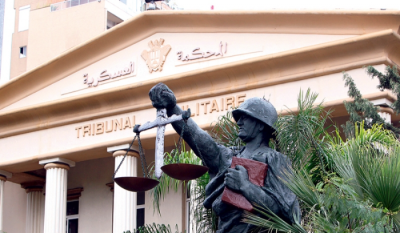
The headquarters of the military tribunal in Beirut. (Credit: NNA)






BEIRUT — Mohieddine Hassaneh, who had been sentenced by a military court to 15 years in prison for “spying on behalf of Israel,” was released by the Military Court of Cassation, headed by Judge Mounir Sleiman, according to several local media outlets and numerous posts circulating on social media.
L’Orient-Le Jour was unable to independently verify Hassaneh’s release with the military tribunal at the time of publication. However, Al-Manar, Hezbollah’s affiliated television channel, published what it said was a copy of the court decision.
The reasons behind the release remain unclear, but Al-Manar reported that “the Military Court of Cassation decided to suffice with the 22 months he had already served and to release him, though without acquitting him.”
Pager attacks
Hassaneh, a telecommunications engineer, was arrested on Dec. 14, 2023, by guards at Parliament Speaker Nabih Berri's residence in Ain al-Tineh — just over two months after Hezbollah opened a support front with Gaza, marking the start of the latest conflict with Israel.
According to pro-Hezbollah outlets, the movements of his car raised suspicion. Intelligence services reportedly found an advanced camera mounted on its roof, linked to a radar system capable of sweeping wide areas. The equipment could allegedly locate anyone using Wi-Fi through a phone, intercept walkie-talkie and pager communications, and capture messages sent over them.
His name later surfaced in connection with the September 2024 pager attacks, which occurred months after his arrest. That attack injured thousands and killed around a dozen people when pagers exploded simultaneously, followed the next day by walkie-talkies, all devices used by Hezbollah members for communication.
Israel’s Mossad claimed responsibility, and it was later found that the devices — imported years earlier directly by Hezbollah — had been rigged from the start.
Citing information from Al-Modon, Hassaneh and accomplices allegedly took more than 350,000 photos of Lebanese regions, particularly Beirut’s southern suburbs as well as Ain al-Tineh, Metn and Kesrouan.
During interrogation, Hassaneh reportedly claimed he was working with an American company mapping large parts of Lebanon, a mission he said he had previously carried out in Libya, Iran, Ukraine and Iraq. He argued that having advanced equipment did not prove he was an Israeli agent.
According to Al-Modon, the Court of Cassation’s decision cited insufficient evidence that Hassaneh delivered data directly to Israel, stressing the highly technical and complex nature of the case. Still, suspicions remain that the information reached Israel indirectly.
Hezbollah protests and reactions
A sit-in was held last Friday in front of the military tribunal to protest the ruling. On social media, pro-Hezbollah users expressed outrage.
Journalist Radwan Mortada accused Lebanese authorities of caving to U.S. pressure: “Is it a coincidence this agent was released right after recent visits by U.S. officials to Beirut? Was his release a consequence?” he asked. Last week, U.S. envoys Tom Barrack and Morgan Ortagus, along with senators, were in Beirut. Mortada also reported that Hassaneh’s father lobbied political officials for his son’s release.
Some said relatives “of those killed because of his actions might lose their temper if they see him,” said Sheikh Toufic Alawieh. Others, including a user identifying as Abo al-Azem, accused President Joseph Aoun and Prime Minister Nawaf Salam of failing to act against the release of a man who “exposed the country’s security.”
Several posts also circulated a photo of Judge Sleiman, accusing him of being poised to release more “agents.”
 The 7 p.m. recap: Houthis advance, government announces counteroffensive; Iran raises stakes; Israeli shells hit close to journalists in south Lebanon
 2 Israeli soldiers injured in 'operational accident,' as army continues attacks in the South