






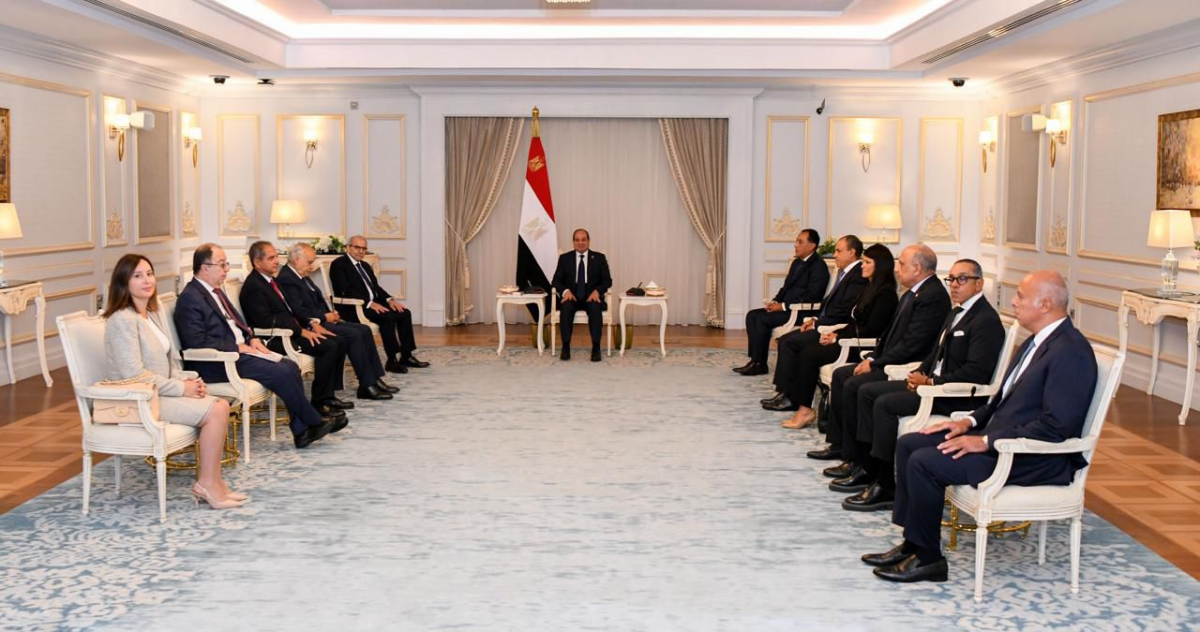
Lebanese Prime Minister Nawaf Salam received by Egyptian President Abdel Fattah al-Sisi at the presidential palace in the city of al-Alamein, on Aug. 27, 2025. (Credit: National News Agency)






Egyptian President Abdel Fattah al-Sisi received Lebanese Prime Minister Nawaf Salam on Wednesday at the presidential palace in the city of al-Alamein, north of Cairo, and reaffirmed his country's "full support" for Lebanon and its efforts to "restore stability and embark on the path of economic recovery and reconstruction."
The Lebanese head of government, for his part, presented his priorities, notably the ongoing economic reforms and strengthening the authority of the state over the entire territory, emphasizing Lebanon's intention "to strengthen cooperation and complementarity with all Arab countries."
Salam was accompanied by Ministers Ghassan Salameh (Culture) and Joe Saddi (Energy and Water), Lebanon's ambassador to Egypt, Ali Halabi, as well as the director of his office, Farah al-Khatib. On the Egyptian side, Prime Minister Moustapha Madbouli and several ministers, including Rania al-Mashat (Planning, Economic Development and International Cooperation), Mahmoud Ismat (Electricity and Renewable Energy), and Badr Abdelatty (Foreign Affairs), participated in the meeting.
The Lebanese prime minister expressed his "deep appreciation" for Egypt, "leadership, government and people," praising its "constant support for Lebanon," which he said reflects "the depth of the historical ties between the two countries." He presented his work priorities, insisting on economic reforms and the continuation of "consolidating the state's authority over all its territory." Lebanon "aspires to strengthen cooperation and complementarity with all Arab countries," he added.
Applying pressure
Salam called on "brotherly and friendly" countries to "exert pressure to ensure that Israel stops its aggressions against Lebanon and fully withdraws from the South." He also advocated for "the international community to support Lebanon's state institutions, above all the army, to enable it to carry out its national missions," and called for "uniting Arab efforts in the face of challenges aimed at Arab national security," notably mentioning the ongoing war waged by Israel in Gaza, "in flagrant violation of international legitimacy and international law."
For his part, the Egyptian president welcomed "the positive steps taken by the Lebanese government in recent months to restore the regularity of state institutions and consolidate its authority over all its territory." He reaffirmed his country's "full support" for Beirut's efforts to "regain stability, embark on the path of economic recovery and reconstruction," emphasizing "the need to guarantee the preservation of Lebanon's national unity and stability."
Salam also met with Egypt's foreign minister, Badr Abdelatty. During the meeting, he reiterated "the need to continue Arab support for Lebanon and to put pressure on Israel to end its aggressions," while stressing the importance of holding the upcoming session of the joint higher Lebanese-Egyptian committee in Cairo this year.
For his part, Abdelatty described Salam's visit as "an important step toward strengthening bilateral relations," and renewed "Egypt's constant support for Lebanon, particularly in the face of repeated Israeli violations." He called on the international community to "step up its support for reconstruction efforts" and affirmed his country's "full readiness" to provide its expertise, citing "the skills of Egyptian companies in the field of construction."
The discussions also covered the regional situation, notably in the Gaza Strip and Syria. The two officials reaffirmed their "united stance in supporting the rights of the Palestinian people" and their commitment to "the unity and stability of Syria."
Agricultural technical committee
Elsewhere, Lebanese Agriculture Minister Nizar Hani and Egyptian Agriculture Minister Alaa Farouk launched the 5th session of the joint agricultural technical committee in Cairo. Farouk stressed "the depth of the historical relations that unite Egypt and Lebanon" and recalled that "the agricultural sector is a key pillar of Arab integration." Hani, for his part, said this is "much more than a technical meeting: It is a founding step for a balanced Arab partnership, based on complementarity and the exchange of knowledge and expertise," adding that "Egypt is our leading partner on this path" to "develop common solutions serving the whole region."
The two officials specified that the committee, which will continue its work over two days, will work on "mechanisms to strengthen agricultural exchanges, cooperation in plant and animal quarantine, scientific research and training, as well as the exchange of expertise and technology," and that they will sign in October "new memorandums of understanding" constituting "a roadmap for a strategic partnership aimed at advancing the agricultural sector in both countries."