


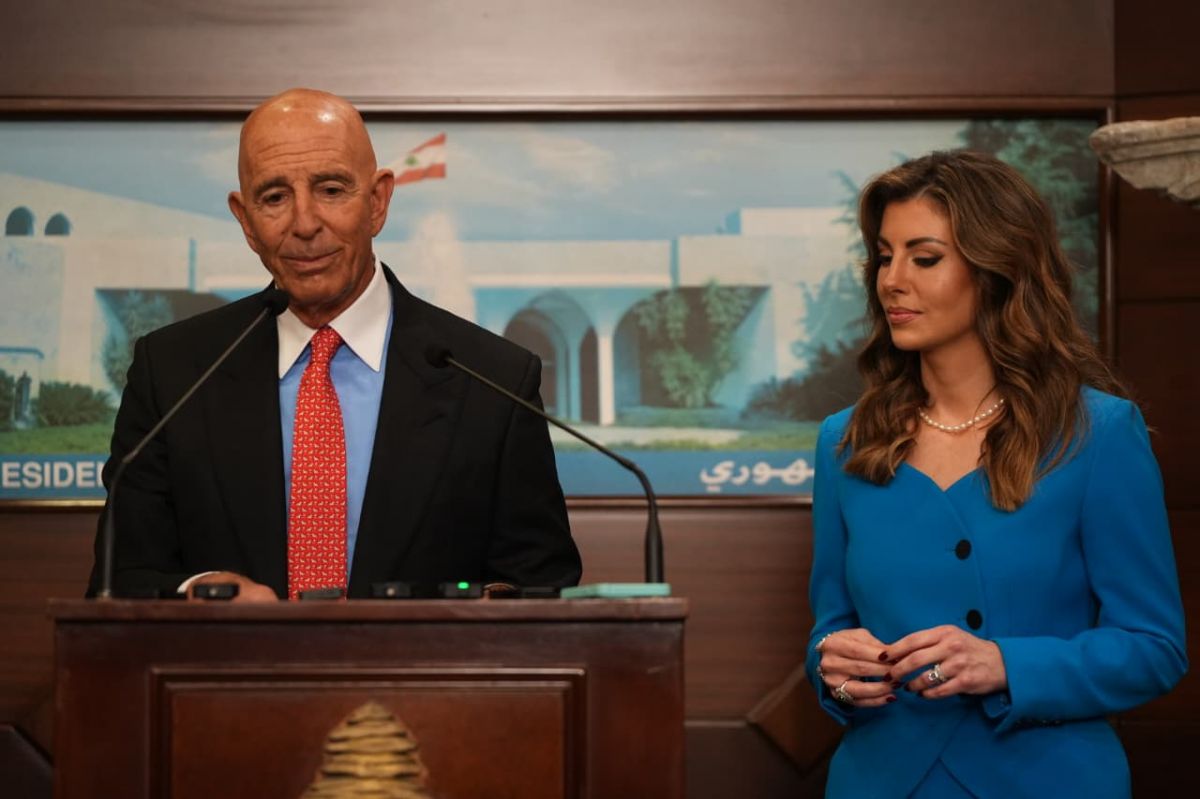
American envoy Tom Barrack and U.S. Deputy Special Envoy for the Middle East Morgan Ortagus at the Baabda Palace, Aug. 26, 2025. (Credit: Mohammad Yassin/L’Orient-Le Jour)






U.S. envoy Tom Barrack stated Tuesday from Baabda Palace that "Israel is ready to withdraw from southern Lebanon but wants to see concrete measures," thus urging Lebanese authorities to implement the disarmament of Hezbollah, which continues to oppose it, nearly nine months to the day after the cease-fire between the two countries took effect following a devastating 13-month war.
"Israel makes it clear that it does not want to occupy Lebanon and is ready to withdraw, but it wants to see concrete measures," Tom Barrack emphasized, who arrived in Beirut the previous day. During a press briefing at the presidential palace, he also recalled that the Lebanese government "has defined eleven points and promised to comply with them, the first being a plan to disarm Hezbollah." He also stated that what U.S. President Donald Trump "has done in the region reflects his desire for Lebanon to prosper."
The Lebanese government tasked the army at the beginning of August to develop, by the end of the month, a plan to disarm Hezbollah and other militias before the end of the year, but the party continues to refuse to surrender its arsenal. "No one wants a civil war," the U.S. envoy also noted, while Hezbollah's Secretary General Naim Qassem had raised the threat of one after the government's decision.
Lebanese Army is the answer, not UNIFIL
Internationally, as the U.N. Security Council is expected to soon decide on renewing the mandate of the United Nations Interim Force in Lebanon (UNIFIL) this week, Barrack stressed that "the Lebanese Army is the answer, not UNIFIL." However, he noted that the United States will approve an extension of the mandate for one year, while Washington and Tel Aviv believe the peacekeepers are ineffective and had opposed a renewal of their mandate.
Regionally, the U.S. envoy also highlighted that Syrian President "Ahmad al-Sharaa does not want hostile relations with Lebanon." Barrack also indicated that the U.S. will "bring in Gulf countries" to help contribute to the economic recovery of southern Lebanon.
For her part, U.S. Deputy Special Envoy for the Middle East Morgan Ortagus, who is accompanying Barrack on his tour, said that "Israel is ready to move forward step by step with the government," noting that "now everything depends on deeds, not words. We will respond to every measure taken by the government with an action from Israel."
In an interview with the press on Monday, Ortagus had already pointed out that the secretary general of Hezbollah and his party "do not represent the Lebanese people," asserting that Washington "will help the Lebanese Army to develop and execute" the plan to disarm the party.
Accompanying the two envoys, U.S. Senator Lindsey Graham said from Baabda that Lebanon "must disarm Hezbollah before raising the issue of Israel's withdrawal." He also asserted that "Hezbollah is not loyal to the people and acts for a foreign agenda, not for the Lebanese people. I believe the Lebanese want a better future and that Israel will not view Lebanon differently unless Lebanon acts differently." He also recalled that "the idea of disarming Hezbollah came from the Lebanese people." The U.S. senator further stressed that "the Israeli withdrawal depends on what Lebanon will do. If Hezbollah and the Palestinians are not disarmed, there will be no progress, and Saudi Arabia will not come to help" the country, he warned.
Disarming Hezbollah, 'difficult but decisive'
For her part, Lebanese-American U.S. Senator Jeanne Shaheen said she "supports the government's courageous decisions." "Our meeting with President Joseph Aoun was fruitful," she added, stating, "I understand that disarming Hezbollah is a difficult but decisive step." She emphasized that "the Lebanese Army needs material and logistical support. We discussed this today with President Aoun. We will help support the army and the economy if Lebanon manages to disarm Hezbollah," she continued. She also stressed that "the United States supports banking sector reforms and hopes that Parliament will succeed in implementing them."
During his press briefing, the American envoy admonished the journalists present who were asking him questions. “Be quiet for a moment. If the situation becomes chaotic and violent, we will leave,” he warned, addressing the press. “You want to know what's going on, so be civilized,” he insisted.
Aoun thanks Trump administration
President Joseph Aoun commented in a statement on his meeting with Barrack and the delegation accompanying him in Baabda, assuring that he had “reiterated his thanks to the U.S. administration and Congress for their continued interest in Lebanon and their commitment to helping the country, in accordance with the directives of President Donald Trump.”
He also reiterated Beirut's commitment to the U.S. roadmap, which was approved “without any restrictions” by Parliament in early August. “President Aoun thanked the U.S. for its continued support for the Lebanese Armed Forces and for strengthening them in all areas so that they can accomplish their missions,” according to the statement. The head of state also expressed his hope that “the U.S. would continue its contacts with all parties concerned, particularly with Lebanon's Arab and Western friends, in order to support and accelerate the reconstruction and economic recovery processes.”
Aoun also "welcomed the positions expressed by the members of the delegation regarding the American vision for saving Lebanon, which is based on three principles. The first is to ensure security by entrusting control of weapons and decisions on war and peace to the state alone, while the second aims to guarantee economic prosperity by relying on the Lebanese people's capacity for innovation and investment", the statement said. According to the text, “the third is to preserve consensual democracy in Lebanon, which protects all Lebanese communities within the framework of a free pluralistic system.”
Finally, the head of state inquired about the results of Barrack's visit to Israel on Sunday, as well as “the positions expressed by Israeli officials.” He reiterated Lebanon's “total” commitment to the cease-fire of Nov. 27, 2024. Aoun was also "informed of the results of the delegation's visit to Damascus [on Monday] and expressed his satisfaction with the Syrian provisions aimed at establishing the best possible relations with Lebanon. He reiterated Beirut's willingness to work immediately on outstanding bilateral issues ... while assuring that Lebanon supports unity in Syria."
The U.S. delegation was later received by Parliament Speaker Nabih Berri and is set to meet with Prime Minister Nawaf Salam.
Their visit comes amid tensions on the Lebanese scene. While Salam's government adopted the American "road map" on Aug. 7, which should gradually ensure compliance with the truce between Lebanon and Israel and disarm the militias present in Lebanon, with the party leading them, the latter does not appear ready to cooperate. On Monday, Qassem reaffirmed his opposition to having his party's weapons removed. For his part, Israeli Prime Minister Benjamin Netanyahu welcomed on the same day Lebanon's "efforts to disarm Hezbollah" by the end of the year, proposing to "reduce" the Israeli presence in southern Lebanon if this disarmament is implemented, without, however, mentioning a withdrawal of his troops.
 Israeli army carries out demolition at Jabal Amel School in Houla as strikes continue