






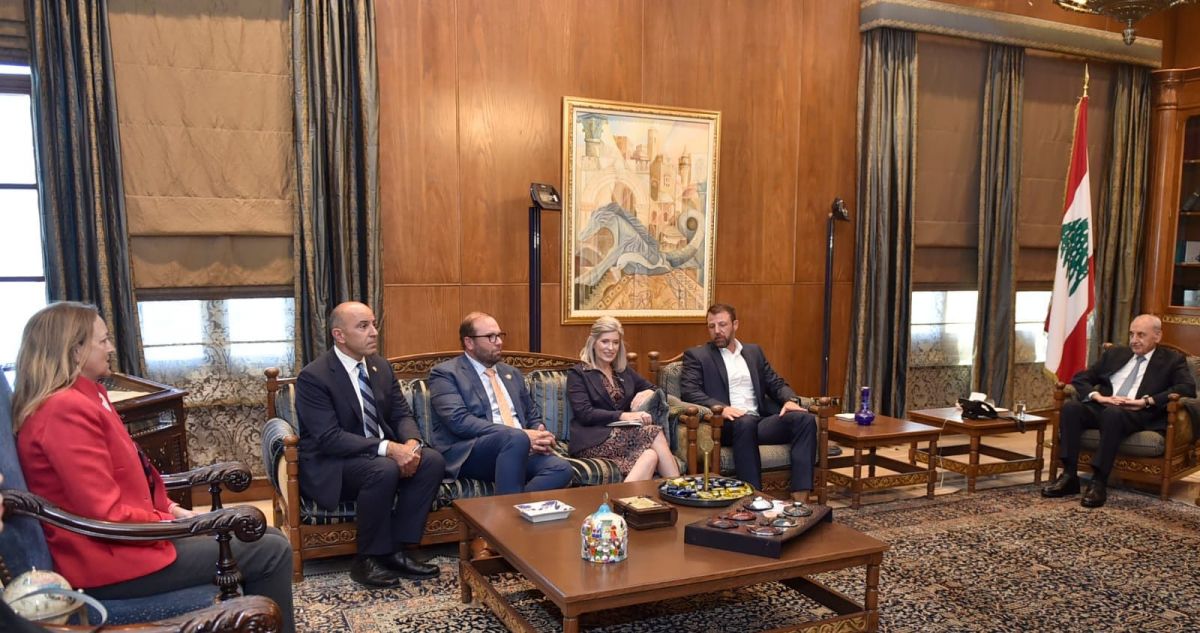
Speaker of Parliament Nabih Berri (R) meeting with American delegation in Ain al-Tineh on Aug. 20, 2025. (Credit: NNA)






BEIRUT — Parliament Speaker Nabih Berri on Wednesday expressed surprise that the United States, which “sponsored Security Council Resolution 425” that created the U.N. Interim Force in Lebanon (UNIFIL) in 1978, is now “targeting its presence and mission,” the state-run National News Agency (NNA) reported.
Berri made the remarks while receiving U.S. Sen. Markwayne Mullin and a congressional delegation of both Republican and Democratic lawmakers, in the presence of U.S. Ambassador to Lebanon Lisa Johnson, at Ain al-Tineh. The meeting focused on developments in Lebanon and the region, as well as the role of international emergency forces operating in the South.
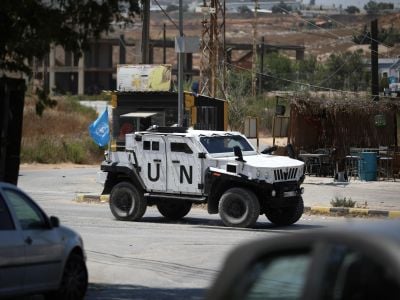
On Monday, the Security Council began debating a draft resolution submitted by France to extend UNIFIL’s mandate for one year, with the ultimate goal of its withdrawal. Washington, a close ally of Israel, has shown little enthusiasm for a renewal of UNIFIL’s mandate, which expires at the end of August, unless its powers are expanded. In that case, the U.S. could veto any resolution. Israel, meanwhile, is strongly opposed to any extension and is reportedly considering a six-month period to organize the withdrawal of peacekeepers from southern Lebanon, according to Israeli media.
Berri, who heads the Amal Movement, an ally of Hezbollah, finds himself in a delicate position after the Lebanese government tasked the army earlier this month with drafting a plan to disarm Hezbollah by year’s end.
During his meeting with Mullin, Berri said that over the years UNIFIL has “continually faced Israeli positions rejecting the implementation of international legitimacy,” while Israel “continues to wage wars, carry out raids and commit violations not only in the area south of the Litani River, where Resolution 1701 applies, but across Lebanon.”
“Despite international efforts, particularly U.S. mediation, to pressure Israel to comply with international legitimacy and implement the cease-fire agreement adopted in November 2024, which calls for applying Resolution 1701 [of 2006, requiring the disarmament of militias and the restoration of army control in southern Lebanon], we are surprised by the counter-efforts of the very sponsor of Resolutions 425 and 1701, and the cease-fire agreement, that target the presence and mission of the emergency forces,” Berri said.
He also recalled that the five-member cease-fire committee, which includes UNIFIL, is led by an American general and represented by a French general: “How can these efforts be targeted while we are working to stabilize the cease-fire and end the war?” he asked.
Despite the cease-fire reached in November 2024 after more than 13 months of war between Hezbollah and Israel, the latter continues to carry out near-daily airstrikes, mainly in the South, and maintains a presence in five areas inside Lebanon. On Aug. 5, the Cabinet decided to task the army with preparing a plan to disarm Hezbollah by the end of the year, further polarizing debate in the country.
While southern Lebanon remained relatively calm on Wednesday, UNIFIL announced in a statement on X that it had “discovered a tunnel approximately 50 meters long, with several unexploded munitions, near the village of Qsair” in the Marjayoun district. The peacekeeping force said the discovery was made “during a recent operation in southern Lebanon,” carried out “in close coordination with the Lebanese Army.”
“In accordance with Resolution 1701, the seized munitions were handed over to the Lebanese Army,” the statement added.