


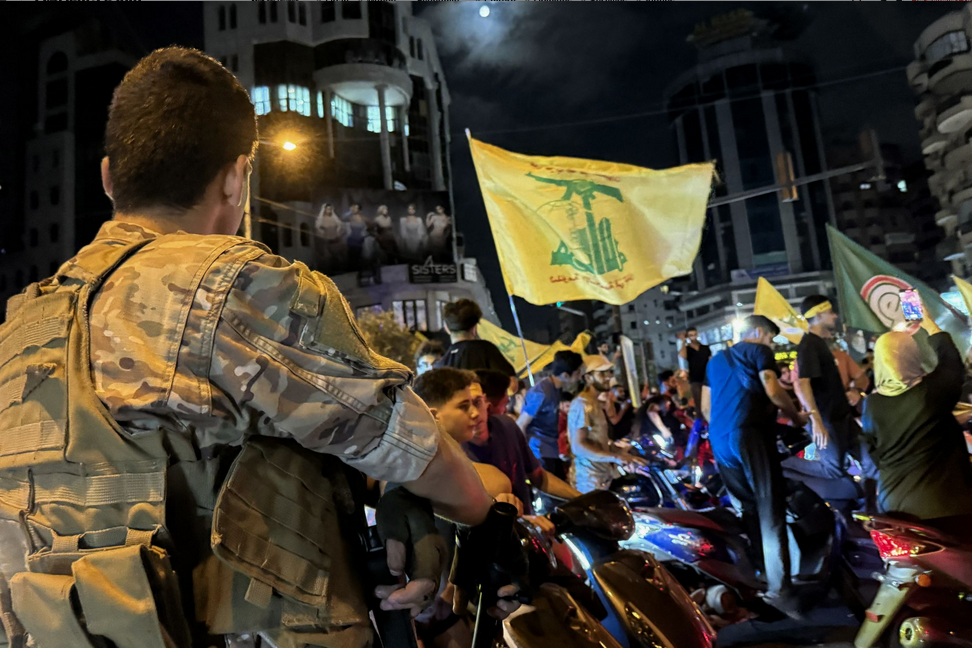
Soldiers deployed in the southern suburbs of Beirut during a Hezbollah convoy, on Aug. 7, 2025. (Credit: Ibrahim Amro / AFP)






Reactions condemning the speech of the Hezbollah leader, who on Friday threatened confrontation if disarmament were imposed on his group, continued for the second consecutive day. These remarks were, however, supported by Iran’s ambassador to Beirut, Mojtaba Amani, who said, “American pressure will not break Lebanon.”
The leader of the Lebanese Forces (LF), Samir Geagea, on Saturday called the statements of Hezbollah Secretary-General Naim Qassem “unacceptable.” Kassem had declared on Friday that his organization was ready for confrontation, especially after the government tasked the Lebanese Army with drafting a plan to disarm it.
“The speech delivered yesterday by Sheikh Naim Kassem is unacceptable in every respect, as it constitutes a direct threat, first and foremost, to the Lebanese government, then to the parliamentary majority that has placed its trust in this government, and finally to all of Lebanon’s constitutional institutions, including the presidency of the Republic and the presidency of the Council of Ministers,” Geagea said in a statement. “It is also a direct threat to all free Lebanese,” he added.
‘Supporting constitutional institutions’
“If Sheikh Naïm assumes that there are no longer any free Lebanese in Lebanon, he is gravely mistaken. If he assumes that he can thereby impose his authority, which does not exist, on these free Lebanese, he is also gravely mistaken,” added the LF leader, of the Christian sovereignist party opposed to Hezbollah’s arsenal.
In a barely veiled threat directed at Hezbollah’s secretary-general, Geagea also promised to “redouble efforts to support constitutional institutions” and to do everything possible “to prevent anyone from undermining support for constitutional institutions again,” considering that the current phase is “foundational” for Lebanon.
“These institutions, represented by the heads of state and government, are striving, with all their patriotism, energy, and strength, to restore Lebanon to itself, to reestablish order in the state, to bring Lebanon’s friends back to its side, and also to bring the international community back with it,” he concluded.
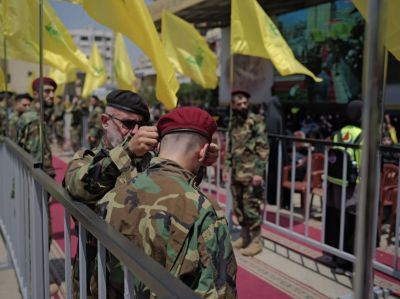
After more than a year of war between Israel and Hezbollah, the party, which has lost much of its leadership—including its chief Hassan Nasrallah, eliminated by the Israeli army on Sep. 27, 2024— continues to refuse to hand over its arsenal to the Lebanese Army, despite pressure from authorities and the international community.
Beirut MP Ibrahim Mneimneh (opposition) said that Hezbollah “should clearly declare that it is handing over its weapons and limit discussion on this matter to the Council of Ministers.” “But Hezbollah continues to break its promises and move in a vicious circle,” he added in a radio interview. He also noted: “The main problem still lies in the lack of trust in a state that is trying to recover. Therefore, Hezbollah should no longer make all Lebanese bear the burden of its crisis.”
‘Threatening official authorities’
Metn MP Elias Hankache, a member of the parliamentary group of the Kataeb Party, said, “We cannot let pass an opportunity to build a country worthy of our ambitions in the face of a regional Iranian agenda.” In an interview with the Lebanese channel al-Jadeed, he accused Naim Qassem of “threatening official authorities in Lebanon, the entire country, and all Lebanese,” noting that this escalation coincided with the visit of Iranian official Ali Larijani to Beirut.
Meanwhile, MP Hadi Abou el-Hosn of the Democratic Gathering bloc (aligned with Jumblatt) said Qassem’s speech is “condemnable and unacceptable,” questioning why he used language from a bygone era, referring to the civil war invoked by the Hezbollah chief. “This escalatory speech, which traps us in the Israeli game, is in total contradiction with Hezbollah’s participation in the government, in which we are all integrated and whose ministerial declaration we have all approved,” he said in a statement.
‘American pressure will not break Lebanon’
Iran’s ambassador to Beirut, Mojtaba Amani, stated that “American pressure will not break Lebanon and its resistance.” In an interview with Al-Alam, reported by various Lebanese media, the diplomat said that his “country resists pressures, government and people united, and wishes the same for Lebanon.”
“Iran supports Lebanon and its people without distinction between different communities, and its support for Lebanon is not a slogan but a concrete reality,” he added. Amani also said, “If houses belonging to Christians, Druze, or other communities are destroyed, Iran is ready to help them, as it does for the oppressed people of Gaza.”
Meanwhile, Hezbollah’s deputy head of the political council, Mahmoud Comati, said on Saturday that Hezbollah is not “in an internal Lebanese confrontation.” Naïm Kassem “did not threaten, but said that we are ready, if cornered, to wage a Battle of Karbala,” referring to the battle in which Imam Hussein and his men were killed in 680 AD.

 7 p.m. recap: Netanyahu seeks mastermind behind Flydubai incident; Washington sanctions 2 French nationals; Ben Gvir's 'I want to kill you' threat