


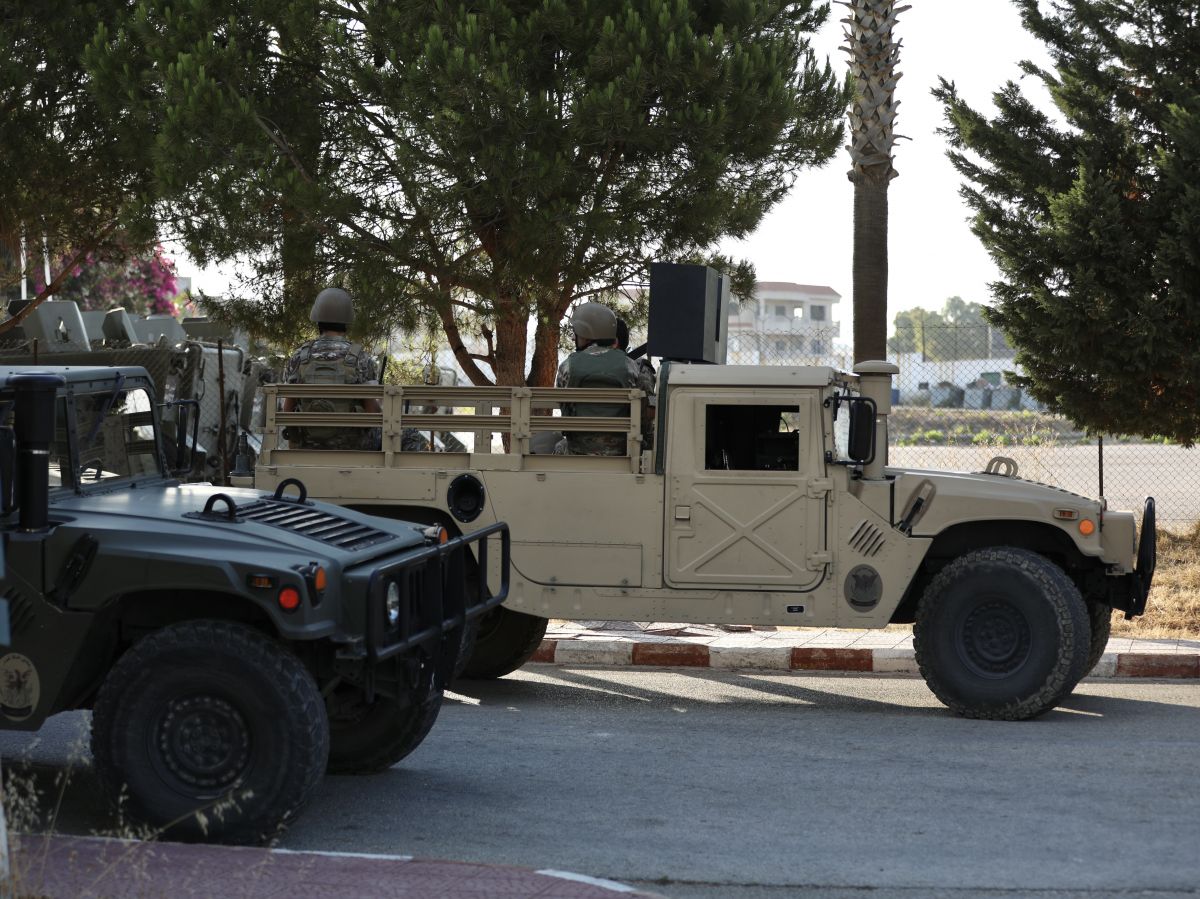
Two Lebanese military vehicles, on July 8, 2025, on an army base in the Tyre region of southern Lebanon. (Credit: Matthieu Karam/L’Orient Today.)






The Lebanese Army announced Saturday afternoon that six of its soldiers were killed and two others wounded in an explosion that occurred while they were dismantling weapons from a "depot" located in the Zebqine valley, near Majdel Zoun (Sour,) in southern Lebanon.
Separately, a man was killed while driving his vehicle, which was struck by four missiles fired from an Israeli drone on the road between Aitaroun and Ainata, according to the Health Ministry and our correspondent in the South.
In a statement, the army said that one of its units "was inspecting a weapons depot and dismantling its contents" when the explosion occurred.
It specified that the provided toll is still preliminary and that an investigation is underway to determine the cause of the incident. In the evening, army command released the names of the six killed, including one non-commissioned officer and five soldiers, most of whom were barely in their twenties. According to our correspondent, four of the soldiers killed were part of the 5th Brigade and two from the engineering regiment.
The statement issued by the military did not specify whether the depot where the explosion occurred belonged to Hezbollah, whose structures the army is currently tasked with dismantling south of the Litani. In accordance with the cease-fire agreement that came into effect on Nov.27, 2024, after 13 months of war between the Shiite party and Israel.
A military source who requested anonymity told AFP that the explosion occurred "inside a Hezbollah military infrastructure" while the soldiers were "removing ammunition and unexploded ordnance."
While information collected by our correspondent from local residents indicated that the explosion occurred in a tunnel, neither the statement nor army sources could confirm this detail. According to our correspondent, rescuers from “the Islamic Mission,” affiliated with the Amal movement, an ally of Hezbollah, participated in rescue operations and in transporting the bodies of the killed soldiers.
Series of tributes
A torrent of tributes to the army and condolences followed the announcement of the death of the six soldiers, both in Lebanon and beyond its borders.
President Joseph Aoun paid tribute to the memory of “the innocent martyrs who, with their pure blood, set the highest examples of sacrifice and devotion, confirming that the Lebanese Army remains the protective shield of the homeland and the faithful guardian of its borders,” wrote the presidency on X.
Parliament Speaker Nabih Berri expressed his condolences to the army and praised its role in “safeguarding unity, security and sovereignty” through its sacrifices.
Prime Minister Nawaf Salam paid tribute on his X account to the “sons of the valiant army” of Lebanon, who “fell as martyrs in the South while fulfilling their national duty.” “All of Lebanon, state and people, bow in tribute to their sacrifices and their precious blood, which reaffirms that our army is the guarantor of security, the bulwark of sovereignty, and the protector of the unity of the nation and its legitimate institutions,” he wrote.
Defense Minister Michel Menassa also expressed his condolences to the families of the fallen soldiers, who “joined their comrades who shed their pure blood on the soil of the South.” Interior Minister Ahmad Hajjar paid tribute to the soldiers and “the heavy sacrifices made by the army to defend Lebanon’s sovereignty.”
“Your sacrifices protect Lebanon and its sovereignty. And your blood confirms the correctness of the principle that the Lebanese Army must be the only legitimate force in the hands of political authority to impose sovereignty and stability over the entire national territory,” wrote Foreign Minister Joe Rajji, an ally of the Lebanese Forces in the cabinet.
Hezbollah MP Ali Ammar, a member of the parliamentary Defense Committee, said that “the resistance will remain alongside the army, in the same trench,” and that the fate of the families of the party’s fighters and the people “is to offer up their sons to defend the homeland and preserve the unity and stability of Lebanon.” “Your misfortune is our misfortune, and we will remain together in the same camp to defend the freedom, sovereignty and independence of Lebanon, whatever the cost,” he added, as quoted by the daily al-Akhbar. Many other political and religious figures, as well as institutions, also paid tribute to the sacrifices of the military.
'Enormous challenges and risks'
The commander-in-chief of the United Nations Interim Force in Lebanon (UNIFIL), General Diodato Abagnara, meanwhile reminded that the army, as the only institution “that legitimately provides security in the country, faces enormous challenges and risks” in its mission to ensure stability in the South and “avoid a return to open conflict.” After offering his condolences to the military and the victims’ families, the UN force chief said he continued “to support the army and its efforts to restore stability in every possible way.”
U.S. envoy Tom Barrack also offered his condolences “on behalf of President Trump and the American people.” “We mourn the loss of these brave soldiers who devoted their lives to the defense and security of Lebanon,” he added. France, via its embassy in Beirut, and Saudi Arabia, Jordan and Palestine, via their foreign ministries, also extended their condolences.
De-mining operations
Since the start of the truce, the Lebanese Army has been carrying out de-mining operations in areas bombed by Israel. On several occasions, soldiers have had to dig up ammunition and missiles buried underground after passing through hit buildings.
On Thursday, the French Army General Staff and the United Nations Interim Force in Lebanon (UNIFIL) stated that peacekeepers and the Lebanese Army discovered in southern Lebanon a “network” of tunnels that had belonged to Hezbollah, along with weapons and hundreds of munitions. In April, three Lebanese soldiers were killed and five civilians wounded in an explosion of munitions that were being transported in a van by the Lebanese Army’s engineering department in Breikeh, in the Nabatieh region.
One dead in Israeli drone strike
Elsewhere, a man identified as Hadi Khanafer was killed Saturday in an Israeli drone strike on the road between Ainata and Aitaroun, in the Bint Jbeil district.
Bursts of automatic gunfire were fired Saturday from the so-called “radar” Israeli site, located on the Shebaa Farms — part of the Syrian Golan annexed by Israel and disputed among Damascus, Beirut, and Tel Aviv — according to our correspondent.
The army also sent reinforcements from the Wadi Slouki junction toward Majdel Selm after local residents opposed the passage of a UNIFIL patrol. Such incidents are frequent in southern Lebanon, where residents and Hezbollah demand that peacekeepers always be accompanied by Lebanese Army soldiers.
According to a count by L’Orient Today, based on figures from the U.N. and the Health Ministry, the number of people killed in Lebanon in Israeli attacks, strikes and gunfire rises to at least 302 deaths since the truce went into effect, in addition to the 4,047 deaths and 16,638 wounded officially recorded by the Health Ministry in early December figures.
 Israeli army carries out demolition at Jabal Amel School in Houla as strikes continue