






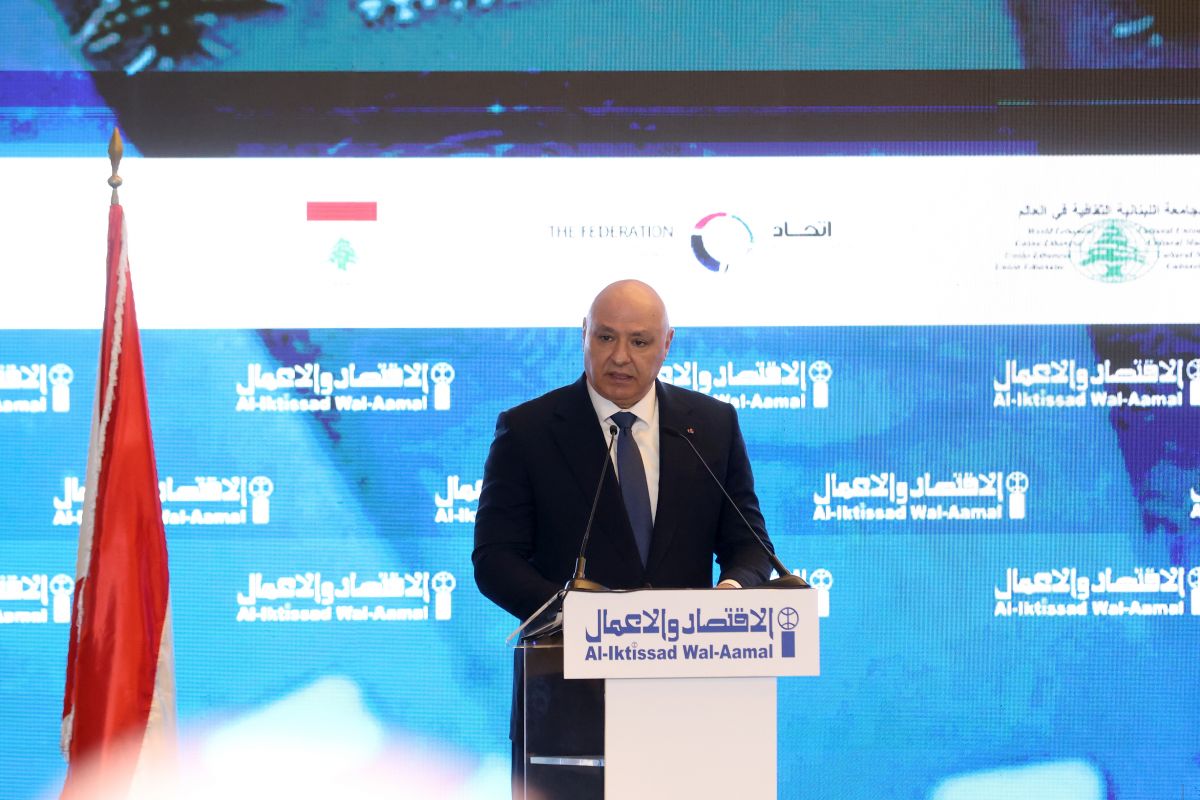
President Joseph Aoun speaking at the Fourth Economic Forum of the Diaspora. (Credit: Lebanese Presidential Press Office)






President Joseph Aoun on Friday invited the Lebanese diaspora to a real partnership and to invest in Lebanon, in order to provide the youth with new job opportunities, as authorities seek to carry out a series of reforms in a country still reeling from the impact of six years of a devastating economic and financial crisis.
"Today, we don’t only need financial support, but a true partnership. We want the expatriate to be an investor, a bearer of knowledge, a partner in planning and decision-making," the president said on X, on the occasion of the Fourth Economic Forum of the Diaspora, which took place at the Phoenicia Hotel in Beirut. "We want them to bring with them new thinking, a wide network of relationships, the willingness to create job opportunities and to support small life projects in all Lebanese regions."
The diaspora 'often more effective than the Lebanese state'
President Aoun told the audience on this occasion that "the diaspora has always been Lebanon’s support and hope," despite the socio-economic collapse. "You have often been faster and more effective than the state. When all sources of income dried up, you alone continued," he said gratefully. "At the beginning of the crisis, transfers from Lebanese abroad amounted to around $6.5 billion per year. And at the height of the collapse, those transfers represented 33 percent of GDP."
The year 2019 marked the beginning of banks applying restrictive and random measures on deposits, while a parallel exchange rate was created at nearly 40 percent above the official rate. The crisis slashed salaries, wiped out jobs, all while inflation hit record levels. Before the summer of 2019, the dollar traded at 1,507.5 Lebanese pounds. By 2025, one dollar is now worth LL 89,500.
'Reforms have begun'
The president did acknowledge that the road was paved with obstacles. "But the reforms have begun," he stated. "We are working with determination on a set of reforms and laws, especially the laws on free economic zones for tech industries, on restructuring the banking sector, on public-private partnerships, on the independence of the judiciary, as well as other structural reforms whose goal is transparency, stability, protecting investors and restoring confidence in Lebanon."
Two new laws, one on banking resolution, the other on the independence of the judiciary, in fact were added last week to the banking secrecy law adopted three months ago. The government additionally approved Thursday the objectives of U.S. envoy Tom Barrack’s roadmap, after setting the year-end deadline for the monopoly of arms to be in the hands of the state. These objectives notably include the disarmament of non-state factions, including Hezbollah, as well as the Israeli withdrawal from the five points still occupied in southern Lebanon.
"Our region is witnessing major transformations," Aoun said, referring to significant investments in new fields such as the green economy and energy, artificial intelligence, and cutting-edge technology. "We Lebanese have a creative and qualified human capital. Our young men and women can be an essential element of this transformation. That’s why we are determined to work on a serious economic diplomacy that will open the doors of employment and investment for Lebanese living in Lebanon and not just abroad."
"It has become necessary to restore Lebanon's productive regional role," the president stated, calling on the diaspora to "be present in the major regional reconstruction projects and the transformations that are reshaping the region’s economic map."

 8 p.m. recap: Israel again threatens Beirut’s south suburbs; 2 ships hit near Hormuz; Riyadh football matches canceled