


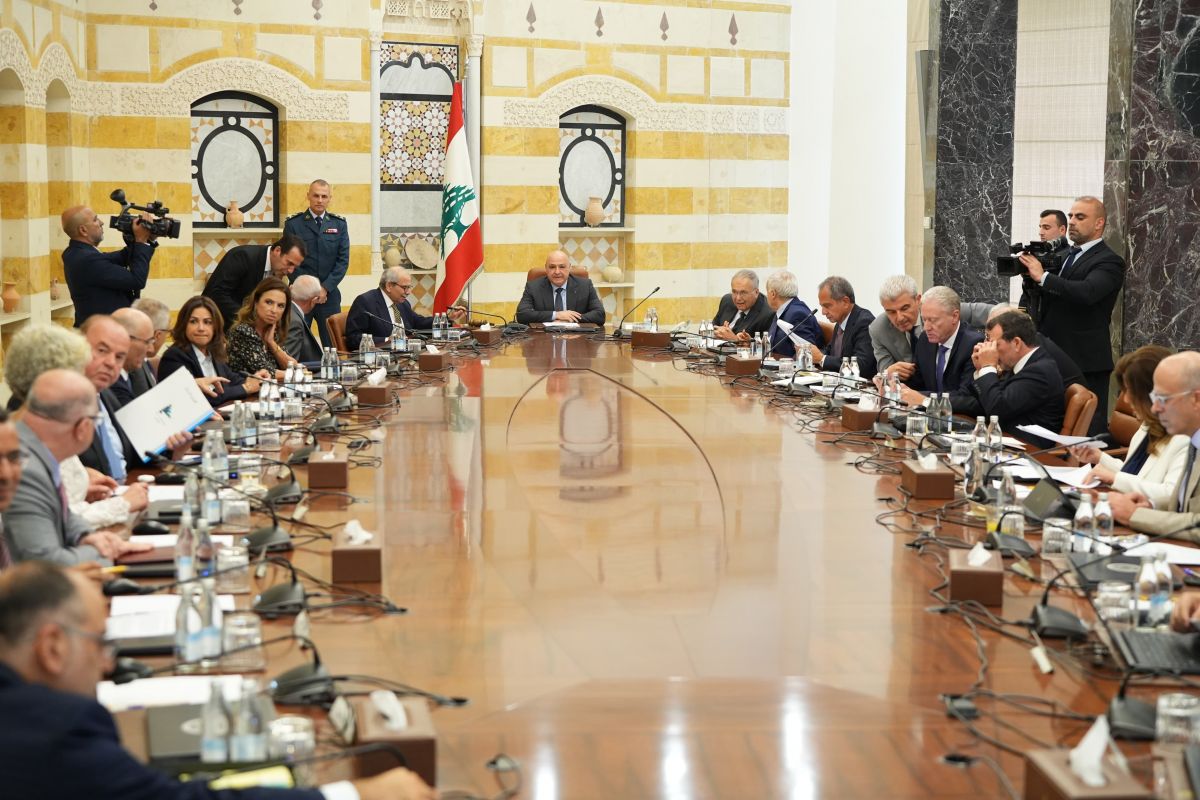
The Lebanese government meeting at the presidential palace in Baabda, on Aug. 7, 2025. (Credit: Mohammad Yassin/L'Orient Today)






BEIRUT — Just half an hour after all Shiite ministers walked out of a Cabinet meeting on the state's attempts to achieve a monopoly on arms, which specifically centers around Hezbollah's disarmament, the government announced on Thursday that it had approved the "objectives set out" by a U.S. proposal on how to do so.
The proposal, often described as a "roadmap" was presented to Lebanon by U.S. envoy Tom Barrack in June, amid increasing domestic and international pressure on the Lebanese government to speed up the process of establishing an arms monopoly, on which sorely needed foreign financial support has been conditioned.
President Joseph Aoun has led discussions with Hezbollah, insisting on a dialogue-based approach that doesn't exacerbate existing tensions amid a shifting political landscape. However, Hezbollah, for its part, insists it will not disarm so long as Israel continues it aggression against the country and its occupation of land in southern Lebanon.
Upon leaving the Cabinet meeting, Information Minister Paul Morcos read out the objectives Cabinet had adopted from the U.S. proposal:
1 : Lebanon commits to implementing the Taif Agreement, as well as the Lebanese Constitution and U.N. Security Council resolutions, in particular Resolution 1701 (2006), and to taking necessary measures to extend its full sovereignty over its entire territory, with the aim of reinforcing the role of legitimate institutions, establishing the state's monopoly over decisions of war and peace, and ensuring the exclusive possession of arms by the state throughout Lebanese territory.
2 : Ensure the durability of the cease-fire, including the end of all violations on land, air, and sea, through organized steps leading to a sustainable, comprehensive, and guaranteed solution.
3 : Gradually end the armed presence of all non-state factions, including Hezbollah, throughout Lebanese territory, both south and north of the Litani River, while providing appropriate support to the Lebanese Army and Internal Security Forces.
4 : Deploy units of the Lebanese Army in border areas and key interior regions, with adequate support for the army and the Internal Security Forces.
5 : Israeli withdrawal from the "five points," and commitment to resolve border and prisoner issues through indirect negotiations and diplomatic means.
6 : Ensure the return of inhabitants of border villages and localities.
7 : Guarantee the complete withdrawal of Israel from Lebanese territory and the cessation of all hostilities, including land, air, and sea violations.
8 : Permanent and visible demarcation of the international border between Lebanon and Israel.
9 : Permanent demarcation and definition of the border between Lebanon and Syria.
10 : Organize an economic conference with the participation of the United States, France, Saudi Arabia, Qatar, and other friends of Lebanon, in support of rebuilding the Lebanese economy and in line with President Donald Trump’s vision to make Lebanon a prosperous country.
11: Provide additional international support to the Lebanese security forces, especially the Lebanese Army, by giving them the necessary military resources to implement this initiative and ensure Lebanon’s protection.

Shiite ministers’ walkout
The issue of compliance with the National Pact should not arise, Morcos argued during his press conference, despite the fact that no Shiite ministers were present when Cabinet made its decision. “They participated in the session and the debate and only withdrew before the vote,” he said.
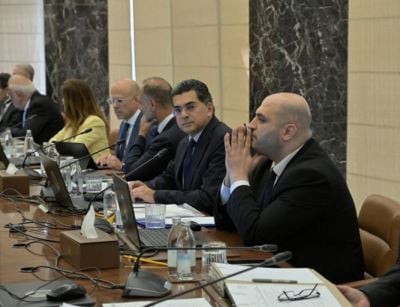
Ministers Tamara Elzein (Amal), Mohammad Haidar (Hezbollah), and Rakan Nassereddine (Hezbollah) first walked out of the meeting. Minister Yassine Jaber (Amal) was absent at today's and Tuesday’s meeting. The three ministers were then followed by the fifth Shiite minister Fadi Makki (not affiliated with either party).
"I left the meeting after my colleagues had already departed," Makki said in a statement released afterward. "The decision was not an easy one, but I could not take responsibility for making such a significant decision in the absence of a key party to the debate."
Makki clarified in statements made to L'Orient Today that he is not affiliated with the Amal Movement or Hezbollah, and that he walked out of the Cabinet meeting after ministers associated with both parties had already done so because he felt that, as the only remaining Shiite minister, “I simply felt that I couldn't take sole responsibility for such a decision.”
Haidar told L'Orient Today that the walkout of Shiite ministers from the meeting was not indicative of any resignation from government. “We wanted to show our opposition to the government's desire to endorse the entire proposal of [U.S.] envoy Tom Barrack, but we will be present at future sessions,” he confirmed.
Haidar had been absent from the Tuesday meeting, during which the arms monopoly was initially discussed, but he took the floor on Thursday to declared his opposition to Hezbollah's disarmament so long as Israeli attacks on Lebanon were ongoing.
“I am a son of this people," Haidar said. "How could I face the mother of a martyr, a father still living in a tent, or a young man who lives every day in existential anguish, and tell him that he must submit and give up the only guarantee that protects him?”
"We cannot talk about disarming 'The Resistance' until the enemy has withdrawn, our prisoners have returned, the attacks have stopped, and reconstruction has begun," he continued. "Otherwise, I am sorry, but I cannot take responsibility for an unjust decision against my people, and I will never accept that the state abandons its own."
A 'free service' rendered to Israel
Hezbollah's parliamentary bloc, “Loyalty to the Resistance,” issued a statement in parallel with the Baabda Presidential Palace Cabinet meeting, describing the government's decision to disarm Hezbollah as a “free service” rendered to Israel.
“We call on the Lebanese government to correct the situation it has put Lebanon in, having bowed to American demands that serve the interests of the enemy,” the statement read.
Ahead of the meeting, Minister of Internal Displacement Kamal Shehadi said that “the Lebanese government is maintaining its decision to achieve the monopoly of arms in the hands of the state” and “will not go back on its decision.”
In an interview with the Saudi pan-Arab channel al-Arabiya, he said he believed that Hezbollah and Amaler were “the only ones protesting this measure, now facing a majority of Lebanese who support it.”

 7 p.m. recap: Sharaa in Riyadh; Qassem signals openness to cooperation; Ben-Gvir: ‘We demolish, again and again’