



"The Putchists," reads the headline of pro-Hezbollah newspaper "al-Akhbar" on Aug. 6, the day after Cabinet set the final date for Hezbollah's disarmament at the end of 2025. (Screenshot of the front page, digital version)






BEIRUT — Cabinet's decision on Tuesday to set the end of 2025 as a deadline for Hezbollah's disarmament was met largely with praise from much of the Lebanese press, with the notable exception, of course, of outlets that support the party and are critical of foreign interference, with some calling the move a "coup."
The sovereigntist daily Annahar opened the next news day with headlines calling Cabinet's move for "monopoly on arms before the end of the year" a "surgical decision."
The meeting, which was closely watched, lasted about five hours and ended with an announcement from Prime Minister Nawaf Salam that the Lebanese Army had been tasked with presenting to Cabinet by the end of the month a plan for an army monopoly for the end of the year.
"The outcomes of the session were truly decisive," Annahar wrote. Salam had also announced Cabinet would reconvene on Thursday to continue the debate.

Unsurprisingly, the newspaper Nida’ al-Watan, close to the Lebanese Forces (LF), the Christian party that sees itself as leading the opposition to Hezbollah, hailed "a historic Cabinet session" and "a position by Prime Minister Nawaf Salam which will be to his credit in the annals."
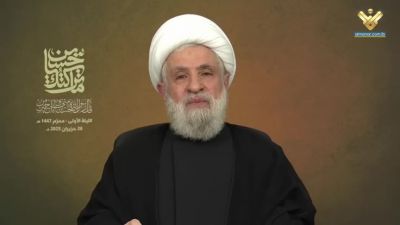
Referring to the televised address given in parallel to the Cabinet meeting by Hezbollah Secretary-General Naim Qassem, during which he reiterated his rejection to disarmament so long as Israeli attacks are ongoing, Nida' al-Watan denounced a "virulent political speech," calling it a "power grab against the Constitution and the Cabinet."
The moderate daily al-Joumhouria and al-Anba', the publication of the Progressive Socialist Party led by Druze leader Taymour Joumblatt, highlighted Hezbollah's refusal to disarm.
"The Cabinet has only postponed the problem, but the deadline remains, and no solution is in sight," wrote al-Joumhouria, leading with the headline: "A half-decision on the arms monopoly."
"Everyone fears a major political split," it wrote in its pages.
In the same vein, al-Anba' wrote of the "postponement of a decisive decision" and accused Hezbollah of "bringing Lebanon back to square one."
'The government overthrows the Constitution and the Taif Agreement'
Michel Nasr, security affairs specialist at Addiyar, a paper previously known for its proximity to Syria's Assad regime, is much more optimistic, believing that President Joseph Aoun and Parliament Speaker Nabih Berri "played a central role in avoiding a political explosion."
"The putschists," marks the front page of the pro-Hezbollah daily al-Akhbar, alongside a photo of Aoun and Salam during Tuesday's Cabinet meeting.
"The government overthrows the Constitution and the Taif Agreement and pushes the country toward explosion to satisfy the Saudi patron," the subheader reads. Al-Akhbar had already, though less bluntly, criticized Aoun’s Thursday address.
But, this time, the paper's editor-in-chief, Ibrahim al-Amine, directly accused Cabinet of "undermining internal stability to please Washington and Riyadh," warning it is leading the country toward "explosion."
"The only thing they [current political leaders] truly fear is the foreign patron," he accused, fearing that the state would "sell off ... even the last public assets, and worse still, [allow] the security and military institutions to fall under the direct sway of the U.S.-Saudi mandate, which works exclusively in the interest of the Israeli enemy."
Salam is also directly accused of being "an executor subservient to the authority of the foreign mandate."
These same criticisms appear in al-Bina, an outlet affiliated with the Syrian Social Nationalist Party (SSNP), an ally of Hezbollah. "The government is bringing down Taif, Resolution 1701 and the cease-fire agreement and opens the country to [Israeli] aggression," al-Bina warns on its website.
The "natural consequence," of Cabinet's decision, its article reads, "would be to turn Lebanon into a second Syria, where the skies would be Israeli, the occupied lands would remain under occupation, and all the South would become a security zone."
 Israeli army carries out demolition at Jabal Amel School in Houla as strikes continue