






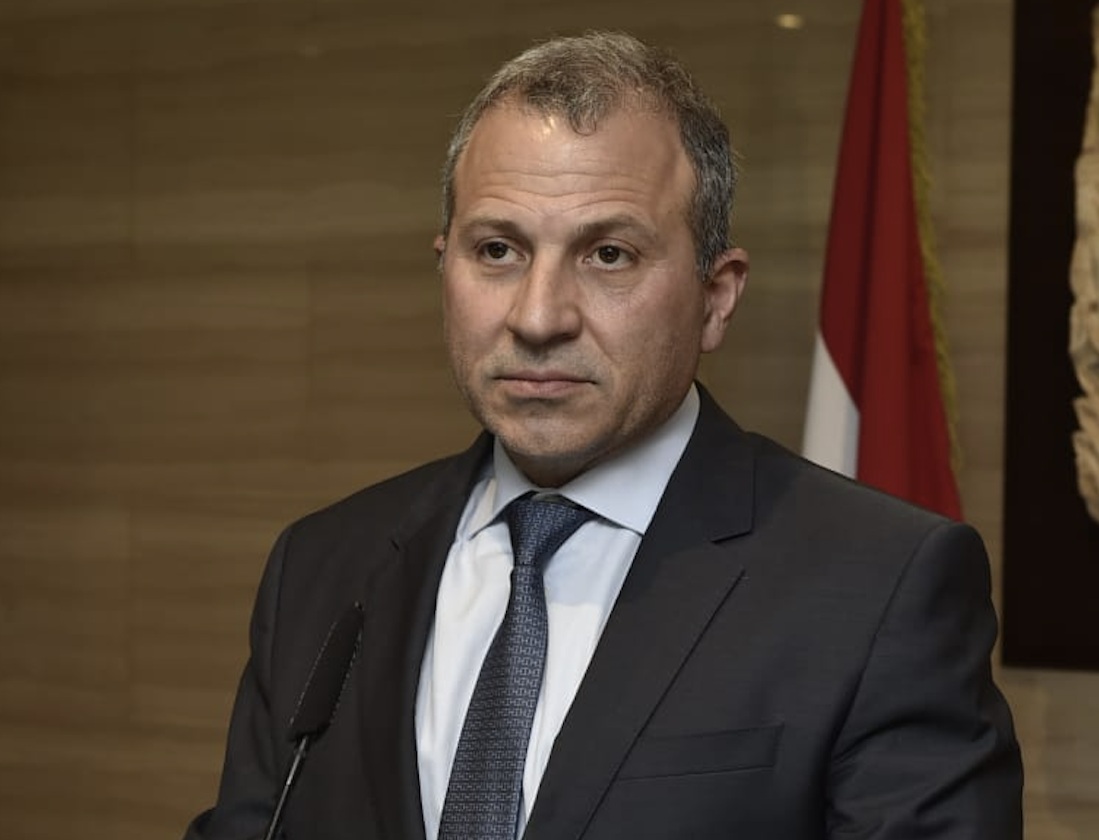
Gebran Bassil during a speech in Ain el-Tiné on June 10, 2024. (Credit: Gebran Bassil’s X account.)






BEIRUT — The head of the Free Patriotic Movement (FPM, Aounist), Gebran Bassil, expressed his concerns Thursday night in a television appearance on MTV about the new Syrian regime of Ahmad al-Sharaa, saying that so far he has "heard nothing reassuring" from Damascus regarding Lebanese-Syrian relations.
The Batroun MP also addressed the issue of diaspora voting, noting that he was foreign minister when the electoral law was adopted in 2017, as well as the state's monopoly on weapons, a matter the new administration has pledged to resolve, which is causing upheaval on the political scene.
Speaking on the show "Sar el-Waët" with star host Marcel Ghanem, Bassil said he discussed in a meeting with Saudi envoy Yazid Ben Farhane the "fear" of a resurgence of terrorist groups in Lebanon. The Assad regime was toppled on Dec. 8, 2024, by a coalition of rebel groups led by Hay'at Tahrir al-Sham, then headed by Sharaa, who has since become interim president.
"In 2014, Daesh [the acronym for the Islamic State organization] entered Lebanon, occupied 450 km², killed soldiers (...) and today, there is a fear of terrorist groups at the border with Syria," Bassil said, as intercommunal clashes have recently erupted in Sweida, southern Syria, between Druze, Bedouin tribes, and regime forces, with civilian massacres occurring. "What are the authorities doing about this? Why don't they tell the people what they are doing?" he asked. "We must conduct an active foreign policy toward Syria, and a government session must be convened to discuss the terrorism coming from the borders via Syria," he said.
Reports regularly indicate tensions or gunfire at the borders, though these incidents have not escalated since last March's clashes between Syrian security force fighters and members of Shiite clans in Lebanon's Hermel border area. The Lebanese Army intervened at that time.
Monopoly on weapons: Aoun has a 'balanced' position
Bassil also denounced the statements of U.S. envoy to Syria Tom Barrack, who had warned — before retracting — that Lebanon might again be attached to "Bilad al-Sham," that is, historical Greater Syria. "Today we have Greater Lebanon, and we are not ready to give up a single inch of land to anyone, whether Syria or Israel." He criticized the fact that, in his view, "no Lebanese official commented on or condemned" Barrack's statements. In mid-July, the American diplomat called for "action," particularly regarding Hezbollah's disarmament and reforms, otherwise "it will return to Bilad el-Sham." He later clarified this statement, asserting it was not a "threat" against Lebanon.
On the subject of weapons, Gebran Bassil said that President Joseph Aoun's statements on the issue are "balanced," following a strong speech in which he called on Hezbollah and its base to "bet on the state." "I think the president really doesn’t have options on this subject. The attempt to buy time is over," he added, however, calling on Hezbollah to "engage in serious dialogue" about its arsenal. He also urged the government, of which the FPM is not part, to avoid "deliberately leading the country toward division," days before a cabinet meeting on the issue of the monopoly on weapons.
The '16th' electoral district
Speaking on another issue currently causing controversy in Lebanon, namely the vote of expatriates for six specific MPs belonging to a "16th" district to be added to the 15 existing in the country as provided for in the electoral law, Bassil, who was foreign minister when the new electoral law was passed, said that "the wish of expatriates" at the time was to be able to vote and "have MPs representing them abroad."
While the law provides for this 16th district of six MPs to be added to the 128, diaspora groups and several political parties are campaigning to continue voting for the 128 MPs, based on their original constituency. This mechanism had been temporarily implemented during the legislative elections of 2018 and 2022 by amending the law. Formalizing this amendment for upcoming elections is notably opposed by Parliament Speaker Nabih Berri.
For the Aounist leader, the law as it stands "gives the right to vote inside the country as well as abroad, to vote for a deputy abroad and to run in the elections, so by removing the relevant article, we are taking away two of these rights." He denounced the refusal to create this "16th district" for Lebanese abroad as "motivated by purely electoral considerations."