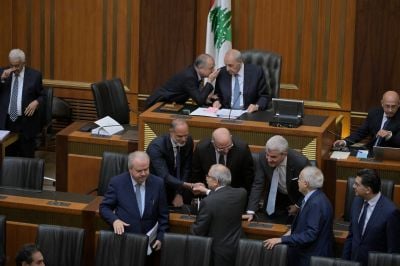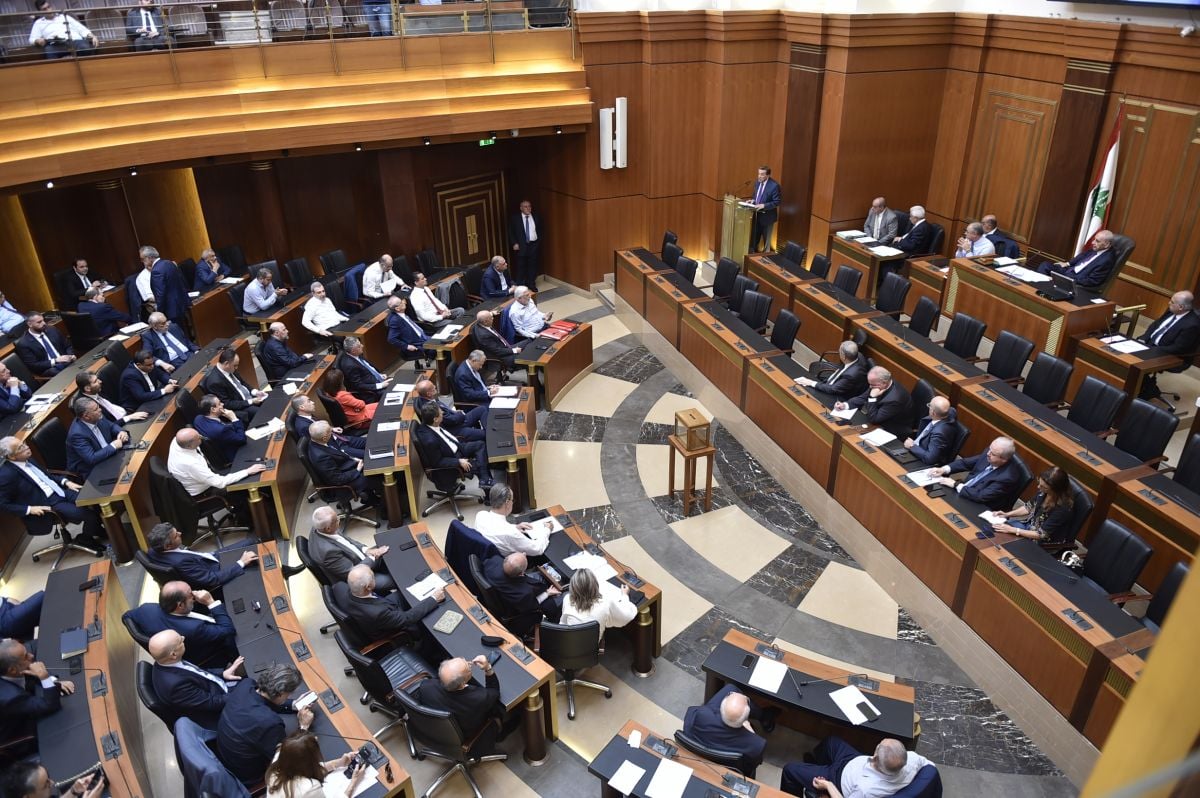
Parliament met on July 23, 2025. (Credit: Lebanese Parliament)






“It’s a good step forward,” said Minister Yassine Jaber with satisfaction. MP Alain Aoun believes the legislation meets the expectations of the IMF.
Parliament adopted, on Thursday, the banking resolution law during a plenary session deemed decisive for the near future of the negotiations with the International Monetary Fund (IMF) for an economic reform program.
The law, which had been debated for several weeks in subcommittee before being validated by the Finance Committee and then submitted to the joint committees, was one of the five drafts that the MPs had planned to consider on Thursday.
Having been in session since 11 a.m., it was only around 7:30 p.m., during the evening session, that the MPs agreed on a final version of the bill.
This law aims to define the framework for the recovery of the banking sector where the majority of the institutions have been insolvent since the start of the crisis that began at the end of 2019.
“It’s a good step forward,” Finance Minister Yassine Jaber told L’Orient-Le Jour. “It took time, but that’s often the case when you follow a democratic process.”
“I believe the text is sound, especially since the IMF was involved throughout the process, right up to the final version that was submitted to us this [Thursday] morning,” said MP Alain Aoun, an ex-FPM member.
Before tackling this law, MPs observed a minute of silence in memory of Ziad Rahbani, an iconic Lebanese musician who died on July 26.
They then adopted amendments to the law on the liberalization of rent for non-residential properties and a law modifying the allowances to public school principals. A proposal to relax regulations for pharmacists was referred to committee, while consideration of the draft on the organization of the judiciary was postponed until the evening session at the request of the prime minister.
IMF remarks
The adoption of the banking resolution law — passed article by article — is one of the key requirements set by the International Monetary Fund (IMF) since the initial talks launched by the Hassan Diab cabinet in 2020. Its adoption had faced resistance from parts of the banking sector and political class, who viewed the country’s crisis as systemic and argued that it was the state — and therefore the taxpayer — that should bail out the banks and cover the country’s massive financial losses.
The IMF does not rule out the state’s participation, but insists on upholding the hierarchy of responsibilities. This requires that bank shareholders bear the brunt of losses first, while protecting, as much as possible, deposits under a certain threshold.
As Aoun pointed out, the IMF had requested several adjustments to the original draft prepared by the cabinet, as well as to the amended versions reviewed by parliamentary committees before the vote.
One of the key demands was to limit the banks’ ability to appeal decisions made by the High Authority established under the law — restricting such appeals solely to cases involving factual errors.
According to a source close to Parliament, the United States, through its embassy in Lebanon, had urged the MPs to take the IMF’s observations into account. The same source added that other international partners, such as France, had pushed during Thursday’s session for the law to be passed that same day, “however imperfect as it may be,” even if it meant amending it later if needed.
Throughout the day, Jaber emphasized his commitment to ensuring the IMF’s observations were taken into consideration. He told L’Orient-Le Jour that most of them — including the one already mentioned — had indeed been taken into consideration.
Make-up of the High Banking Authority
One of the main sticking points in the draft law concerned the composition of the second of the two chambers that make up the High Banking Authority established by the text — the one specifically tasked with overseeing the restructuring of the banking sector.
During Thursday’s debate, a key challenge for the Lebanese Forces (LF) and the Kataeb Party was to eliminate an amendment introduced in committee that would require the inclusion of the first deputy governor of the central bank as a member of this chamber. The appointment of this official is influenced by the Speaker of Parliament and head of the Amal Movement, Nabih Berri.
The Change bloc and the Progressive Socialist Party (PSP) joined these efforts. The PSP argued that it should be up to the BDL’s Central Council to decide who would sit on the Authority.
During the session, Prime Minister Nawaf Salam called for the inclusion of an independent expert and requested that the representative of the Deposit Guarantee Institution sit in a personal capacity, rather than as a formal delegate of the institution.
Another contentious provision — an article that called for the appointment of an expert by decree, selected from a list provided by the economic bodies – the country’s main employers’ organization that also represents the interests of the Association of Banks in Lebanon, had been removed the day before and did not make it through Thursday’s sessions.
The final version of the text suggests that MPs opted for a compromise. According to information provided by Jaber, the first deputy governor remains part of the High Banking Authority’s composition, but will be joined by another Central Bank official, selected through a specific procedure.
The Salam’s request was also incorporated into the final version of the law, which provides for the appointment of two economic experts: one independent — without ties to the government or the banking sector — appointed by decree, and a second proposed by the Ministry of Finance and selected by the economy minister.
The Finance Ministry’s director general and a judge with experience in financial cases — appointed by decree upon the recommendation of the justice minister, based on a list provided by the Higher Judicial Council — complete the panel that makes up this chamber, alongside the president of the Banking Control Commission, who will, however, have no voting rights, according to the minister.
Whether this will be enough to guarantee the independence of the body remains to be seen.
The vote on the banking resolution law is, however, just one of the measures intended to organise the country’s financial recovery process, as MP Ibrahim Kanaan, chairman of the Finance Committee, said during the session.
Next step: the losses
The banking resolution draft law is indeed part of a set of interdependent laws that must also address the distribution of several tens of billions of dollars in losses among the state, the central bank (BDL), and the banks, as well as the partial restitution of the large volume of deposits that have remained frozen since the end of 2019.
All these laws have been stalled for years by the same actors and for the same reasons.
“The next step is the draft law that organizes the distribution of losses (financial gap law),” Aoun told L’Orient-Le Jour. He added that the government and the speaker hope to have a law approved that meets expectations by October.
That is when the IMF and World Bank annual meetings will take place — a crucial moment at which the country must show concrete results if it hopes to convince the IMF of its commitment to reform and its ability to follow through.