


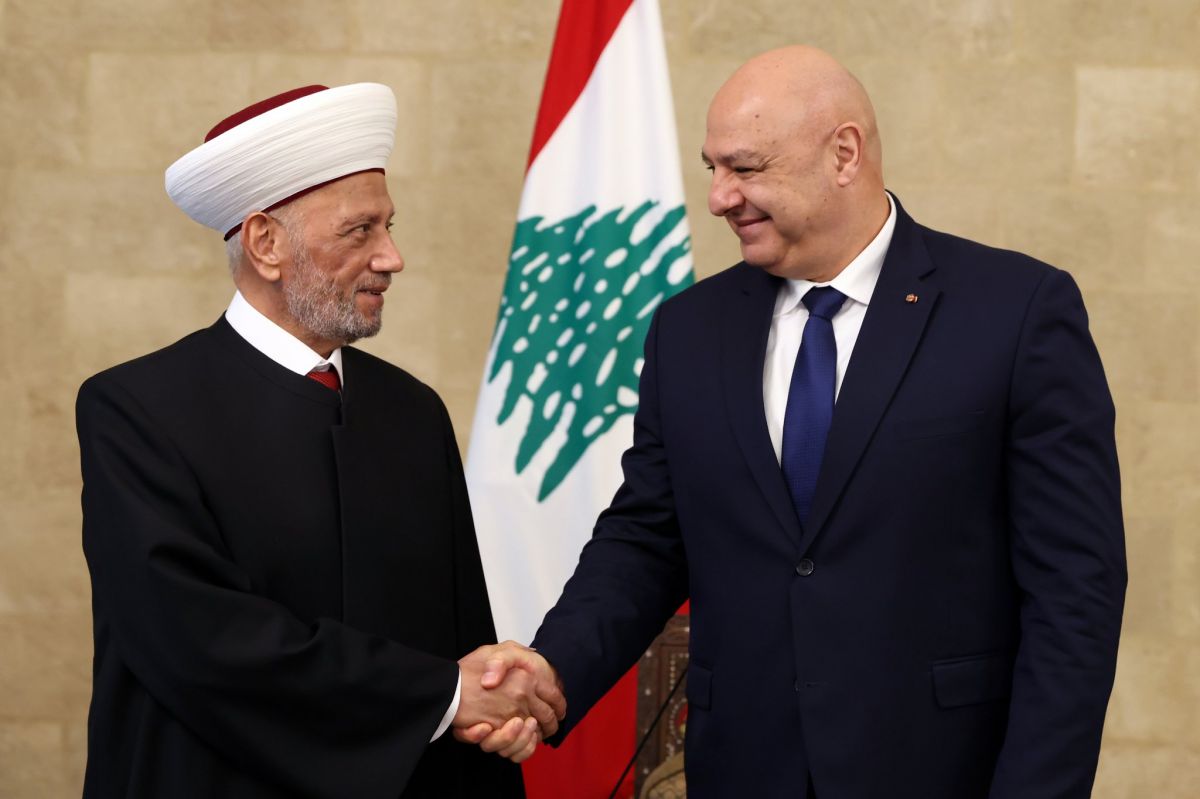
Mufti Abdel Latif Derian (left) and President Joseph Aoun, in Baabda, on July 24, 2025. ((Credit: X/@lbpresidency)






Mufti Abdel Latif Derian visited Baabda Palace Thursday morning, where he said, following his meeting with President Joseph Aoun, that no "plan to divide" the Lebanese would succeed, after clashes between Druze fighters and Sunni Bedouins in southern Syria in recent weeks sparked fears of spillover into Lebanon. The president stated that there would be "no return to the language of war" in the country, as the issue of Hezbollah’s disarmament — which the president pledged to address in his inaugural speech — has also raised concerns about tensions in the country.
During the meeting, the president stated that Lebanon was at a "crucial and decisive crossroads," for which "unity, cooperation and solidarity are essential."
"The fatal mistake made by the Lebanese in the past was to rely on foreign parties to oppose others within the country, and we have seen the consequences of that. I want to rely on my partner and brother inside the country against outsiders, whoever they may be," he added. Lebanon saw 15 years of civil war between 1975 and 1990, marked by numerous foreign interventions.
"No one can eliminate anyone in Lebanon, and no one is more deserving than the other, because it is together and united that we make Lebanon strong," he stated, emphasizing that Sunnis in Lebanon offer the country "moderation internally, and the guarantee of Lebanon's belonging to its Arab environment."
"Lebanon is doing well and there will be no return to the language of war, our common framework is Lebanon," Aoun added, before stating that he would "follow through to the end with the issue of fighting corruption."
"Our main problem in Lebanon is corruption and the absence of accountability. Corruption has no color, no religion, no sect," he said.
No one can divide the Lebanese
From Baabda, Sheikh Derian stated that "communication is ongoing" with the president and that he used this meeting to discuss "what can be done to protect Lebanon," stressing that he was on the same page as Aoun on this issue. The president "insisted that he is committed to implementing his inauguration speech, which is important for maintaining the country's stability and security," Derian said. In his speech before Parliament, after his election in January 2025, Aoun notably promised that the state would restore its monopoly on weapons, a commitment that includes the disarmament of Hezbollah and Palestinian refugee camps.
Derian also said that U.N. Security Council Resolution 1701, adopted in 2006 and forming the framework for the November 2024 cease-fire agreement between Lebanon and Israel, "has only been implemented on the Lebanese side." Israel "has repeatedly violated" the terms of this resolution and still does not respect the truce agreement, he said.
Faced with ongoing Israeli army attacks, which have killed more than 270 people since the start of the cease-fire, Sheikh Derian stated that "the most powerful weapon against Israel is the unity of the Lebanese people. No one will manage to push through a partition or fragmentation project that would divide the people." In recent weeks, reports — subsequently denied — had circulated notably in Israeli media about an annexation of certain Lebanese regions to Syria as part of a normalization agreement between Syria and Israel.
The spiritual representative of the Sunni community in Lebanon also welcomed Lebanon’s strengthened "presence" on the Arab and international scene, thanks to meetings the president held in Gulf countries and Europe in recent months.
On Wednesday, Joseph Aoun was in Bahrain, where King Hamad bin Isa Al Khalifa announced the establishment of a permanent Bahraini diplomatic mission in Beirut. Several Gulf countries, including Bahrain, had recalled their diplomats from Beirut in October 2021 in response to comments by then-Information Minister Georges Qordahi criticizing the Saudi military intervention in Yemen.
Since then, the Gulf monarchies essentially severed ties with Lebanon, suspending their imports from the country, amid multiple drug seizures from Lebanon, and banning their citizens from traveling there. Only the United Arab Emirates allowed its citizens to travel to Lebanon again in May 2025. The election of President Aoun and the appointment of Nawaf Salam as prime minister signified Beirut’s clear intention to rebuild ties with Arab countries in the region.
Derian also went, with a delegation of muftis from different Lebanese regions, to Ain al-Tineh to meet Parliamentary Speaker Nabih Berri.
This article was originally published in French in L'Orient-Le Jour.