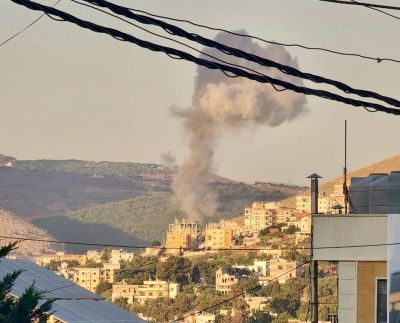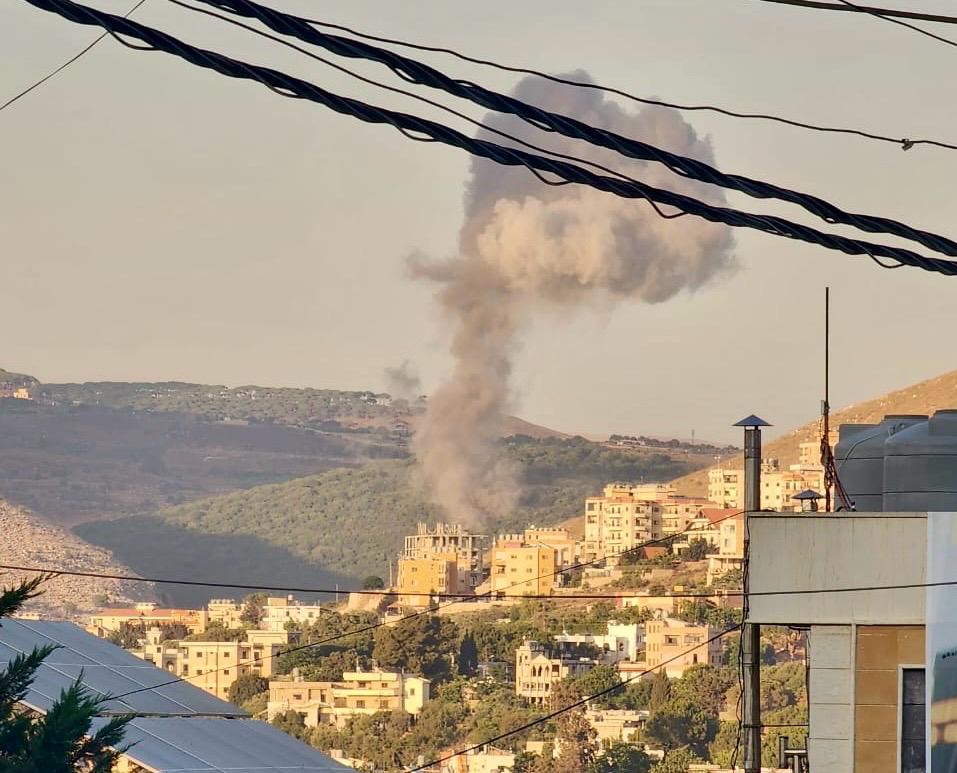
An Israeli strike on southern Lebanon, July 3, 2025. (Photo shared by L'Orient-Le Jour's correspondent Muntasser Abdallah)






In a statement to the Israeli channel N12 (or Channel 12), an Israeli army commander outlined the main features of the surveillance, strikes and assassination system on Lebanese territory to prevent Hezbollah from deploying along the border between southern Lebanon and northern Israel.
The officer, who was not named but was presented as the commander of the 89th Battalion of the 8th Brigade, a reserve armored brigade, appeared in a report focused on the eight months since the cease-fire between Israel and Hezbollah, aired on Tuesday. The report’s contents were translated by the Institute for Palestinian Studies. Several media outlets, including Nidaa al-Watan and Hudhud — a Palestinian media outlet specializing in tracking Israeli media reports and statements — relayed this translation.
"As part of the cease-fire agreement, we gather intelligence and attack the enemy who tries to reorganize in areas near the border," the commander said. Military activities are focused on what the army calls "the security zone," he explained, though he did not describe it further, stating that Israeli soldiers were continuously updating their intelligence on the party's movements.
He mentioned coordination between observation, intelligence and combat units.
"We have a substantial amount of high-quality intelligence thanks to the army’s advanced surveillance systems," he said. Operations follow directives issued by his higher command, which include strikes not only in southern Lebanon but also in other areas such as the Bekaa Valley or the southern suburbs of Beirut. He stated that these attacks, which the Lebanese side says are violations of the cease-fire along with the occupation of five strategic points in southern Lebanon, have killed more than 200 Hezbollah members.
'A few pockets remain'
According to a tally based on figures from the Health Ministry and the Office for the Coordination of Humanitarian Affairs (United Nations), about 280 people in total, including civilians, have been killed in Israeli strikes on Lebanese territory since late November.
The commander also claimed that "Hezbollah is no longer as visible in the area," and that it "keeps its distance from the border," though "a few pockets remain."
According to a spokesperson contacted by L’Orient-Le Jour, the party asked its members, since the beginning of the cease-fire, to avoid going to the south without urgent reason, whether to see their homes, families or for any other compelling reason.
"As the person responsible for this area, I observe the Lebanese villages and I feel that Hezbollah has weakened. It no longer has the same capabilities as before Oct. 7 [2023]. It can no longer conduct attacks or harm the population," the Israeli commander told Channel 12.
In addition to strikes, the military official also confirmed that the Israeli army sometimes carries out special operations inside Lebanese territory to "dismantle enemy infrastructure." He mentioned a recent operation in a southern Lebanese village to destroy "a site containing many rockets ready for launch, communication devices and instructions regarding targets."
In a statement published July 9, the Israeli army said Wednesday that its soldiers entered southern Lebanon to carry out "special and targeted operations" to dismantle Hezbollah infrastructure a few kilometers from the Israeli border.
As recently as Sunday, the Lebanese army increased its deployment near the border village of Rmaish (Bint Jbeil) after an incursion by Israeli military vehicles. In early July, the Israeli army infiltrated Mais al-Jabal and blew up a newly renovated textile factory.
While the cease-fire agreement, in effect since November, is violated daily by Israel, the United States is currently engaging Lebanon and Israel to arrive at a formula that would trigger the effective disarmament of Hezbollah and the Israeli withdrawal from southern Lebanon. Talks have yet to succeed despite the third visit in several weeks from U.S. envoy Tom Barrack, who is in charge of the issue.
This article was originally published in French in L'Orient-Le Jour.