






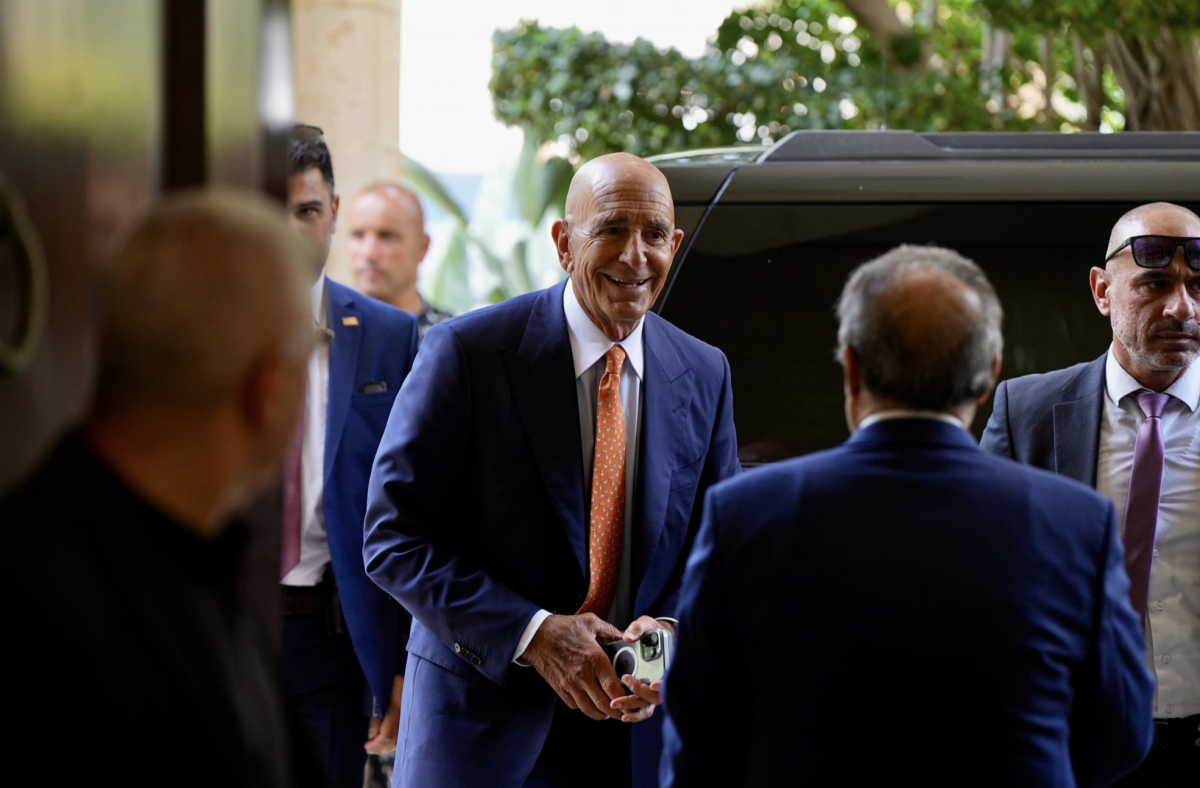
Thomas Barrack arrives in Ain al-Tineh for his meeting with Parliament Speaker Nabih Berri, on July 7, 2025. (Credit: Mohammad Yassine / L'Orient-Le Jour)






In an interview published Saturday by Emirati outlet The National, U.S. envoy Tom Barrack warned of what he called an “existential threat” to Lebanon, pointing to a rapidly shifting regional landscape.
“I honestly think that they are going to say ‘the world will pass us by’. Why? You have Israel on one side, you have Iran on the other, and now you have Syria manifesting itself so quickly that if Lebanon doesn’t move, it’s going to be Bilad al-Sham again,” said Barrack, referring to the historical geographic term for Greater Syria, which included modern-day Syria and surrounding territories. His remarks come amid continued deadlock over Hezbollah’s disarmament, which has blocked progress toward political stability.
“Syrians say Lebanon is our beach resort. So we need to move. And I know how frustrated the Lebanese people are. It frustrates me,” added the diplomat, who is of Lebanese descent.
Although Barrack later sought to clarify his remarks — stressing Saturday evening that they were not intended as a threat to Lebanon — they triggered a wave of criticism from across the Lebanese political spectrum.
“My comments yesterday praised Syria’s impressive strides, not a threat to Lebanon,” Barrack wrote on X. "I observed the reality that Syria is moving at light speed to seize the historic opportunity presented [President Trump’s] lifting of sanctions: investment from Türkiye and the Gulf, diplomatic outreach to neighboring countries, and a clear vision for the future."
“I can assure that Syria’s leaders only want co-existence and mutual prosperity with Lebanon,” Barrack said. “The United States is committed to supporting that relationship between two equal and sovereign neighbors enjoying peace and prosperity.”
During the interview, Barrack also commented on Lebanese President Joseph Aoun’s cautious approach to the issue of Hezbollah’s arms: “He doesn’t want to start a civil war,” he said.
Bassil: "Lebanon will not disappear"
Barrack’s comments sparked sharp reactions in Lebanon. Lebanese Forces leader Samir Geagea on Sunday urged authorities to take the envoy’s remarks seriously, warning of the risk of Lebanon falling under foreign tutelage again, similar to the Syrian control the country endured after its civil war.
“In the early 1990s, when the international community saw that the Taif state was failing, Lebanon was placed under Syrian tutelage,” Geagea said in a statement. “Will the authorities push Arab and international actors to once again put Lebanon under foreign control because of their own shortcomings?”
“We are living through a delicate period, and any misstep could drag us back decades, or worse,” he warned. “The international and Arab consensus is clearly reorganizing the region. Any country unable to take control of its own affairs will be left behind.”
Free Patriotic Movement leader Gebran Bassil also responded, writing on X, “Lebanon will not disappear.”
MP Mark Daou added: “Lebanon is neither a vassal nor an appendage. It is a sovereign, free, and independent country. Any rhetoric suggesting annexation or attachment to another country is an attack on its status and identity.”
Former minister Wiam Wahab, known for his ties to the Assad regime, responded on X with a direct message to Barrack: “We are capable of sending Golani [Syrian interim President Ahmad al-Sharaa] back to Idlib.” Wahab warned that “tens of thousands of fighters in Lebanon and Syria are ready for battle,” and that the only thing preventing it is “the international and regional protection enjoyed by Syria’s new leadership.”
Outrage in Lebanese circles
Beirut MP Fouad Makhzoumi echoed Geagea’s concerns, saying Barrack’s statements “should serve as a wake-up call.” In a statement, he called on the Lebanese state to disarm Hezbollah and assert sovereignty nationwide by dismantling illegal security and military networks.
“Otherwise, Lebanon will be sidelined — politically and economically. The Lebanese people are expecting courageous decisions, not just time-wasting and crisis management,” he said.
Former President Michel Sleiman issued a statement Sunday urging Lebanese authorities to “take Tom Barrack’s warnings seriously and request clarification regarding his comments about Lebanon returning to Bilad al-Sham.” He called for a diplomatic strategy involving Syria, the Arab League — particularly Saudi Arabia — the United Nations, and the five permanent members of the U.N. Security Council.
On the other end of the political spectrum, Jaafarite Mufti Ahmad Kabalan — close to Hezbollah — called Sunday for “strong national positions” in the face of what he described as a “dangerous game of regional redrawing.”
“This is a historical and moral moment that should unite Islam and Christianity in Lebanon,” Kabalan said in a statement, stressing that this is no longer about political squabbles but “about Lebanon’s survival as a unified entity.” He accused the U.S. of “manipulation” and engaging in “opaque regional deals.”
Kabalan alleged that Washington was advancing a plan to benefit Israel. “Every day reveals more clearly that Washington is nothing but a project of strategic betrayal,” he said. “When Tom Barrack raised the threat of the Syrian card, he was actually referring to the Israeli one.”
Warning against any partition plans, Kabalan declared, “Lebanon is not an easy prey.”
Hezbollah MP Ibrahim Moussawi also condemned what he called “bizarre comments that defy basic logic, diplomatic norms, and historical facts.”
“Tom Barrack’s talk about Lebanon returning to Bilad al-Sham reflects dangerous intentions and confirms the existence of an American-Zionist project targeting the region — Lebanon in particular,” Moussawi said. “But Lebanon will never bow to threats, nor compromise its sovereignty. It is a country of resistance, dignity, and resilience. It will never submit to U.S. diktats, Israeli threats, or any form of foreign control or annexation.”

 8 p.m. recap: Israel again threatens Beirut’s south suburbs; 2 ships hit near Hormuz; Riyadh football matches canceled