





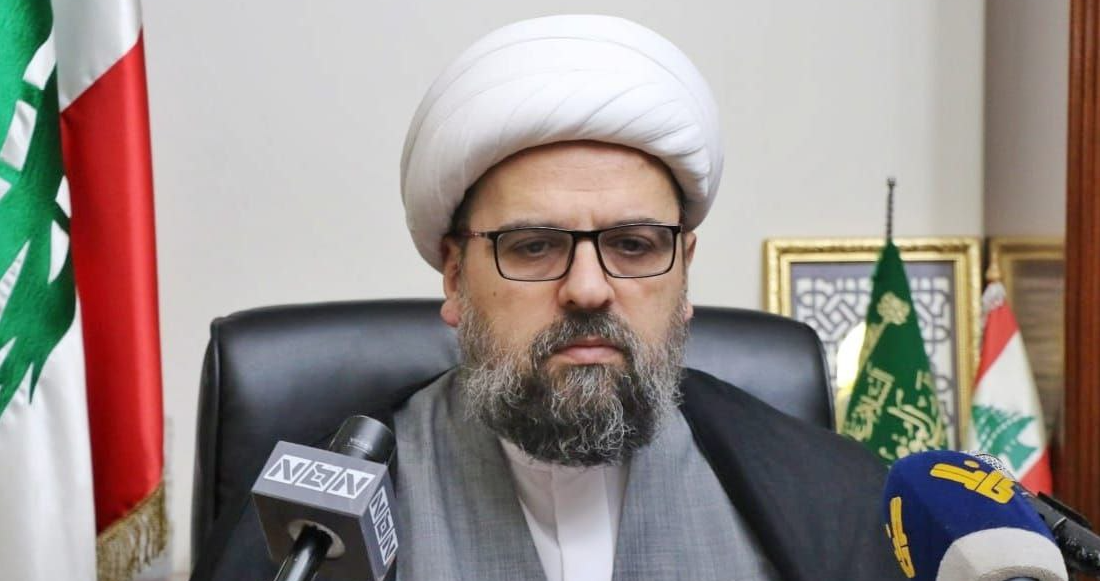
The Jaafarite mufti, Sheikh Ahmad Kabalan. (Credit: NNA.)






BEIRUT — Jaafari mufti Ahmad Kabalan on Sunday called for "strong national stances" in the face of what he called a "dangerous regional redrawing game," referring to recent remarks by American envoy Tom Barrack, who warned Lebanon against a return to "Bilad al-Sham"— that is, Greater Syria — if it did not disarm Hezbollah and launch reforms.
"This is a historic and moral moment that must unite Islam and Christianity in this country. This is no longer about political squabbles, but about the survival of Lebanon as a united entity," he said in a statement, while denouncing what he described as "American manipulations" and "murky regional deals." Without offering further details, Kabalan mentioned rumors circulating in recent weeks about a possible territorial deal that would involve ceding a large part of the occupied Syrian Golan Heights to Israel in exchange for attaching Tripoli, the major Sunni city in northern Lebanon, and its surroundings, to Syria.
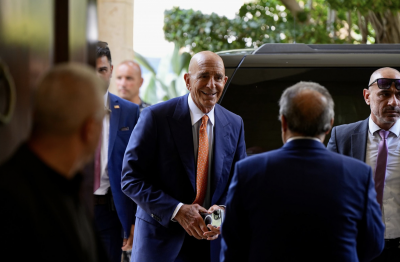
On Wednesday, during his visit to Damascus, Barrack dismissed such claims, saying they had "no basis" and were "caricatures", while Tripoli MP Ashraf Rifi had said the information was being spread by Hezbollah to justify keeping its arsenal.
On Saturday, the U.S. envoy sought to clarify his statements on "Bilad el-Sham," insisting it was not a "threat" against the country of the Cedars, according to a post on X.
'Strategic betrayal project'
That did not stop Kabalan from accusing Washington of pursuing a project in Israel's favor. "Every day reveals a little more that Washington is nothing more than a strategic betrayal project. And when Tom Barrack issued threats using the Syrian map, he was in fact thinking of the Israeli map," he said. Worried about these possible plans to fragment the country, the mufti warned that "Lebanon is not easy prey".
"Drawing maps on paper is easy, but the epics waged in border towns place us face-to-face with Lebanon’s strategic and existential strength," he added, referring to the struggle waged by Hezbollah fighters to oppose the Israeli army's takeover of the town of Khiam in southern Lebanon, during the 13-month war between the Shiite party-militia and Israel in 2023/24.
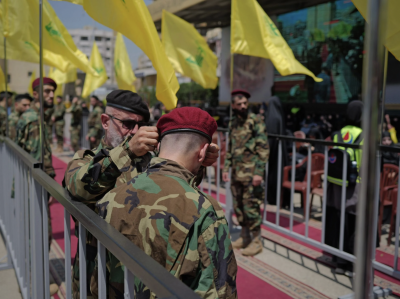
He therefore praised the role of the Lebanese "resistance," calling it the country's "backbone." "The resistance is not just Lebanon’s strategic reserve, it’s its backbone—it's through it that Lebanon stands tall and continues to exist," he said.
Kabalan also criticized attempts at sectarian division and described current diplomacy as a "game of hypocrisy." "Those who sow poison will end up consuming it," he declared, before concluding that Lebanon should not become "a commodity sold cheaply on the slave market run by Washington."
Despite the fall of the Assad regime in December 2024, relations between Damascus and Beirut remain tense, as Syria in recent months has pursued negotiations with Tel Aviv toward possible normalization. If, during his last visit to Beirut, Barrack mentioned the need to disarm Hezbollah before November, according to Reuters, he ultimately declared this week that Lebanon was not bound by the United States to "any timetable" regarding such disarmament.
Audi calls for respect of the constitution
In his Sunday homily, Greek Orthodox Metropolitan of Beirut Elias Audi called for upholding the Constitution to avoid falling "behind our surroundings."
"We must unite under the banner of the Constitution, implement it, and move the country forward. Otherwise, we will lag behind and lose, because the rest of the world is moving very fast," he said.
"The state must keep its promises and implement necessary changes, legislation, and appointments. It’s time for the state to show authority, enforce the law, and put an end to clientelism and paralysis. We hope the coming weeks will mark the end of political and economic instability, the implementation of reforms, and a swift resumption of key appointments to give the administration fresh momentum," Audi added.
On Friday, the government approved a series of appointments, including the reappointment of Wassim Manssouri as first vice-governor of the Central Bank of Lebanon (BDL).

 Evening recap: Netanyahu announces West Bank offensive; 7 killed in Jordan church shooting; tents burned in south Lebanon
 US strike on Iran this weekend? ‘Absolutely,’ says Barrack; ‘I have no idea,’ says Trump