






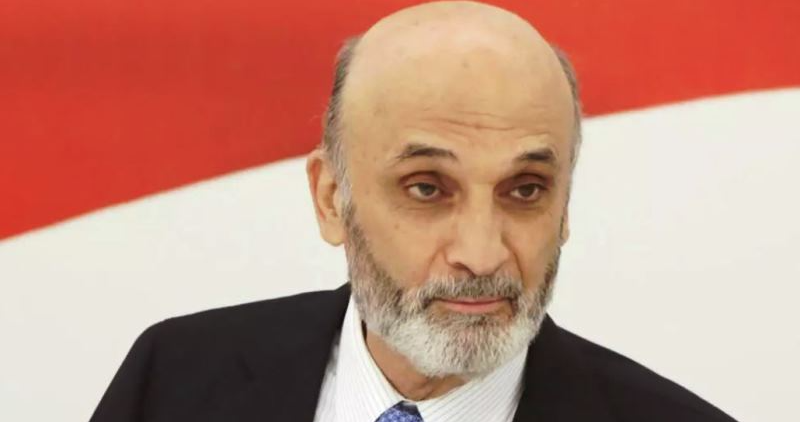
The head of the Lebanese Forces, Samir Geagea. (Credit: NNA.)






BEIRUT — Reactions continue to pour in over comments made by U.S. envoy Tom Barrack regarding Lebanon, which he warned could revert to Bilad al-Sham (Greater Syria) — if it failed to disarm Hezbollah and implement reforms.
Despite Barrack’s clarification on Saturday evening that his remarks were “not a threat” against Lebanon, the fallout has not subsided.
On Sunday, Lebanese Forces (LF) leader Samir Geagea urged the authorities to “take the U.S. envoy’s words seriously,” warning against the possibility of Lebanon falling under international trusteeship — similar to the Syrian tutelage that followed the civil war (1975–1990).
“In the early 1990s, when the international community saw that the post-war Taif Accord state was failing, Lebanon was placed under Assad’s Syrian trusteeship. Will today’s authorities once again prompt international and Arab powers to impose a new form of tutelage due to their shortcomings?” Geagea asked in a statement.
“We are in a delicate phase, and any failure could set us back decades — if not worse,” he continued. “It is clear that international policy, supported by an Arab consensus, is working to reshape the region. Any country unable to manage its own affairs will be left behind.”
Hezbollah MP Ibrahim Moussawi denounced what he called an “American-Zionist project designed for the region.”
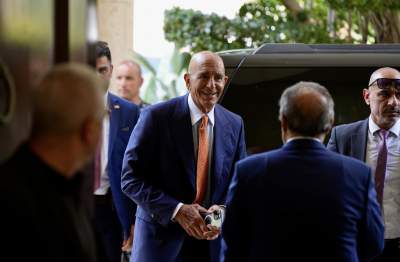
In an interview with the Emirati outlet The National published Saturday, Barrack again warned Lebanon about the "existential threat" it is facing if it does not disarm Hezbollah, adding that the country could return to "Bilad al-Sham" in that case.
He then justified himself Saturday on X, stating that his words "praised the impressive advances of Syria [and that they] in no way constituted a threat to Lebanon." "I can assure you that Syrian leaders only want coexistence and mutual prosperity with Lebanon, and the United States is determined to support this relationship between two equal and sovereign neighbors, in peace and prosperity," added Barrack, who is also the U.S. envoy to Damascus and ambassador to Ankara.
Sleimane, urged Sunday in a statement that the Lebanese authorities "seriously address the warnings of Tom Barrack and ask him for clarifications about his statements regarding Lebanon's return to the fold of Bilad al-Sham." He also called for "a diplomatic approach with Syria, the Arab League led by Saudi Arabia, as well as the U.N. and the five permanent members of the Security Council."
"Whether it is a bad joke or a threat, Lebanon will not be part of Bilad al-Sham or any other country. Lebanon and its people are united and this is a sovereign country," responded Jbeil MP Simon Abi Ramia on X.
'American-Zionist project,' says Moussawi
Hezbollah MP Ibrahim Moussawi, denounced “bizarre statements that contradict the most basic principles of logic, politics, diplomacy, and historical facts.”
“The remarks made by envoy Tom Barrack, in which he spoke of Lebanon returning to the fold of Bilad al-Sham, are evidence of dangerous intentions and clearly reveal the American-Zionist project designed for the region — and Lebanon in particular. But Lebanon does not submit to threats and does not compromise on its sovereignty. On the contrary, it is a country of resistance, pride, and resilience [...] Lebanon will never bow to American dictates, Israeli threats, or be subject to or annexed by any foreign country,” he said.
“These arrogant statements require a firm response from the Lebanese state, both politically and diplomatically. The Lebanese Foreign Affairs Ministry must immediately summon the U.S. ambassador and deliver an official rejection of these hostile and shameless remarks. The Lebanese state must clearly demand that the U.S. administration respect Lebanon’s sovereignty, territorial integrity, and security, refrain from interfering in its internal affairs, and fulfill its role as guarantor of the cease-fire agreement with the Israeli enemy, in accordance with the implementation procedures of Resolution 1701,” he added.
Beirut MP Fouad Makhzoumi said that Barrack’s statements “should serve as a wake-up call for the state.”
“We call on the state to remove weapons [from Hezbollah] and assert its sovereignty over the entire territory, to dismantle illegal military and security infrastructure — otherwise, Lebanon will be sidelined both politically and economically. The Lebanese people expect bold decisions from the state —beyond simply buying time or managing the crisis,” he emphasized in a statement.
Former President Michel Sleimane, for his part, urged Lebanese authorities in a statement on Sunday to “take seriously the warnings made by Thomas Barrack and seek clarification of his remarks regarding Lebanon’s return to Bilad al-Sham.”
He also called for “a diplomatic approach with Syria, the Arab League — especially Saudi Arabia — as well as the United Nations and the five permanent members of the Security Council.”
“Whether it’s a bad joke or a threat, Lebanon will not be part of Bilad al-Sham or any other country. Lebanon and its people are united — it is a sovereign state,” wrote Jbeil MP Simon Abi Ramia on X.

 8 p.m. recap: Israel again threatens Beirut’s south suburbs; 2 ships hit near Hormuz; Riyadh football matches canceled