


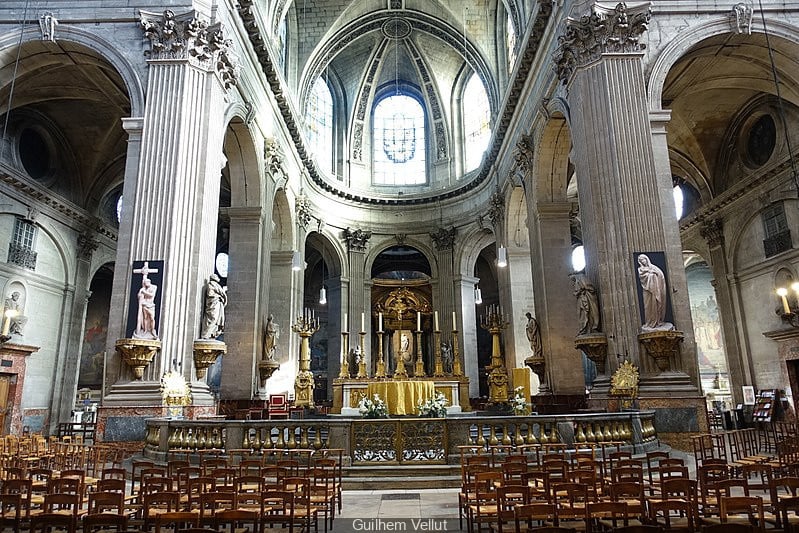
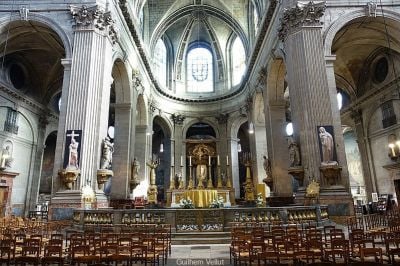
The Saint-Sulpice Church hosts the choir of the Musicals of Lebanon. (Credit: Wikicommons.)






Faure, Boely, Derghougassian, Kandalaft, Kanaan, Marnhac, these are the composers playing for this new edition of the Musicales of Lebanon on Friday, June 27 at Saint-Sulpice Church in the 6th arrondissement of Paris.
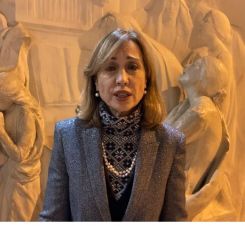
The concert is already almost sold out. Zeina Saleh Kayali once again plans to please her audience. “It is with pianist Georges Daccache, musician and treasurer Emilio Matar, and choir director Fadi Khalil that we prepare the programs of our concerts. Initially, the festival took place over three Sundays in November, with chamber music. When Fadi and Emilio joined us, they brought a breath of fresh air. Fadi wanted to found a choir, which is a total success. They gave us the idea of relocating, creating our concerts elsewhere than at Notre-Dame du Liban Church, and suggested spacing the concerts over time,” joyfully explains Zeina Saleh Kayali, who founded the festival with Georges Daccache.
“The festival is a way to make the Lebanese repertoire known and to have it travel among French musicians. The thirty choristers will perform Faure’s "Requiem," a famous and appreciated work, as well as that of Sevag Derghougassian. The festival has also commissioned a motet (sacred vocal work) from young composer Ramzi Kandalaft, as a way to enrich our musical heritage,” continues the director of the collection Figures musicales du Liban.
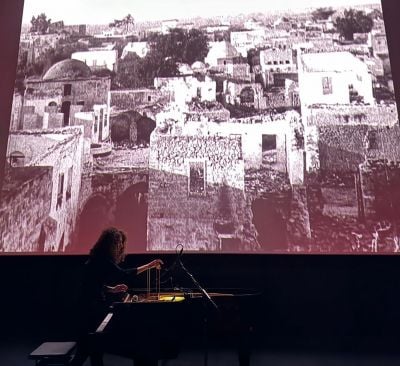
'A kaleidoscope of styles, colors, and musical identities'
“It all began in the choir of my parish in Ghadir, at 12 years old. I played the organ, and it encouraged me to take music training courses at the conservatory. At the same time, I sang in Father Rahme's choir, at Notre Dame University (NDU), where I became the choir director's assistant. For several years, I also joined the choir of the great master Toufic Succar,” explains Fadi Khalil, whose musical background is solid and varied.
After studying musical writing at the Beirut Conservatory, he continued with lyrical singing and bassoon courses, then an orchestral conducting training at the Musin Society in Milan, between 2015 and 2020, thanks to the support of the CPML (Lebanese music heritage center).
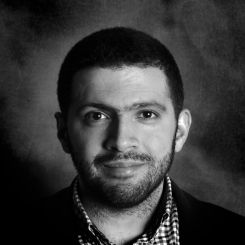
“The festival's choir was founded in 2024, initially bringing together 12 young Lebanese singers from major university choirs of the NDU, the USJ (Saint Joseph University, ed.), and the Antonines. Very quickly, French singers and other nationalities joined us. Two months after the first rehearsals, we had a concert for the ten-year anniversary of Saïd Akl’s passing, which was a great success. Our second concert takes place at Saint-Sulpice, with soloists Marthe Davost and Adrien Forunaison, and organist Axel de Marnhac,” rejoices the choir director.
“The festival's choir is a real space of encounter and dialogue between singers from various backgrounds, Lebanese musical traditions, and the great choral repertoire worldwide,” he continues. Artistic director of the Dar al-Milad festival in Philokalia, he emphasizes the interest in Lebanese musical composition, which began to thrive in the early 20th century. “It seeks to create an original language by blending traditional Levantine music with the great tradition of Western classical music. Contemporary composers build on paths already explored by their predecessors to create new languages, more free, more personal, and often more daring. It’s a real kaleidoscope of styles, colors, and musical identities,” remarks Khalil
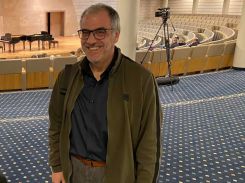
One of the concert's masterpieces is the requiem of Lebanese composer Sevag Derghougassian, who was immersed in a musical atmosphere from childhood. “My mother played the piano, my father the accordion, and we listened to a lot of Armenian, Arabic, Greek, Russian, and Turkish music,” recalls the musician.

“From the age of 13, I thought a lot about musical forms, their lines, their contours, the emotions they convey. I was looking for ways to express the colors of my view on the world and create my paradise,” he continues. Derghougassian’s compositions are numerous, two of them are particularly significant according to him.
“Etude opus 34 reveals how études allow a sophisticated expression of emotions. My Nocturne opus 1, meanwhile, is the beginning of a long journey that took me very far,” he specifies. “The Requiem opus 26 sung at Saint-Sulpice is a first. I composed the music in 2016 and performed it for the first time in Beirut, on two pianos, then in France, at Notre-Dame du Liban Church and the Museum of Fine Arts in Dijon, with pianists Georges Daccache and Betty Salkhanian,” he continues. The influences in Derghougassian’s works are numerous.
“On an academic level, I find myself in European, Russian, and Armenian compositions, as well as with Luciano Berio and György Ligeti. My music is based on classical foundations for harmony, form, and philosophical aspects. Ethnomusicologist Soghomon Soghomian was an important figure for me,” he insists, while lamenting that he composes much less lately. “Life's difficulties mean that I have to give many piano lessons, which leaves me very little time. Nonetheless, I am happy to teach music to the new generation. My latest composition, Bagatelles opus 41, for oboe and piano, dates from 2023,” concludes the musician.
Contemporary musical writing according to Ramzi Kandalaft
Ramzi Kandalaft’s Sanctus will allow the public to discover a young composer under 30, who entered the music world through violin lessons.
“After my first orchestra experiences, I decided to embark on composition and take musical writing courses at the Beirut Conservatory. I remember the emotion when I played my own pieces, in Philokalia, then in Beit Tabaris,” confides the violinist. His Sanctus is inspired by the French tradition of the early 20th century. “I started with a traditional liturgical text and conducted the musical adaptation in a quite intimate style that I have developed in recent years. There is a bit of Poulenc, of Fauré, a bit of Ravel’s and Debussy’s impressionist aesthetics. I feel close to a well-crafted writing that remains light and fluid,” explains the musician, who participated in the Musicales of Lebanon three years ago as a violinist. “This experience taught me a lot, I relentlessly train through readings, research, and master classes, notably that of Naji Hakim,” continues the composer.
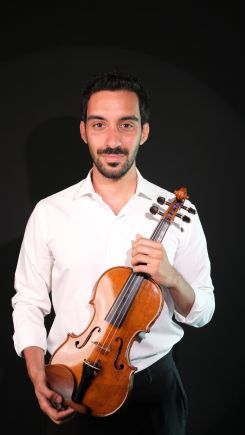
“We have very active choirs in Lebanon that deserve to perform creations more often, and it’s a chance for us to be able to hear our pieces brought to life by them. When I work on a Lebanese text, an oriental influence appears by itself. I just finished a vocal work which was commissioned and sung by the NDU choir, around the Virgin Mary. It’s about pushing the harmonic and rhythmic limits of Arabic sung music towards more advanced styles. It is rather conservative in an effort to preserve traditions,” he observes. “We tend to enrich the Arabic repertoire to find a more profound meaning pathway with Arabic words,” concludes the musician, who will be in Rabat on June 28 in the orchestra accompanying Majida el-Roumi.
After the June 27 concert, the Musicales of Lebanon invite their public this fall. “On October 16 at the 5th arrondissement’s town hall for a piano concert, then on November 30 at the Institut du Monde Arabe in Paris for an event around Toufic al-Basha, and finally on Dec. 7 at Notre-Dame du Liban Church, for composer Naji Hakim's 70th anniversary. A delightful program that would not be possible without the support of our main patron, Philippe Helou,” recalls Zeina Saleh Kayali.
This article was originally published in French by L'Orient-le Jour.

 7 p.m. recap: Netanyahu seeks mastermind behind Flydubai incident; Washington sanctions 2 French nationals; Ben Gvir's 'I want to kill you' threat