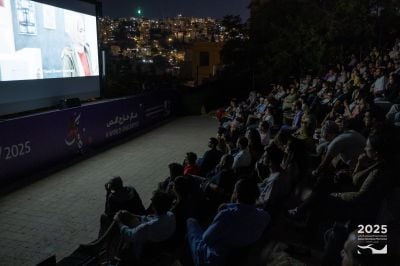


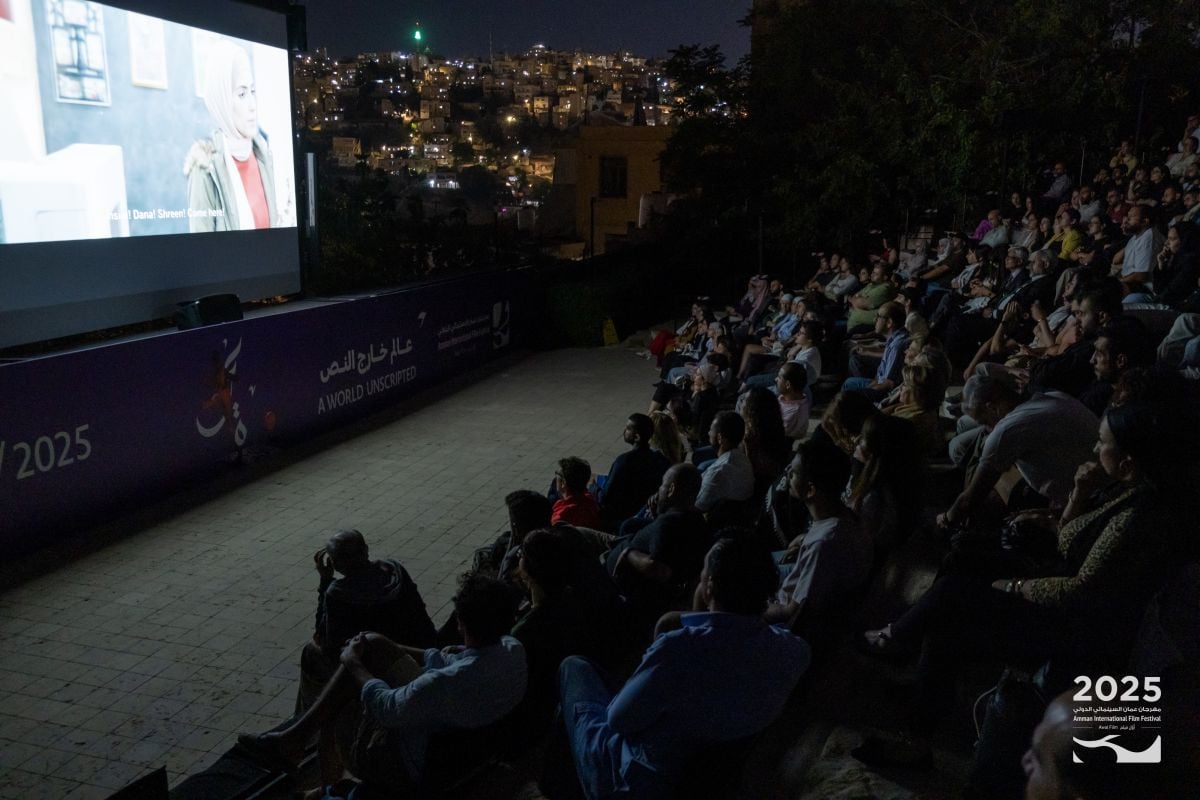
Archive image of a film screening during the 6th edition of the Amman International Film Festival in 2025. (Credit: Photo provided by Amman International Film Festival)






L'Orient-le Jour: This year, the festival is being held in a context marked by violent wars raging in the region, as well as economic and political crises on a global scale. What challenges has the festival faced this year?
Nada Doumani: Since the festival was created in 2020, we have gone through difficult times. The Covid pandemic, to begin with, forced us to make extraordinary choices: we held screenings in open spaces, drive-ins, and outdoor theaters, with mandatory mask-wearing and social distancing. This situation lasted almost two years, depending on the regulations in force.
Then came the war in Gaza. Naturally, Jordan and Jordanians are very close to and concerned about everything that happens in Palestine. The festival therefore adapted to the circumstances, abandoning any ostentatious signs of glamour, including the red carpet, to focus on content. In any case, the overall atmosphere was not right for celebration; in our opinion, that would have been almost indecent. We also made it a point to show films about Gaza and made by Gazans.
Last year, the Iranian-Israeli-American conflict led, among other things, to missiles flying over our heads until a week before the festival opened at the beginning of July. Some guests then dropped out, fortunately in very small numbers. And this year's scenario is somewhat similar.
The conflict that is raging in the region, economic crises, and the general air of uncertainty that hangs over the entire cultural sector are all factors that make organizing a cultural event difficult: from financing to welcoming guests, whose safety is a priority, to keeping up the morale of the team faced with worrying daily news. In Lebanon, you know this reality well; you live it every day and have done so for decades.
However, we are determined for the festival to continue with the same quality and ambition. Our festival focuses mainly on Arab cinema. We believe that, in times of collapse, culture itself is a small act of resistance — even as some try to erase Arab culture, its influence, its modernity, and, above all, its ability to carry its own stories and tell them to the world in its own way.
L'Orient-le Jour: German philosopher Walter Benjamin believed that cinema has political and cultural power capable of influencing the masses. For his part, Slovenian cultural critic and philosopher Slavoj Žižek sees cinema as helping us discover the illusions, desires, and hidden ideas that govern our lives — making the seventh art a space of ideological struggle. Today, we experience this struggle in the context of the war between Israel, the United States, and Iran. You launched the festival under the slogan "Beyond the Frame." Does this slogan have a political or philosophical dimension, or does it reflect a particular position?
Every year, we choose a theme or a slogan, often inspired by the prevailing situation. "Beyond the Frame" refers to the cinematic frame, but also to what lies behind the image on the screen: the director's choices, deliberately excluded sequences, underlying ideas that are not necessarily stated, and so on.
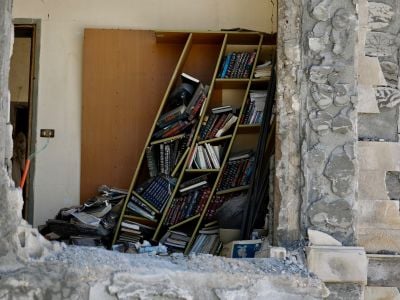
Today, as we launch this edition in the midst of a conflict that affects the region in multiple ways, we cannot pretend that cinema, art, and culture stand apart from what is happening. The slogan is also an invitation to look beyond the surface: to look past the first image and the prefab story that is presented to us. Cinematic works, especially documentaries in our region, are often produced as a stance toward social, economic, or political reality — not as a detached aesthetic luxury.
L'Orient-le Jour: This year, 82 films are participating in the festival, including 10 world premieres and 15 Jordanian films. What are the dominant themes of this edition? How many films were submitted to the festival? And what sets this edition apart?
Nada Doumani: We received more than 900 films, from which we selected those mentioned above. The dominant themes this year revolve around identity, memory, and displacement. These themes carry a particular sense of urgency because of what the region is experiencing, as if the films themselves anticipated the events while dialogging with them.
This year we chose to pay tribute to Tunisian cinema for several reasons. It stands out for its innovative, modern, and bold language, which does not hesitate to address taboos and forbidden topics with finesse. Tunisian films are often featured at major international festivals and at the Oscars. The relationship between our festival and Tunisian cinema is not incidental; it has been built over the years through collaborations on films, workshops, and visiting guests. During this edition, we will pay tribute to one of the greatest producers in the Arab world, the Tunisian Dora Bouchoucha. We will also open the festival with Sofia, a film directed and performed by Dhafer L’Abidine, a warm and captivating work that begins with a personal story to reveal deeper social realities.
L'Orient-le Jour: The festival is seven years old and is dedicated to films made by first-time filmmakers. It is therefore a young festival in its pace, age, and orientation, as well as in its support of modern and experimental experiences — generally given little attention in our region. After seven years, how do you assess the evolution of different factors: the audience (in terms of number and diversity), the festival’s impact on cinematic production in Amman and in the region, as well as the festival’s age and longevity? Especially considering festivals in the region usually do not last very long and face many obstacles, as was the case in Dubai, Lebanon, Abu Dhabi, and Syria.
Nada Doumani: After seven years, I can say that the festival has grown authentically, even organically. The audience has doubled and become more diverse. It is no longer limited to that of Amman; it has expanded to other governorates and now brings together generations and groups of people who did not previously see independent cinema as part of their daily lives.

In terms of production, we see a real impact through the Amman Film Industry Days, which after several years of work have become a genuine platform allowing projects to move from the development or post-production stage to the screen. This year, 20 projects are competing for awards. That is also the role of a festival: not only to screen films but also to serve as an incubator and a platform for cinematic projects.
Your question about sustainability is essential. We are fully aware of the fragility of cultural events in the region. That is why we chose to base our sustainability not on scale or spectacle, but on a real network of relationships with filmmakers and, above all, with the local audience — a network that is difficult to unravel. That is also why we have deliberately chosen to grow gradually but surely, to avoid mistakes and gain the trust of our partners. Today, the Amman International Film Festival – Awal Film is a true reference in its field, recognized in the region and beyond for its professionalism and unique identity. We intend to preserve this identity, not only in the years to come but, we hope, for decades into the future.
Highlights of the festival program
From July 26 to Aug. 3, the Amman International Film Festival – Awal Film offers 82 screenings organized around competitions for feature-length fiction, documentaries, and Arab short films, as well as an international competition. This 7th edition honors Tunisian cinema, with a retrospective of six films and a tribute to producer Dora Bouchoucha. New features include the "Made in Jordan" section, dedicated to young Jordanian talents, as well as several special screenings, including "Sophia" by Dhafer L’Abidine as the opening film, "Ma’ Rosa" by Brillante Mendoza, and "Who is Still Alive" by Nicolas Wadimoff. The program also features meetings with filmmakers, master classes, free outdoor screenings, and decentralized sessions across Jordan, with special attention paid to the festival’s accessibility. Lebanon marks one of the most highlighted Arab presences at this edition, with seven films selected in various sections of the festival. Among them are the feature film "A Sad and Beautiful World" by Cyril Aris, the documentaries "Do You Love Me" by Lana Daher and "Birds of War" by Janay Boulos and Abd Alkader Habak, as well as the short films "All This Death" by Fadi Syriani, "Alya" by Yara Melki, and "What If They Bomb Here Tonight?" by Samir Syriani. Out of competition, the documentary "Litanies" by Marlène Khoury completes this Lebanese presence.