





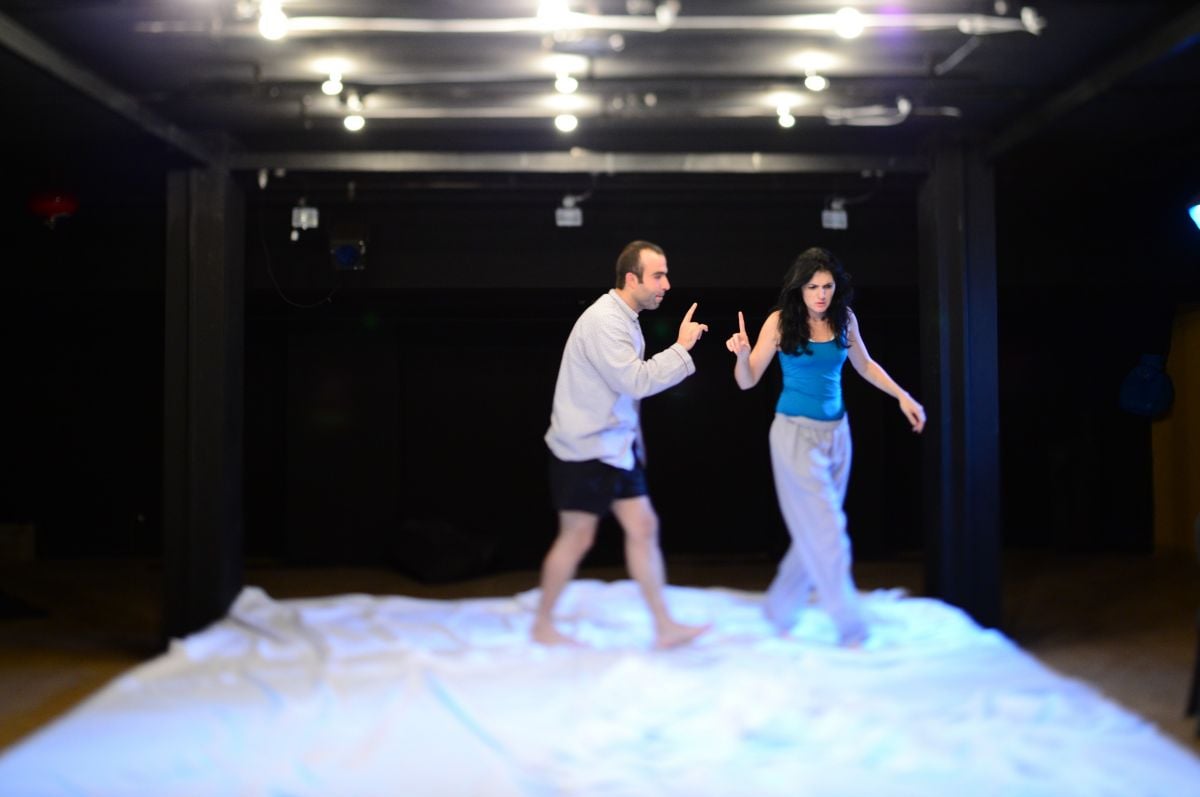
Between laughter and painful confessions, Sahar Assaf and Elie Youssef bring to life a couple on the verge of breaking up in "Mon amour, retourne au lit" at KED, Quarantine district in Beirut. (Credit: Alexy Frangieh)






The play My love, go back to bed, currently running at the KED and directed by Lina Abyad, adapted and translated by Sahar Assaf and Tarek Tamim from a text by American playwright Greg Kalleres, raises a series of essential, almost philosophical questions about love, marriage, commitment, infidelity, sexual attraction, and all the crises that accompany them: loss of trust, weariness, doubt, hesitation, routine, and the disappearance of desire. All of this unfolds in a comic register that is never free of pain. The pain of admitting, confessing and laying oneself bare before another person — a partner, lover, spouse or friend. Also the pain of separation between Lynn and Jad, portrayed with remarkable agility, great chemistry and perfect harmony by actors Sahar Assaf and Elie Youssef.
During a long, anxiety-filled night, as emotions shift and roles reverse, the two spouses find themselves, lying in bed after 12 years of marriage, realizing that the flame of their love has gone out and that something has been irrevocably broken between them. They attempt to rekindle this lost passion through a dialogue of disarming sincerity, filled with such precise detail that the audience at times feels as though the author has entered every bedroom to overhear the bitter and tender confidences of couples everywhere.
For an hour and a half, the two performers, equally talented and daring, drawing on their long international theater careers and numerous collaborations together, keep the audience laughing throughout what initially appears to be a purely comic work. Beneath the surface, however, the play is profoundly human and melancholic, delicately questioning the nature of romantic relationships and the transformations they undergo over the years.
Scenography as a key to interpretation
Absolute simplicity runs through Lina Abyad’s staging. Everything begins with subtle lighting that shifts between shadow and medium intensity according to the emotional fluctuations of the two characters, following a carefully controlled dramatic crescendo. The lighting accentuates facial expressions, glances and the sadness that inhabits Lynn and Jad’s confusion.
The director has also opted for a stripped-down yet highly meaningful scenic design. At the center stands a bed — or rather, an arena — whose pristine whiteness dominates the space. A simple sheet covers the square stage: sometimes a blanket during sleep scenes, sometimes a true dramaturgical element, it becomes the visual expression of the confrontations and tensions between the spouses.
The set thus plays a fundamental role in the immersive theater experience envisioned by Lina Abyad. The audience literally surrounds this bed-stage and is drawn into the couple’s intimacy, watching their glances, whispers, cries, suffering in the face of fading feelings and desperate attempts to recover a lost emotion.
Two lovers, once tender, faithful and happy when they decided to build a life together and start a family, gradually become adversaries, like two fighters facing each other in an arena.
Another key element is the play’s “Lebanonization,” carried out by Sahar Assaf and Tarek Tamim. By bringing the work closer to Lebanese audiences, they root it in Lebanese language, daily life, streets, colloquial expressions, familiar poems and the names of writers and philosophers known to the public. This adaptation significantly strengthens the bond between the play and its spectators, sometimes even prompting spontaneous audience participation: people call out words, labels or suggestions that can be heard across the venue.

Thanks to its humor, satire, impressively precise, fluid, expressive and intelligently bold performances, and a script that feels as though it could have been written in Lebanon, the play has won over hundreds of spectators since its premiere in 2012 and again during its 2017 revival in the presence of its American author, Greg Kalleres. It is now being performed again at KED until July 23.
"I spent two years thinking before agreeing to direct My love, go back to bed, which Sahar Assaf suggested after discovering it in Chicago as a sitcom, when the script was originally written as a bedroom play," Lina Abyad told L’Orient-Le Jour. "At first, I saw this text as a bourgeois and elitist work, a world that doesn’t particularly appeal to me."
But the text continued to haunt her, both for its realism and its intelligence. She then wondered how to bring it closer to Lebanese audiences, especially since the themes it raises remain largely taboo, even within some couples.
A multi-dimensional relationship
Lina Abyad extends her reflection to the point of making the scenography the keystone of the performance. Everything begins with the bed, placed at the center of the space and surrounded by the audience. “The scenography transformed our approach to this text on every level,” she explains. The intimacy between viewers and actors allows every detail, every exchange and every silence to be followed almost face to face, much like the couple themselves, who confront each other over the future of their relationship.
"This staging was a genuine challenge, both for me and for the actors. They must address spectators sitting on all four sides of this square bed. We also wanted the show to be popular and accessible, not reserved for an elitist audience."
The director also mentions an unexpected constraint: "There was also a challenge with the costumes. We have only one pair of pajamas for the two characters, which they exchange from scene to scene." Added to that is a challenge for the audience itself. "The audience is extremely close to the stage and the actors. This proximity requires constant presence, attention, and involvement from them, especially as they’re also observing the reactions of other spectators sitting on the opposite side of the bed."
This multifaceted, intimate relationship is one of the production’s defining features. It is established not only between the actors and the audience, but also among the audience members themselves. Each spectator becomes, despite themselves, a witness to the reactions of others. The arrangement exposes the actors as much as those watching, taking the play far beyond text, performance or set design. It sends everyone back to their own bedroom, to their own past, present or future relationships, their wounds, their years of passion or emotional dryness, and all that separates them.
Abyad readily accepts this interpretation. "This play is unsettling because it acts like a mirror. It can be uncomfortable, sometimes painful, even though it’s profoundly funny."
She believes this approach is unprecedented in Beirut. "In this form, it’s very likely the first immersive and chamber theater experience of its kind in the capital. The only precedent I can think of is Jacques Maroun, when he presented Le Monstre, in its first version in 2019, using the codes of chamber theater."
Asked about the boldness of the content and the direction, Abyad says: "All these intimate questions about love and relationships are perfectly legitimate. There's probably not a single couple that hasn’t asked them. Lovers or spouses may not always have the courage to voice them as directly as Lynn and Jad do on stage. But, deep down, we never really know if all these conversations truly took place or if they belong to the realm of dreams. Did this confrontation actually happen or is it just one of their dreams?"
For the director, "one of the most important aspects of this play lies in the candor of the subject as much as in the questions it raises. Its audacity personally reminds me of Cage, by Joumana Haddad, about sexuality — a fundamental part of human life that nevertheless remains taboo in our region. It’s essential to talk about it, but also to consider how to approach it with intelligence, boldness, and without ever falling into vulgarity."
Does love have an end?
University professor, director, actress and artistic director, Sahar Assaf told L’Orient-Le Jour that Greg Kalleres’s script profoundly affected her. Yet when it premiered in the United States, the play wasn’t particularly successful. The chosen format — highly realistic and close to a sitcom — and the almost naturalistic staging of explicit sexual scenes did little to convince critics.
By contrast, she explains, the work she and Elie Youssef developed follows a different approach: to engage the audience’s imagination rather than faithfully reproduce reality. It is a deliberate choice that makes this version more inventive than the American production. Although Lynn and Jad exchange kisses, embraces and gestures of tenderness under the lights, the most suggestive moments are left to darkness, where only voices and evocative sounds are heard.
"The play highlights an essential reality of marriage," says Assaf. "A real relationship doesn’t end with a simple word or a few lines at the courthouse. What fascinated me is how Greg Kalleres describes the bond uniting these two spouses with such accuracy: the way they love each other, even when they choose to separate, because they know with clarity that love or passion can eventually fade. It’s a painful play, but a deeply truthful one."

Speaking about her portrayal of Lynn, she says: "I chose to consider that Lynn still loves Jad, even though she claims otherwise during their confrontation. She actually refuses to accept the end of their love. When she tells him she doesn’t love him anymore, it’s because she thinks it’s the only way to end their relationship. She is sincere; she expresses what she feels in that moment. Anyone who has experienced a long love story will understand this state. Relationships start a certain way and end differently. What happens to them is not simple, and Lynn herself struggles to accept this reality."
Opposite her, Assaf continues, Jad is a man capable of understanding, listening and engaging in dialogue. "He truly listens to her as a partner. He plays with her, sometimes he accepts, sometimes he doesn’t. He loves her. He’s clear-sighted, mature, open, positive, and deeply authentic. He gets angry, expresses his frustrations and disappointments, but remains understanding." What particularly touched her is "the way these two continue to listen, understand, and support each other. It’s wonderful, and it’s essential that this remain possible, even when the relationship ends."
For Assaf, "the relationship between Lynn and Jad is ultimately a success because it results in reconciliation, honest conversation, and a form of maturity. As individuals, it’s important for us to be able to admit that a relationship can end one day. But it’s even more important to think about how we want to end it — or, on the contrary, continue it — with lucidity, respect, and consideration for each person’s feelings."
One of the play’s underlying themes is the idea that relationships, including marriage, can come to an end. This remains largely taboo, both socially and religiously, in societies where marriage is viewed as a sacred and indissoluble commitment, and where women — often the more vulnerable party — are expected to sacrifice everything to hold the family together.
Lynn, the mother of an eight-year-old son with Jad, nevertheless chooses to break with these expectations. She decides to save herself, and also to protect the man she still considers her best friend, by refusing to let their relationship deteriorate into lies, infidelity or pretense. She dares to tell her own husband something many women would confide only to a friend, sister, mother or therapist: that she no longer loves him.
* Friday, July 10, then July 18 and 20 at 8 p.m. at KED, Quarantine district, Beirut. Tickets available at the box office.


 7 p.m. recap: Iran warns Egypt, Israeli soldiers vote in south Lebanon, Haret Hreik responds to Kataeb