





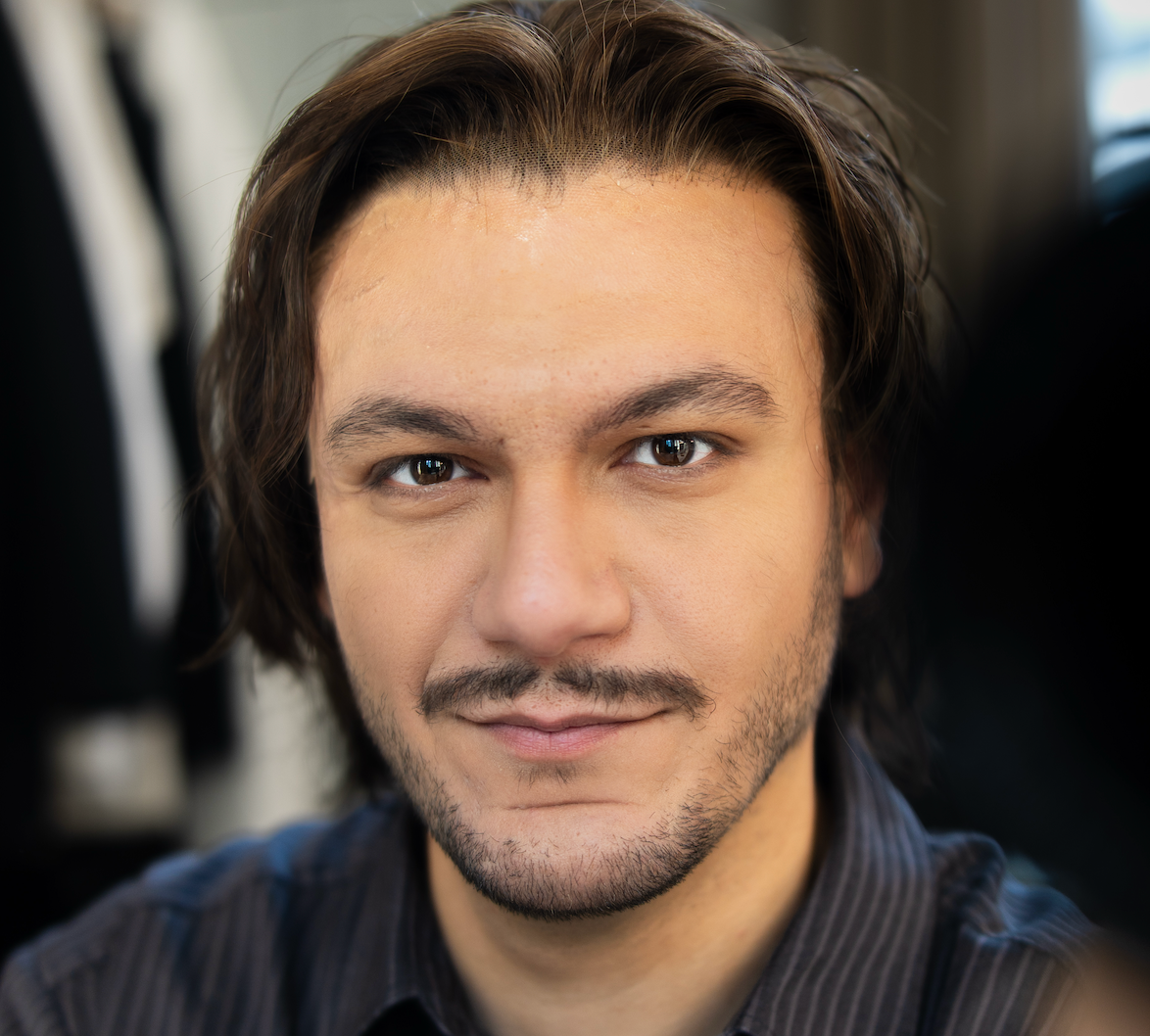
At just 34 years old, Lebanese tenor Joseph Dahdah is gradually establishing himself as one of the most promising voices of his generation on European opera stages. (Credit: Joseph Dahdah)






Discovered last January in the role of Don José in Pavia, Lebanese tenor Joseph Dahdah delivered the most convincing interpretation heard in over a decade. With a voice that is both robust and youthful, he possesses all the qualities of a great lyric tenor poised to move into more dramatic repertoire.
Joseph Dahdah is a young Lebanese tenor whose career is enjoying remarkable growth on the greatest European stages thanks to a repertoire covering Verdi, Puccini, Bellini, Bizet, Spontini, and Busoni. Born in Zgharta in 1992, he began studying voice and piano at the age of twelve.
On a rapid ascent, he has already appeared at the Maggio Musicale Fiorentino, the Bühnen Bern, the Immling Festival, the Teatro Petruzzelli in Bari, as well as the opera houses of Piacenza, Pisa, Jesi, Ravenna, Brescia, Cremona, Como, Bergamo, Pavia, and Modena.
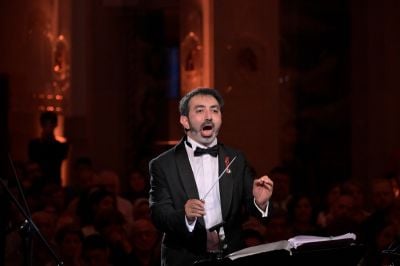
His repertoire notably includes Pollione in "Norma," Radamès in Aida and Cinna in Spontini's La vestale. Among his most notable roles in recent years is Don José in Bizet's "Carmen," which he has sung in several productions throughout Italy as well as at the Immling Festival.
His upcoming engagements include Mario Cavaradossi in "Tosca," Ismaele in "Nabucco," Radamès in "Aida" and Pinkerton in "Madama Butterfly." He will perform the latter role in early 2027 at one of the world's most prestigious opera houses: La Fenice in Venice.
The announcement of his debut as the thrilling Manrico in "Il Trovatore" in Hanover naturally made for a must-see event. Alas, as travel plans were already set, only a dress rehearsal could be attended. The occasion nonetheless provided the chance to hear Joseph Dahdah and the excellent Cristiana Oliveira in two of the most demanding roles in the lyric repertoire.
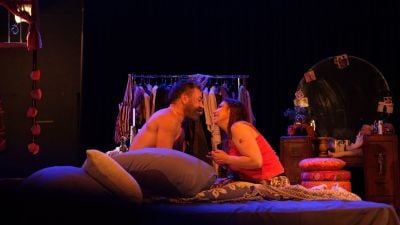
"Il Trovatore" remains one of Verdi's most popular operas. Its plot is as passionate as it is implausible: after a nobleman has a gypsy woman burned alive, her daughter Azucena tries to take revenge by throwing the nobleman's child onto the pyre, but accidentally burns her own son. She then kidnaps the noble's baby and raises him as Manrico. At the end of the opera, the Count di Luna kills Manrico, his romantic rival, before learning he has just murdered his own brother.
As extravagant as it may be, the plot is set in a real historical context: the civil war that broke out after the death of King Martin of Aragon in 1410. The Count di Luna and Manrico support opposing sides in the battle for succession. This opposition between the established power and outcasts offers considerable dramatic potential, rarely exploited by stage directors.
German director Wolfgang Nagele sets the action in our own time, in a country torn apart by civil war. The idea of making Ferrando a TV presenter and regime propagandist works particularly well. On the other hand, the transformation of the gypsies into tourists is less convincing. Certain situations, such as Leonora's entrance to the convent or some chivalrous behavior involving pistols, seem implausible in this modern context. Admittedly, opera was never intended to be realistic, but this update sometimes puts viewers' suspension of disbelief to the test.
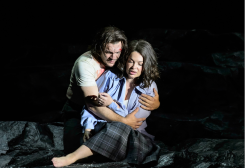
Enrico Caruso famously said that it takes the four greatest singers in the world to succeed in "Il Trovatore." The point still holds, as all four main roles are highly demanding. Composed in 1853, the piece is often considered Verdi's last great bel canto opera. Leonora, in particular, requires a first-rate lyric soprano able to blend agility, expressive power, and technical mastery.
For his debut as Manrico in Hanover, Dahdah impresses with his vocal assurance, energy, and stage charisma. His high notes, remarkably secure, appear to be produced with disconcerting ease. Even more impressive, his solid technique suggests a promising and steady evolution in his career.
The contemporary setting suits him perfectly: he credibly embodies a modern rebel, driven by passion and conviction. In the act one trio, “Di geloso amor sprezzato,” he displays rare musical intelligence, avoiding gratuitous display despite the impressive means at his disposal. His scene with Azucena reveals another side of his talent: through subtle inflections in the text, he sensitively conveys Manrico's doubts and vulnerability.

Already remarkable as Don José in "Carmen" for his excellent French diction, Dahdah is equally impressive for his command of Italian. Beyond flawless pronunciation, he has a true instinct for the language and its musical expression. His linguistic skill is another asset for an international career that looks set for a brilliant future. Add to this an ideally suited physical presence for leading roles: Dahdah today combines all the qualities required for a great career — and then some.
Already remarkable as Leonora in Lisbon three years ago, Portuguese soprano Cristiana Oliveira remains an ideal interpreter of the role. Her dark tone, flawless technique, and dramatic commitment bring real nobility to the character. Her performance of "Tacea la notte placida" was one of the evening's highlights.
In the second act, Leonora, believing Manrico to be dead, is about to enter a convent as the Count di Luna tries to abduct her. In this production, an armed confrontation replaces the traditional duel. Nevertheless, Cristiana Oliveira manages to express with emotion Leonora's overwhelming joy at finding Manrico alive. If her singing remains admirable, the bustle on stage somewhat detracts from the lyrical intensity of the moment.
The staging of the second act is particularly interesting. Azucena is no longer surrounded by gypsies but by tourists visiting a region devastated by war. The character's trauma is cleverly highlighted: she keeps intact the room of her lost child, turning the space into a haunting symbol of her guilt.
Italian mezzo-soprano Silvia Beltrami offers a first-class Azucena. Avoiding all melodramatic excess, she creates a character deeply marked by tragedy. Her "Stride la vampa" captivates with expressive intensity and richness of low notes.
Croatian baritone Grga Peroš is more convincing for the beauty of his voice than for his dramatic portrayal of the Count di Luna. His interpretation of "Il balen del suo sorriso" is elegant and sincere, but his character sometimes lacks authority. However, in this contemporary take, the count resembles more a militia leader than an aristocrat, lessening this shortcoming.
Transformed into a television presenter, Ferrando becomes the regime's spokesperson. Georgian bass Shavleg Armasi seems to thoroughly enjoy playing this pompous and manipulative character. His telling of Azucena's story effectively sets up the opera's tragic atmosphere.
On the podium, Masaru Kumakura conducts with mastery and a sense of theater. Attentive to the singers' needs, he accompanies this demanding score with skill. Some tempo choices are surprising, notably in Ferrando's aria, but they serve to characterize the roles. Overall, this performance was particularly successful. Only one regret remains: being able to attend only the dress rehearsal, as this production deserved to be discovered in all the fervor of an opening night.
This article originally appeared in French on L'Orient-Le Jour.