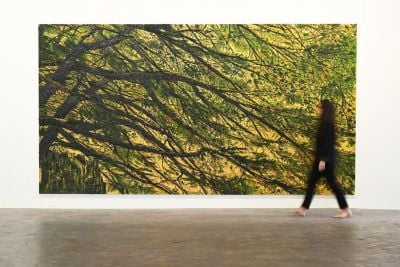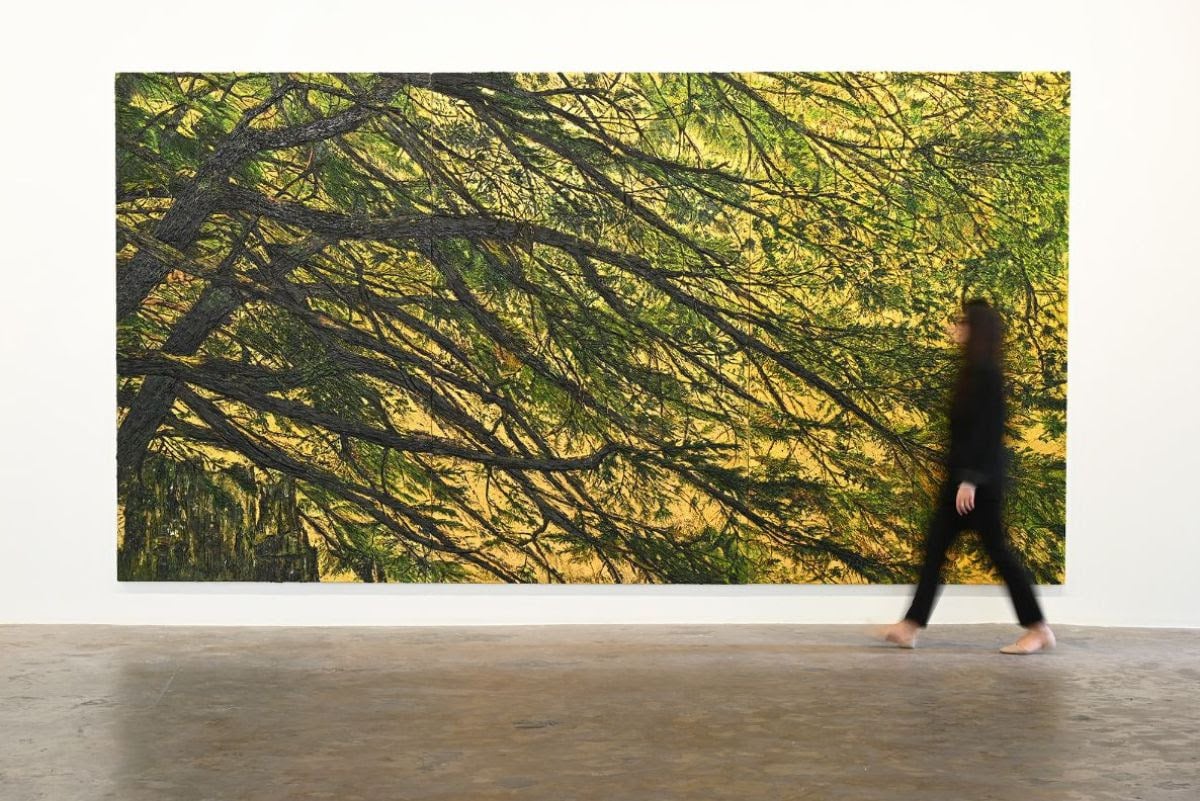
“My Lebanon,” oil, acrylic, and sand on canvas by Tamara Haddad. (Credit: Courtesy of the artist and Tanit Gallery)






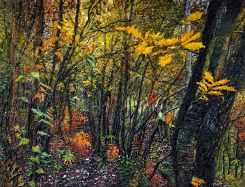
Her paintings draw you into groves streaked with light, undergrowth with dense foliage, forgotten paths, glimmers filtered through the branches and silences inhabited by the wind. From the outset, they pull you out of the city’s pollution, the urban pace, but also the tensions that haunt our exhausted Lebanese minds.
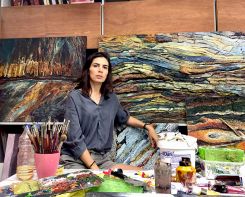
With brushstrokes that are both precise and poetic, Tamara Haddad summons the soul of the forest in her dense, textured canvases, gathered under the title "To My Father" and on view through June 4 at Tanit Gallery in Beirut*.

Visiting her exhibition is, in a way, like giving yourself a breath, a gulp of air untainted by the political and security situation. It means letting yourself be carried away by the beauty of Lebanese nature, but also by the eco-conscious perspective that underpins the artistic approach of this young painter.
From advertising to ecology
Are people made more aware of the need to preserve the environment by exalting the beauty of nature rather than by showing ecological disasters? The question naturally arises upon discovering the artist’s new works. Known until now for exploring in her canvases the earth’s fissures, fires and the wounds inflicted on the landscape, Haddad has clearly chosen this time to shift her perspective. Her new series proves more soothing, more luminous as well, even if a certain melancholy still surfaces.
A self-taught painter, this former advertising professional says she felt several years ago the need to return to a form of emotional authenticity, far from the codes and constraints of marketing, in order to express her personal concerns more freely. Starting with the ecological question. Air pollution caused by generators, the waste crisis and unchecked urbanization: These degradations of her Beirut environment have shaped her outlook and sharpened her sensitivity to the fragility of living things.
'Trees are poems'
A forest walker, trail wanderer and seeker of beauty, Haddad is inhabited by nature, to the point of nourishing her artistic practice with its contemplation and with a sensitive reflection on the fragility of this ecosystem and the need to preserve it.
Her first exhibition, titled "Fault," presented at the French Institute of Beirut in 2013, approached these questions through apocalyptic lunar landscapes, in mineral strata crossed by gashes, evocative of the violence done to the earth. More recently, it was fires and deforestation that imposed themselves on her, at the very moment flames were ravaging the pine forest of Baskinta, above her family home. The young woman drew from this a series of dark, almost charred canvases, reflecting a feeling of loss, suffocation and asphyxiation.
For this new vintage, it is a text by Gibran Khalil Gibran that serves as the basis of her inspiration. "Trees are poems that the earth writes upon the sky. We cut them down and turn them into paper to record our emptiness": This quotation shifted her gaze. Retaining only the first sentence, Haddad decided to leave behind the register of catastrophe and wounded trees to devote herself to a more poetic and positive pictorial writing. A choice that, far from sugarcoating reality, instead reveals its emotional depth.
Nature and slowed time
From this was born her new series of canvases rooted in the photographs taken during her forest hikes. From this raw material, Haddad extracts rhythms, masses, diffuse lights... In short, everything that makes up a living landscape. Which she further enhances with branches, bark and twigs gathered and incorporated into her compositions.
From large landscapes of interwoven forest growth to close-ups of a bush, foliage, a few woodland berries or the branches of a cedar (in an immense diptych), the mixed media (oil, acrylic and various elements) she then develops almost make visible the secret trembling of living things. Under the artist’s brush, however, a diffuse unease surfaces. Nothing frontal, but a gentle melancholy runs through the compositions in autumnal tones.
Somewhere between contemplation and meditation, Haddad thus makes the forest an inner territory as much as a threatened landscape.
Dedicated to her father, who died in recent months and who "loved trees and poems," this exhibition intertwines personal memory and ecological awareness. In a world saturated with urgency, visiting it imposes a slowed temporality. It invites us to truly look at this "natural world" that we no longer see. To grasp the measure of its essential presence and to remember that it is the vital breath that our hyperconnected lives tend to relegate to the background.
*"To My Father" by Tamara Haddad at Tanit Gallery in Beirut, Mar Mikhael. Through June 4.
This article was translated from L'Orient-Le Jour.