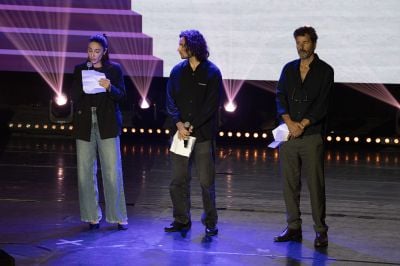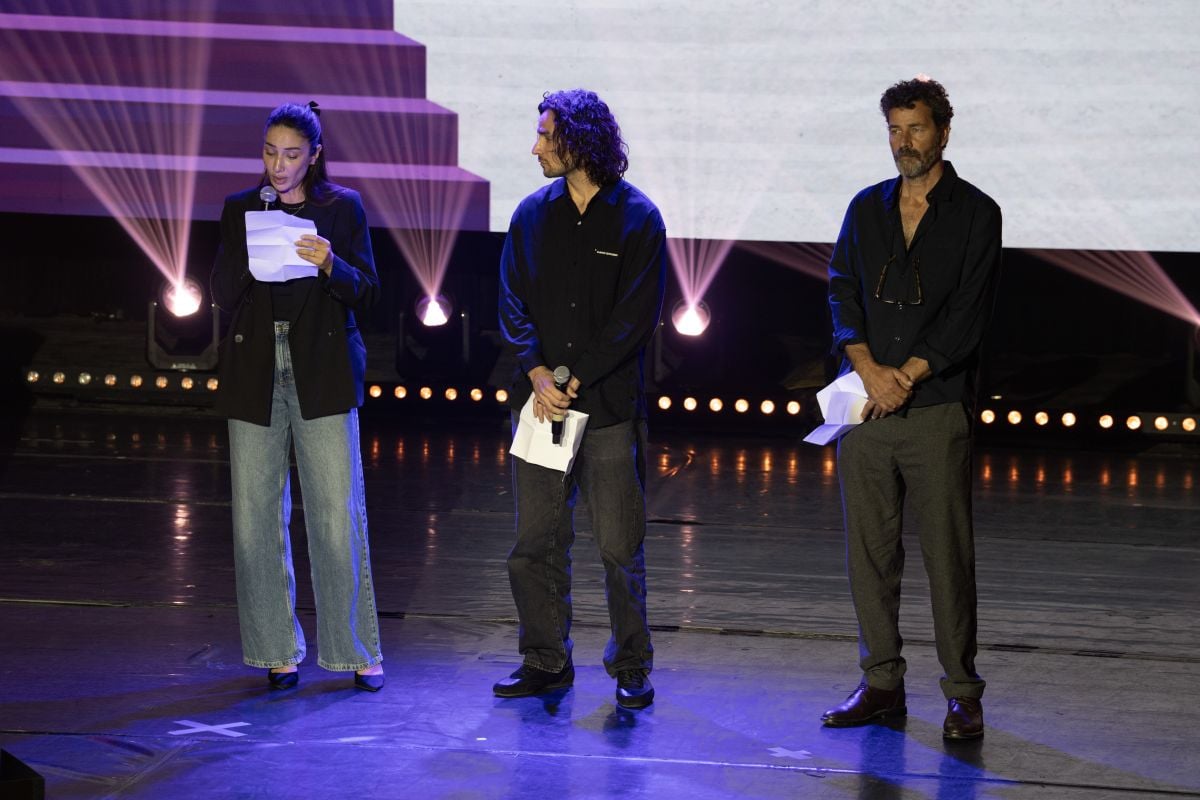
The children of Mohammad Bakri pay tribute to the memory of the Palestinian actor during the opening ceremony of the 7th edition of the Amman Film Festival. (Credit: Amman Festival)






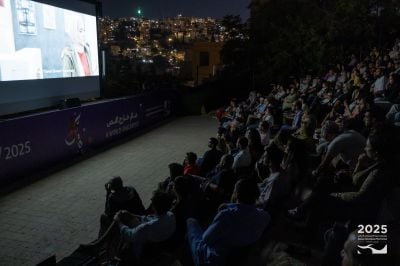
The seventh edition of the Amman-Awal Film Festival opened Sunday evening at the Al-Hussein Cultural Center, with a heartfelt tribute to Palestinian actor Mohammad Bakri, a major figure of Palestinian cinema who passed away in 2025, and a celebration of Tunisian cinema through the screening of "Sophia," written, directed, produced, and performed by Dhafer L’Abidine.
The ceremony began with a film looking back on the landmark moments of Mohammad Bakri’s career (1953–2025), an artist whose work was inseparable from his commitment to the Palestinian cause. A regular at the Amman Film Festival, where several of his films were screened, Bakri also had a deep connection with Jordan, which he called his "first second country." The tribute was especially moving, highlighted by the interventions of his children.
Deeply moved, his daughter Yafa Bakri said: "Dad, what can I write about you? How do I speak of absence when you are still present on this stage, in the eyes of the audience, and in everyone’s memory? You stood up to the tyrant, made 'Jenin, Jenin' against the silence, and withstood, like a rock, this madness called Israel. No one was able to erase you."
His son Adam described his father as "a free spirit, magical, courageous, and deeply rebellious," saying that "if he wasn’t a prophet, he surely bore within him what prophets carry." His brother Saleh concluded the tribute on a more political note: "We promise you, in the name of the invincible weapon that is art, we will tear death and oppression from our land and fill the world with suns, from East to West."
Beyond the frame
In her opening speech, festival president Princess Rym Ali addressed this year's theme, "Beyond the Frame." "What lies beyond the frame is culture, memory, and the experiences we go through. These are what give films their emotion, authenticity and voice. For Arab filmmakers, looking beyond the frame also means reclaiming our narratives. For too long, others have decided which stories deserved to be told, and which should remain off-screen," she said.
In honor of Tunisia, the guest country of this edition, Jordanian musician Yazan al-Rousan, founder of the band Autostrad, performed "Sabah el-Kheir, Tunis" before joining singer Zein Awad to rework a Jordanian heritage song. This musical interlude brought a light touch to a ceremony hosted by Zein Awad and journalist Muhannad al-Jazeera, against a regional backdrop still shaped by war.
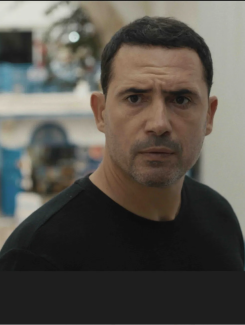
Dhafer L’Abidine: 'Telling our stories with our own voices'
The festival’s opening night concluded with the screening of "Sophia," whose plot follows Emily, a Briton who leaves London to join her daughter Sophia in Tunisia, hoping to help her reconnect with her ex-husband Hicham. But the young woman's sudden disappearance turns the trip into an investigation blending family secrets, lies, racism, hatred, and cultural rifts.
Director L’Abidine said he was "proud" to see "Sophia" open the festival. "It’s an honor, but also a responsibility to represent Tunisian cinema in Amman," he told L’Orient-Le Jour. "Sophia" is an atypical film: neither classic auteur cinema nor commercial cinema. It’s a Tunisian-British coproduction that tackles deeply human issues through the language of the thriller."
L’Abidine also welcomed the spotlight on Tunisian cinema this year. "There’s a genuine closeness between Tunisian and Jordanian cinema. Two years ago, the Carthage Festival paid tribute to Jordanian cinema; today, the roles are reversed. We face the same difficulties: financing, distribution, and the circulation of our films, which sometimes travel more in the West than in their own countries. It’s essential that we support each other and give Arab audiences the chance to discover their own stories."
While many films at the festival address war, memory, or loss, "Sophia" chooses a different register. "It’s a thriller, but deals with a universal subject: cultural differences, racism, and prejudice. These issues aren’t linked to any specific event; they have long shaped our societies."
Having lived in the UK for 26 years and married to a british person, L’Abidine says this dual culture has deeply influenced his writing.
"I was long frustrated to see our stories told from the outside, from an orientalist perspective, without depth or authenticity. I wanted to write, produce, and direct them with our own voices, our sensibility, and our culture, so they would speak to both Arab and international audiences."
The director believes Arab cinema deserves greater recognition on the international stage. "I make films because I have stories to tell and a worldview to share. 'Sophia' is about families, identity fractures, and differences in perception between Tunisia and Britain. My ambition is for us to be present on the global stage with works that are sincere, ambitious, and deeply rooted in our reality. That’s why I chose to produce my films myself, funding them from my own resources."
The director is also delighted about "Sophia’s" international run, especially its reception at the Santa Barbara International Film Festival.
Known for his career as an actor in film and television, both in Tunisia and abroad, L’Abidine admits that this notoriety enabled him to take the leap to directing, writing, and producing. He describes it as a new adventure, an obvious step fueled by a longtime passion for cinema. He is currently working on two new feature films, which he says will be very different from his previous works.