

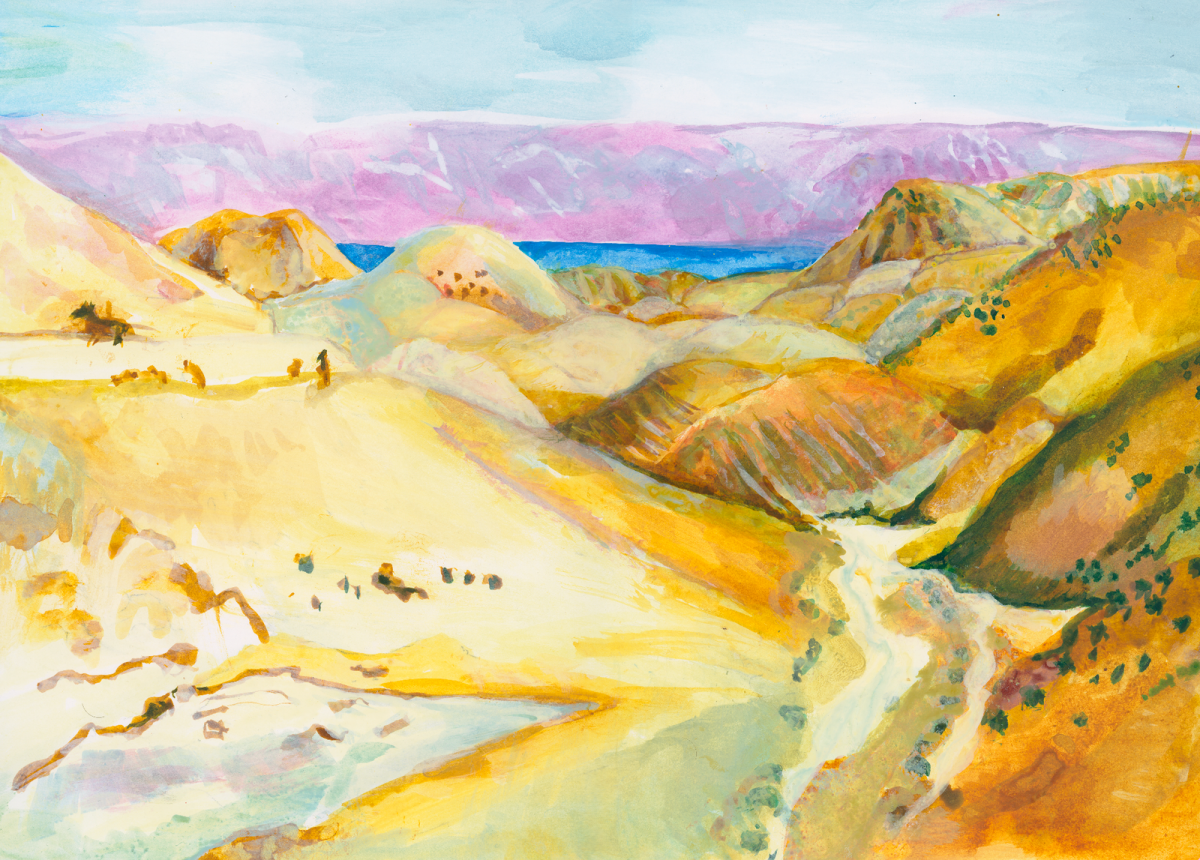
A landscape of the Levant painted by an Australian soldier and reproduced by Lamia Joreige in the exhibition "As I Weep" presented at the Marfa' gallery. (Credit: Youssef Itani/Studio Tajareb)

Upon entering Marfa’ gallery, two large canvases by Lamia Joreige invite visitors on a journey through time. The first, titled "Safar Barlik," depicts, in a palette of pale, blurred tones, a viaduct crossing an arid landscape; the second features a steam train emerging from a tunnel carved directly into the rock.
These two paintings immediately transport visitors to the 19th-century Levant, the region of the Eastern Mediterranean encompassing present-day Lebanon, Syria, Palestine and Jordan, which was then part of the Ottoman Empire. A space with porous borders, open to movement and intermingling, before the French and British mandates redrew its map in the aftermath of World War I.

In "As I Weep," on view until Sept. 3 at the Beirut Port enclave gallery, the visual artist and filmmaker continues her exploration of the origins of the contemporary Middle East, focusing on the turbulent years between the fall of the Ottoman Empire and the establishment of the French and British mandates. A "turning point between a vanished era and another opening onto the unknown," as she writes in Arabic script on one of the two paintings that open the exhibition. A phrase that strikingly echoes the upheavals currently shaking the same region.
This exhibition continues "Uncertain Times," a long-term project Joreige has been developing since 2017, centered on the period from 1913 to 1921. It was while observing, with concern, the profound upheavals threatening to fragment the region’s countries once again that she turned, nearly a decade ago, to this pivotal era, which a century earlier had profoundly reshaped the Middle East following World War I, the Mount Lebanon famine, the collapse of the Ottoman Empire and the colonial redrawing of the region.
From London’s archives to the Sydney Biennale
"In the first chapter of this project, I drew on the Ottoman archives, Lebanese photographic collections, and the diplomatic archives of Nantes, aiming to cross-reference Arab, Ottoman and French perspectives," the artist tells L’Orient-Le Jour. In this new phase, she broadened her investigation to the British perspective, delving into the British Library and National Library collections. But when curator Hoor al-Qasimi invited her to participate in the 25th Sydney Biennale, Joreige felt a new imperative: "My work had to speak to Australians as well, while remaining consistent with the project."
She therefore extended her research to Australian archives and museums, where she discovered the diaries of Australian soldiers who fought alongside the Allies on the Levant front during World War I.
Joreige drew on these materials to create "Uncertain Times – War Diaries," an artwork blending her own drawings and notes with photographs, topographical maps, soldiers’ personal accounts and reimagined landscape paintings made by some of them during their deployments in Lebanon, Syria, Palestine and Egypt.
Gaza, martyred city in 1917
Brought back from the Sydney Biennale (which closed on June 14), this mural work occupies an entire wall and a central place in the Marfa’ gallery exhibition. It offers visitors a kind of war chronicle, assembled as a montage bearing witness to a landscape undergoing profound transformation between 1914 and 1919.
Among other elements, it features an image of Gaza destroyed by the 1917 bombings — the site of fierce battles between the British and Ottomans — disturbingly similar to today’s photographs of the martyred city.

Yet this mural is far from a strict historical reconstruction. As always, the artist prefers to compose a sensitive journey in which archives, maps, personal stories and visual artworks interact to reveal another reading of the past — fragmentary, intimate, poetic and deeply political.
War booty, museum mosaic
Another key work in the exhibition is an enigmatic "painted canvas sculpture." The piece is inspired by the Shellal mosaic, a Byzantine church floor dating from the 6th century, discovered near Gaza by Australian soldiers during World War I and brought back to Australia as war booty.
Now held at the Australian War Memorial in Canberra, this archaeological work is displayed incomplete, with several fragments scattered across various Australian collections.

By recreating, in a uniquely abstract and fragmented composition, the missing silhouette of the mosaic as it appears in the Canberra museum, Joreige highlights the impossibility of a single narrative in the face of a fractured history, whose traces remain scattered across countries, languages and memories.
Her work also underscores that "every archive is a construction, made up as much of what it preserves as of what it allows to disappear," notes the Lebanese artist. At a time when calls for the restitution of antiquities are growing more urgent, she asks what it truly means to "return" a work when the place it once belonged to no longer exists in the same form, when borders have been redrawn and political realities have drastically changed.
Another thread running through the exhibition is a series of small watercolors on canvas: portraits, domestic scenes, landscapes and everyday details. Inspired by the diary of Ihsan Turjman, a young Jerusalemite soldier in the Ottoman army who recorded his daily life between 1915 and 1916, these works are sketches for a feature film Joreige had planned to make based on his writings.
The war halted the project, so the artist transformed it into a video, "Casting for a Film, the Diary of Ihsan." Shown on a loop in Marfa’s projection room, it features Palestinian and Lebanese actors performing scenes from the script before discussing Jerusalem — now inaccessible to them — and the echoes between that century-old past and their contemporary reality.
Emotion as artistic material
And then there is the work that gives the exhibition its name. It appears as documents from British archives, altered by the artist’s own tears.
"When I arrived in London in December 2024, I had access to the original Sykes-Picot Agreement map, but also to manuscripts, maps and rare documents: reports on preparations for the Paris Peace Conference on Syria, Lebanon and Palestine, territorial negotiations, Zionist proposals and Palestinian petitions," Joreige recounts.
"Faced with these fragments of history, fragile vestiges of a past that continues to shape the region, my tears flowed ... I had been holding them back for a year in the face of the genocide unfolding in Gaza," she confides.

As her tears fell onto the archival documents, they blurred the words, diluted the inks, erased some lines and even obscured borders themselves. "As I Weep" was thus born from a simple gesture, but one of great symbolic power.
At a time when archives are perceived as guarantors of objective truth, Joreige reintroduces vulnerability, emotional memory and the subjectivity of perspective. Her tears are a reminder that every reading of the past is inevitably colored by the wounds of the present.
It is precisely in this dialogue between different periods of time that the exhibition reveals its full impact. The stories it unearths from history resonate with the threats now looming over Middle Eastern territories and borders.
Without ever imposing a single interpretation, Joreige weaves a long-term body of work where intimacy, politics and history converge. In this second chapter of "Uncertain Times," she reminds us that the past is never completely behind us: it continues to haunt places, memories and gazes, while casting its shadow over the times to come. More uncertain than ever …
"As I Weep," by Lamia Joreige, at Marfa' gallery, Beirut Port sector, until September 23, 2026.







