


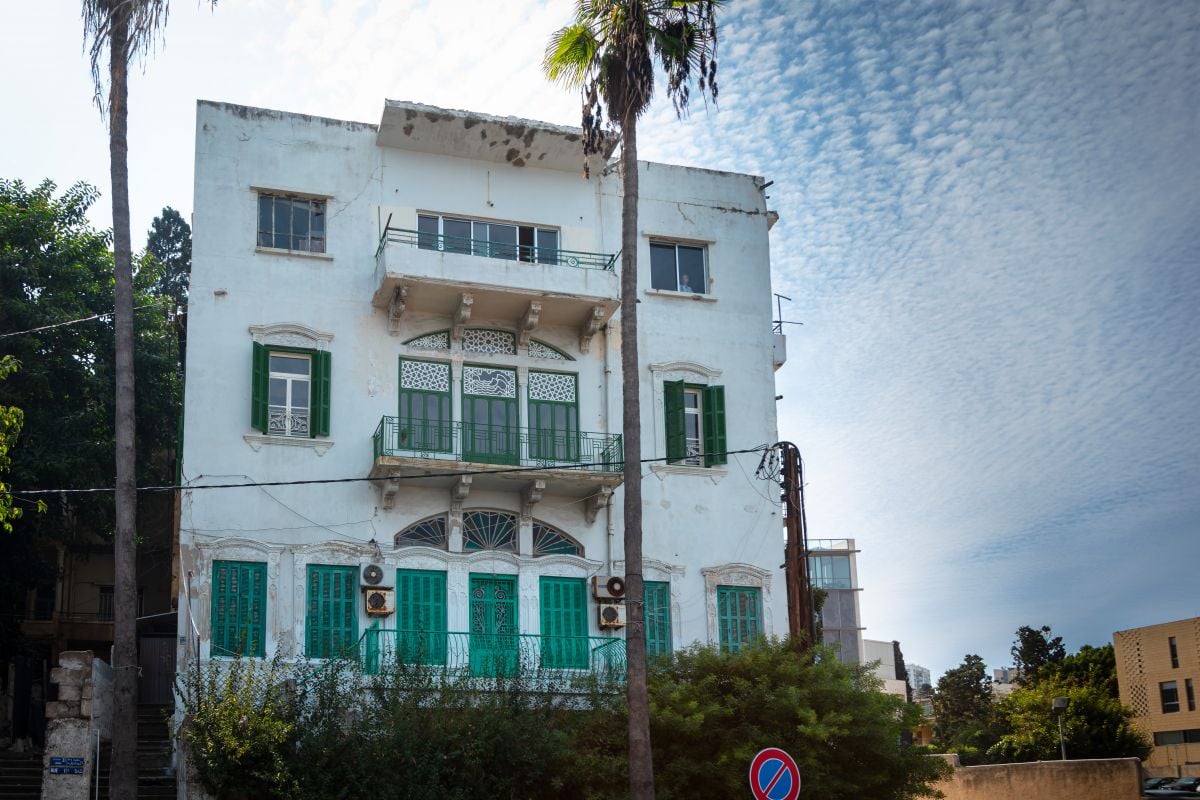
In Aïn el-Mreissé, a house that opens onto the sea.






It's hard to believe that one is still in Beirut upon entering this house that opens onto the sea and silence. Yet, that's what Beirut was once: a maritime city before it was concrete; an open city before it was fractured. The relationship with the sea was not, as it has become today, a mere “visual consumption,” to use the words of architect Ala Tannir, who denounces the increasing privatization of the coastline for the benefit of a financial oligarchy, whose relationship with the environment and the collective is based on appropriation. Living with the sea is something else altogether. This is precisely what this unique and minimalist project seeks to convey, based on the restoration of one of the few houses from the French mandate that escaped the real estate frenzy: an ode to the preservation of heritage—architectural, environmental, cultural—and the possibility of having it dialogue with contemporary interpretations of our heritage and collective memory.
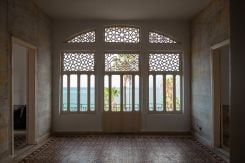
Artists from different regions of the Arab world
While in Beirut, Ala Tannir, a young Lebanese architect based in New York, discovered this house for the first time in 2021, which she initially envisioned as a future studio. But she soon realized that such a place “cannot be taken for granted in a city like Beirut.” “As an architect, the urban development of the city concerned me. I wanted to return this space to the city,” she confides. Like so many others, the house was damaged by the double explosion at the port on August 4, 2020. Thanks to funding from the Graham Foundation, which supports projects at the intersection of art and architecture, Ala Tannir launched a restoration project punctuated by permanent creative interventions, conceived in situ.
She reached out to several artists from different regions of the Arab world, each bringing their own voice to the walls of this house that she deliberately chose not to overcrowd. She bet on space and silence, traversed only by the soundscape of Khyam Allami and the films of Panos Aprahamian and Vincent Vicken Avakian, subtly resonating with the spirit of the place. Since the destruction of August 4 is the very origin of the project, the curator invited Jana Traboulsi and the design collective 7w20 to restore the moucharabieh torn by the blast. But instead of reproducing it identically, they chose to deconstruct the original pattern and recompose a new design from its fragments, in poetic dialogue with the sea. This scar, visible from the outside, has become an integral part of the landscape. It cannot be erased, but perhaps it can be opened towards the horizon.
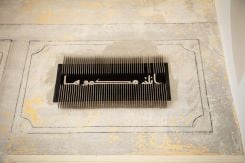
To protect the house from harm, Syrian architect Khaled Malas transformed a vent into a mosaic of pearls inspired by the Umayyad Mosque in Damascus. He inserted Quranic inscriptions from a talisman that Ala’s grandmother received from a Damascene sheikh after losing several infants. On the advice of the latter, she threw the talisman into the sea once she returned to Beirut. Ala's father, born after this gesture, lived 55 years. This project is dedicated to him—to the man who loved the sea, his daughter now offers a work of art.
The installation also documents the history of the house through the memories of Ala’s great-uncle, Khalo Aziz, 96 years old, born in the building and still residing there. His stories restore the family memory, but also that of the Ain el-Mreissé neighborhood and its transformations. The jury of the Milan Triennale was sensitive to this personal and creative approach: the microhistory of a place often says a lot about that of a city.
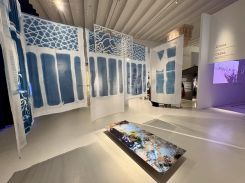
Continuing her research on the neighborhood, Ala Tannir discovers that “the history of this area is quite different from the one we have inherited.” In her view, the recent upheavals in Beirut are part of a historical continuity initiated in the 19th century by the Ottomans, continued under the French mandate, and culminating with the post-war reconstruction led by Solidere. She recalls that the corniche was built in stages, from the 1920s, swallowing beaches, the shoreline, and life by the sea. The erosion of Beirut’s built heritage is above all, according to her, the result of a deliberate lack of planning, both at the national and metropolitan level. She develops this analysis in the exhibition catalog.
Political and poetic intent
While Ala Tannir’s intent is resolutely political, it is also deeply poetic. Anglo-Iraqi musician Khyam Allami designed a sound system based on the house's architecture: a magnetic tape runs along the panels, emitting a discreet and immersive sound. In the same spirit, physician and photographer Lara Tabet created friezes from samples taken from the nearby sea: marine bacteria, cultivated by a chemical process, generated a painting, a true microbiological imprint of the Mediterranean.
Ala Tannir herself went to the sea to symbolically take this house to Milan. Using cyanotype techniques, she produced blueprints, full-size facade plans at a 1:1 scale. Yumum—plural of the word “sea” in Arabic—gives its name to the larger project she envisions: a research and creation platform focused on the southern and eastern shores of the Mediterranean, questioning the transformation of space and its vital link to the sea.
Trained at AUB, then at the Rhode Island School of Design, having gone through MoMA, the Venice Biennale, and the Milan Triennale, Ala Tannir dares to dream of other futures, where beaches would become public again, fish recognizable, waters clean and fishermen restored to their rights. She reminds us that the elders of the neighborhood formed committees to defend their heritage against real estate developers. “I must imagine all this to be able to continue living,” she states with the fervor of a thirty-year-old.
And from my heart I blow kisses to the sea and houses (Et de mon cœur j’envoie des baisers à la mer et aux maisons is “a maximalist installation made of minimalist pieces,” summarizes visual artist Vladimir Antaki, who is also passionate about memory and history. Supported by AFAC and the House of Today foundation, the exhibition is visible at the Milan Triennale until November 9, and in Beirut, in the house overlooking the sea, until June 13.