






Jezzine
The "Together for Jezzine" list, supported by the Free Patriotic Movement and former MP Ibrahim Azar, is in the lead, and results so far indicate that it won all the seats.
In a live statement from the Interior Ministry, Prime Minister Nawaf Salam thanked "all those who contributed to the success of the electoral process."
"We are now preparing for the parliamentary elections, and we will prepare an electoral bill that will correct the existing shortcomings," he said. "I am satisfied with this election, and we have learned from the shortcomings encountered."
Interior and Municipalities Minister Ahmad Hajjar said he received a number of complaints and followed them up with security services, adding that no irregularities or interference in favor of any side was found.
He stated that turnout was low compared to 2016, but that after nine years of absence, the Lebanese people exercised their democratic right, which he said was "the most important thing."
He also said that "the victory by acclamation is a healthy democratic process and does not present any irregularities from a legal point of view."
109 municipalities decided their elections by acclamation in South Lebanon.
The leader of the Free Patriotic Movement, MP Gebran Bassil, will deliver a speech this evening at the "victory celebration" in Jezzine.
The Lebanese Army announced in a statement that its units deployed on the ground will continue to take the necessary measures to support the electoral process until the completion of the count and the announcement of the results.
It also called on citizens to refrain from shooting in the air during the announcement of the results, to avoid endangering the lives of others, particularly in the sensitive context currently experienced in the south.
As polling stations closed, the turnout rates published by the Ministry of the Interior were as follows:
Saida District: 41 percent
Sour District: 36 percent
Jezzine District: 41.37 percent
Nabatieh District: 41.35 percent
Hasbaya District: 35.38 percent
Marjayoun District: 30.40 percent
Bint Jbeil District: 26.50 percent
All districts recorded a significant drop in participation compared to the 2016 municipal elections. The most notable were in Bint Jbeil and Marjayoun, areas heavily targeted during the war between Hezbollah and Israel, where participation rates fell from 42.5 percent to 26.83 percent in Bint Jbeil, and from 43.20 percent to 30.66 percent in Marjayoun.
The general monitoring table of complaints related to the municipal elections showed that the total number of complaints received so far was 214. Of these, 184 were administrative in nature, 25 concerned the media and five were security-related.
Polling stations in South Lebanon closed at 7 p.m. Counting will begin shortly.
Aqtanit, in the Zahrani district
In Aqtanit, where army chief Rodolphe Haykal is from, two lists are competing: one supported by the Lebanese Forces ("Together for Aqtanit"), which already won the municipal elections in 2016, and the other "independent" ("Because Aqtanit deserves to live") with Mira Jabbour Atallah, 37, and Christelle, a mother of two in her 30s, favoring this second list.
Atallah, whose mother is from the village but does not vote here herself, told L'Orient Today journalists in the village that the municipality deserves "young and independent people to be in charge instead of an old list who did nothing for the past nine years." Christelle voted for the "new youths, as I think they embody more of my values, and what I aspire to see in the village."
Inaam Hayek, 75, a resident of the village, voted for the LF-backed list.
"The village deserves to have an infirmary. To not have our lands sold off. To have people who want to work for our village," she stated.
The general monitoring table of complaints related to the municipal elections showed that the total number of complaints received so far was 193. Of these, 166 are administrative in nature, 23 concerned the media and four were security-related.
Voter turnout increased by nearly 10 percent in the past two hours, according to updated figures from the Interior Ministry. It exceeded 30 percent, with the exception of the districts of Marjeyoun and Bint Jbeil, which were hit hard during the war.
- Saida District: 36 percent
- Sour District: 32 percent
- Jezzine District: 38 percent
- Nabatieh District: 35 percent
- Hasbaya District: 30 percent
- Marjayoun District: 27 percent
- Bint Jbeil District: 23 percent
Ghazieh
In Ghazieh, near Saida, although the municipal elections were won by acclamation by Amal, the battle for the mokhtar seats continues, according to L'Orient Today's reporter on the ground. It is a family struggle between the Ghaddar and Khalifeh families, two prominent local families.
Marjayoun
The army deployed around a polling station in the "school district" following an incident. According to L'Orient Today's correspondent in south Lebanon, several people entered the center and engaged in tense verbal exchanges with security forces inside and the army outside. One person at the scene fainted, as tensions remained high in the area.
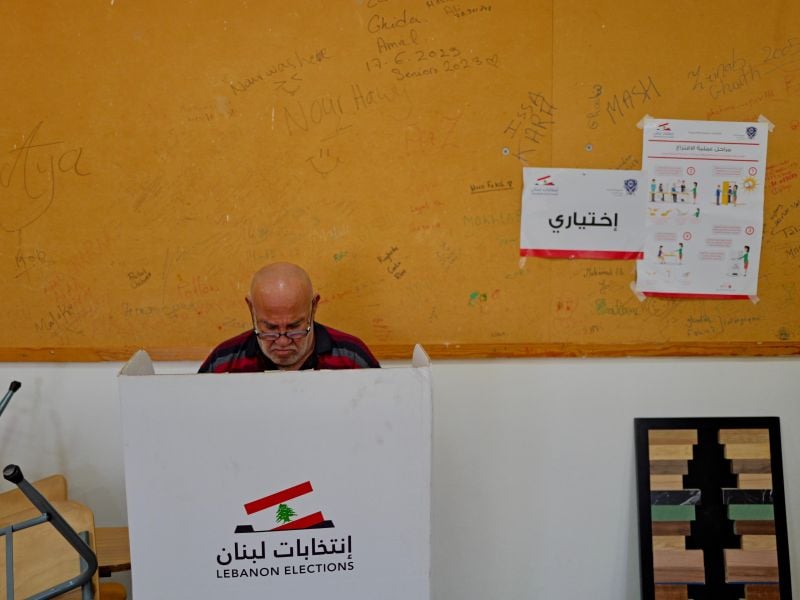
A voter at a polling station in Sour. (Credit: Matthieu Karam/L'Orient Today)
Hope for a 'change in reputation' of Haret Saïda
In Haret Saida, Mohammad Saleh, 30, said he voted for the Hezbollah-Amal list, although he was not very optimistic with some of the candidates. "There could have been more qualified and educated people," he told L'Orient Today, hoping that the new council would "improving the bad reputation" of the village. According to him, the villagers' reputation as "thugs" was harming its popularity and its economy.
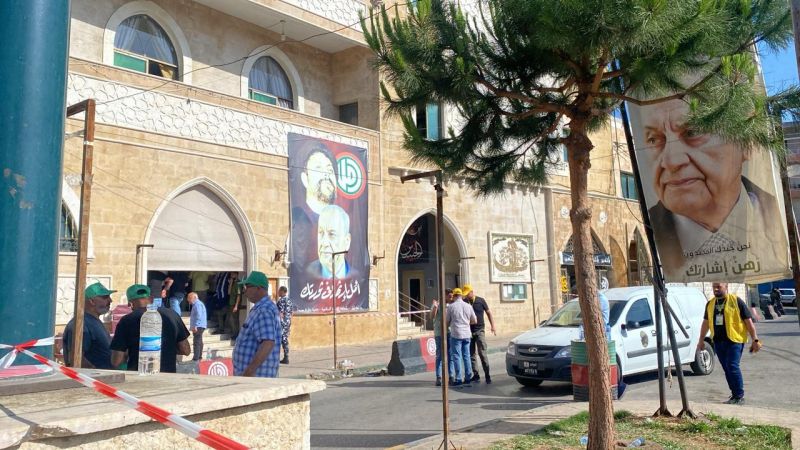
(Credit: Marguerita Sejaan/L'Orient Today)
In Haret Saida, Hezbollah and Amal face a single opponent
In the village of Haret Saida, only one independent candidate is running agains the Amal Movement and Hezbollah's list. The candidate refused to withdraw from the race despite attempts at compromise led by Parliamentary Speaker Nabih Berri. An official from the local branch of the Amal Movement said that the village "needs the roads and gardens to be maintained, but nothing has been done," and that the municipal council has done nothing for the past nine years. None of the outgoing members of this council are reportedly seeking reelection, but the head of the Hezbollah-Amal list is the brother of the outgoing municipal president.
Roum's two lists and family allegiances
In Jezzine district's Roum village, Maroun Nicholas Haddad, a 63-year-old from a family of mokhtars, told L'Orient Today that he would vote for the “Roum families” list, backed by the Free Patriotic Movement and Hezbollah. His vote doesn't come with the most enthusiasm. He says he doesn't think the list is qualified to "do much for the village," like the competing list perhaps is, but that instead it's "more representative."
Joseph Haddad, head of the Jezzine union or restaurant owners, announced he'd be voting for the other list. He hopes that the next municipal council will reopen the village school, closed for lack of pupils. These elections are not a political battle, he says, but rather a family one.
So much for Saida's 'relaxed' voting scene...
Fights broke out in Saida, each involving several dozen people, in front of polling stations located next to the Maarouf Saad Cultural Center and the American School, according to videos shared with our correspondent Muntasser Abdallah. It's not known whether the disputes have been resolved or how they came about in the first place.
With a little over three hours to go before polling stations close, here are the latest voter turnout rates shared by the Ministry of Interior:
• Saida district: 23%
• Sour district: 21%
• Jezzine district: 28%
• Nabatieh district: 23%
• Hasbaya district: 22%
• Marjayoun district: 18%
• Bint Jbeil district: 16%
In Roum, voting on 'my feelings'
In the village of Roum, in Jezzine district, peculiar alliances have taken place this year. The Free Patriotic Movement is backed by Hezbollah and the Lebanese Forces list is backed by the Amal Movement. So far today, 823 out of 2300 registered voters have cast their votes
A Roum resident in her early 60s said that she always votes, but this year is the first time she's feeling hesitant about who to vote for because none of the candidates are familiar to her.
"l'll decide in the [polling center,] that's what I always do," she says. "I always wait to go in first and then when I'm inside, I decide based on my feelings.”
Jezzine's waterfalls, an election favorite
Fadi, a Jezzine resident in his 40s, said that he used to be with the Free Patriotic Movement but left them in 2020 because they "kept failing." He told L'Orient Today that he has come to Jezzine today to vote. He hasn't decided who to vote for yet, but he says he'll choose based on the electoral campaigns.
According to Fadi, as is usually the case with Jezzine politics, both the Lebanese Forces and the FPM had said during their campaigns that they want to build a hydro facility around Jezzine's numerous and popular waterfalls... "As if that's every going to happen," he adds.
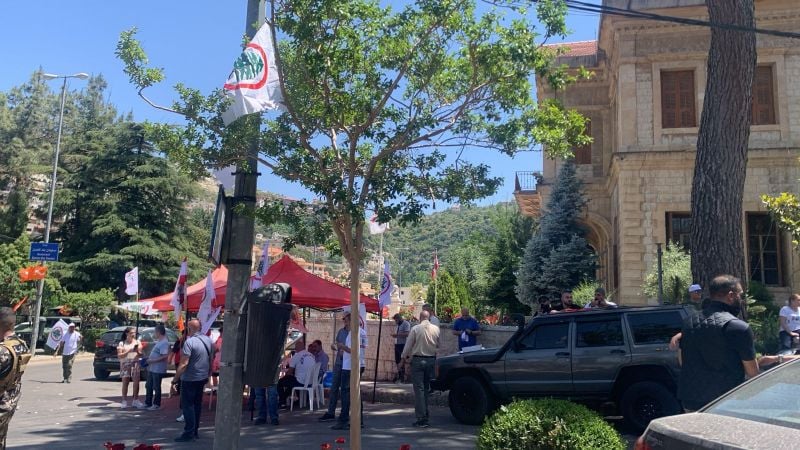
In Jezzine, a view of the town center, where voters and delegates (but mostly delegates) mingle as the days voting procedures play out. (Credit: Tasnim Chaaban/L'Orient Today)
To change or not to change... that is the question in Jezzine
Thirty-six-year-old Cynthia, standing outside Jezzine's public high school, told L'Orient Today that she voted for people she thought would work hard for the good of the locality, but that overall, she doesn't want things to change. "I love the town the way it is," she says.
A woman in her 30s, who wished to remain anonymous, could not agree less: “I want everything to change," she says. "I want them to build schools, universities, hospitals. I voted today because I'm tired of seeing the same people getting elected over and over again.”
Liza Touman, a woman in her 40s, also voted for change: "We got a new president and a reformist government, and now we want a reformist municipality that could do better for Jezzine," she says. "I have two daughters, I had to send both of them to Saida for education, but it’s a different environment. I would have preferred they stay here. I would like to see university branches in Jezzine."
Voter Jeannette al-Asmar welcomed what she described as a greater representation of women and young people on both of the competing two lists. "We wish the winner all the best," she says. "What's important is that he or she works for Jezzine without any political affiliation.”
131 complaints received by the Interior Ministry
The Interior Ministry has announced that the number of complaints received by the authorities concerning the conduct of the vote has so far reached 131, according to statements cited by the state-run National News Agency.
NNA also reported that a dispute arose at polling station number eight in Nabatieh, and voting was temporarily interrupted as the dispute was resolved. In Shamaa (Sour), a fight broke out between voters at the Bassel al-Assad cultural center, but the voting process carried on uninterrupted.
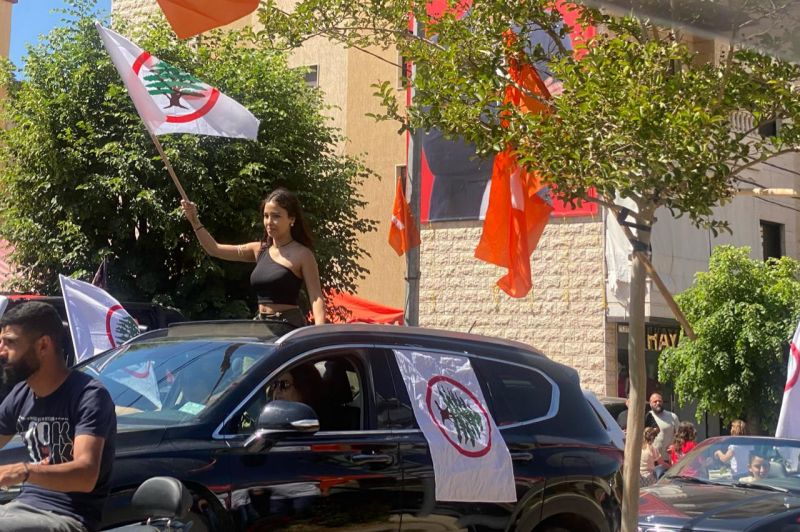
Both Lebanese Forces flags and Free Patriotic Movement flags fill the streets and cover cars in Jezzine amid a tense race. (Credit: Marguerita Sejaan/L'Orient Today)
Tense face-off in Jezzine between FPM and LF
The situation in Jezzine is tense, our correspondents on the ground report, especially compared to the excited and relatively calm atmosphere in Saida. The Free Patriotic Movement and the Lebanese Forces are facing off, with the tents set up on either sides of the streets, blaring their respective party's anthems from loudspeakers
Near the schools where the town's two polling stations are set up, barely 50 meters from each other, Lebanese Army and State Security presence is significant.
Turnout rates in the various districts of the South, according to the Interior Ministry
Saida: 19.7%
Sour: 17.33%
Nabatieh: 19.29%
Bint Jbeil: 13.87%
Marjayoun: 16.07%
Hasbaya: 19.25%
Jezzine: 24.39%
At a polling station in Saida's Bizri school, a voter fainted just after casting his ballot and was taken to the hospital, according to our correspondent Mountasser Abdallah.
In the villages between Saida and Jezzine, all stores and restaurants are closed and the roads are virtually deserted, according to our journalists on the spot. Along the roads, polling stations are moderately full, with a normal flow of voters.
Between Hezbollah and Amal, 'more solidarity' and 'the blood of martyrs'
In a Sour cafe, one woman is waiting to vote. "I'm voting for the [Hezbollah-Amal] alliance," she says, "But I'm rather pro-Amal. Since the end of the war, there's been more solidarity between us, there's the blood of the martyrs.”
"I used to blame Hezbollah for 'opening the front' in southern Lebanon against Israel [on Oct. 8, 2023],, but Israel was going to bomb us anyway,” she says. "Maybe we should have continued this war to show what we can do. Without The Resistance, the Israelis would have reached Sour."
Before polling stations even opened this morning, lists of candidates built in coordination between Hezbollah and Amal had already won, unopposed, in seven municipalities.
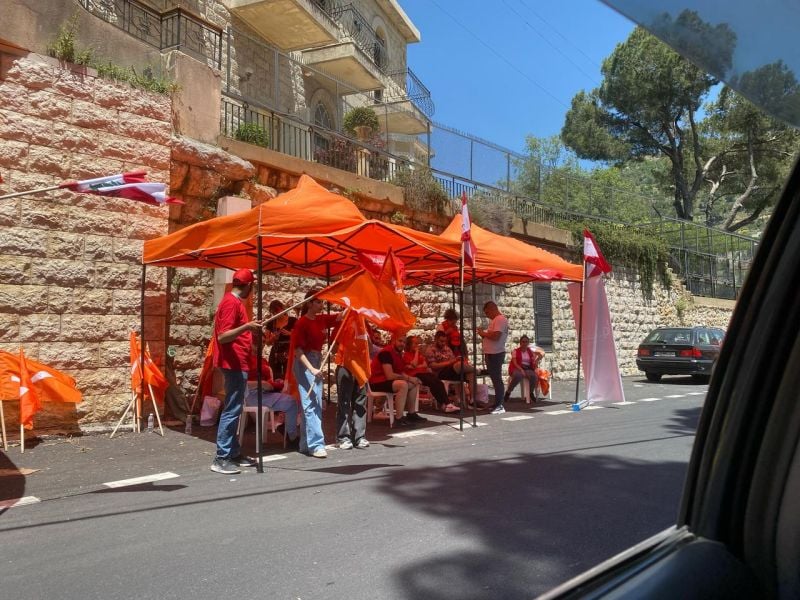
Free Patriotic Movement tents set up along the road leading into Jezzine. (Credit: Marguerita Sejaan/L'Orient Today)
In a message on X, the leader of the Free Patriotic Movement (FPM), Gebran Bassil, said that the people of southern Lebanon “show their attachment to their land." He called for a massive vote “so that the South remains free.” The FPM's main competition is in the city of Jezzine, in southern Lebanon, against the Lebanese Forces.
'I voted bright and early'
Speaking on the condition of anonymity, a shop owner in his 60s hanging out near the Mourjan voting station told L'Orient Today that bribes increase as the day unfolds, but he doesn't play that game.
“People wait till the end of the day to vote, because they know then they can ask candidates for money," he said. "Me, I voted bright and early. I voted for experienced people, doctors and engineers, not young people. We need people with experience to control the country better.”
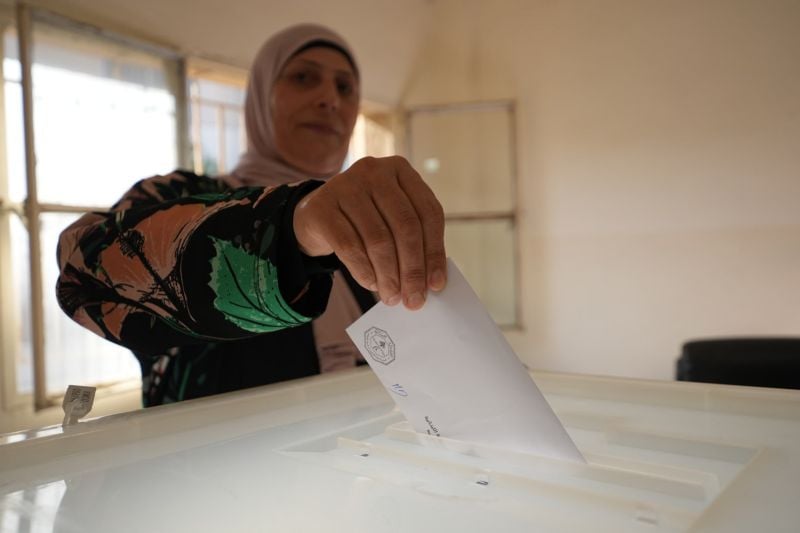
A woman casts her ballot at a polling station in Hebbarieh, Hasbaya district, in South Lebanon, on May 24, 2025. (Credit: Mohammad Yassin/L'Orient Today)
Future Movement SG's arrival causes some turmoil at Saida polling station
In Mourjan High School, converted to a polling station for the day, in Saida, the situation is very tense, compared to scenes on the street. Soldiers are shouting and screaming so that people move away from the entrance. Soldiers are keeping the door to the school mostly closed and checking people's IDs as they enter to vote.
“People are leaving without voting because they're tired of standing in the sun,” complains one passer-by.
A Lebanese Association for Democratic Elections (LADE) observer standing outside the school said: "There was some tension when [Secretary-General of the Future Movement] Ahmad Hariri showed up because soldiers were forced to make everyone get out and they had to stop the electoral process until he left."
"But then it went back to normal," the volunteer says. "So far in Saida everything has been going well and smooth."
At the same polling station earlier today, ballot casting was temporarily halted after the head of the center had a health incident and fell down inside the bathroom.
Meanwhile in Sour, the battle for, or against, Hezbollah and Amal, is in full swing
In Sour, UNIFIL peacekeeprs patrol the streets. At the city's northern entrance, youth wearing Hezbollah caps head downtown, while the seaside boardwalk is deserted. In a restaurant, a hookah in her mouth, Salwa proudly shows L'Orient-Le Jour's journalist Lyana Alameddine her purple-stained finger, proof of her vote.
"I voted for freedom and independence," Salwa says. She came all the way from Jounieh, in the Kesrouan district, and voted for candidates from several lists, with the exception of lists belonging to Hezbollah and Amal. “I hope we'll have a municipal council that works for the town and not for a party,” she explains. She hopes that other voters “will be more awake” and do the same.
“I doubt it,” laughs the young man sitting next to her.
Elsewhere in Sour, a woman dressed all in black explains that she voted in Burj al-Shemali, then came to Sour as a delegate for Hezbollah and Amal's list. “I am the mother of a martyr,” she says. Her son was killed by an Israeli airstrike in Naqoura and it took three months before they could recover his body, she recounts.
According to this voter, Hezbollah “is more popular than ever” and insists that the pre-election wins by acclamation are no sign of a decline in the party's popularity.
'People look different today'
A 72-year old British man who works as a government advisor was waiting with his two kids for his wife outside the voting station in Saida. "To me, today's elections are a total sham," he says. His 8-year-old sons pipes up: "It's because only the same people get elected every time!" he says.
Still, the father admits today's elections feel different from the past, echoing other residents' sentiments. "I’ve noticed today that the people look different," he says. "All the activists are young and excited, which proves young people want change ... I’ve seen a lot of people go in in wheelchairs. There’s a lot of diversity. While I think municipalities can barely make any change because of their very minimal budgets, at least they bring hope."
His wife, who is in her early 40s, comes out after voting and states that she voted "for inclusivity and diversity," as well as for a few young candidates, "but not always, because experience is important."
"I chose candidates instead of a list, and I chose people I know are fighting for the rights of people with disabilities."
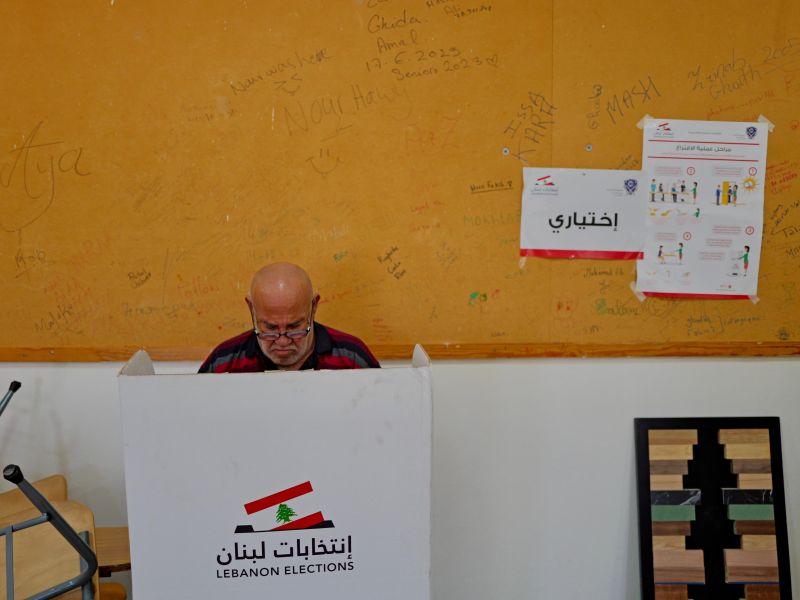
A voter selects their chosen candidates on the ballot at a polling station in the Lebanese Islamic University in Sour. (Credit: Matthieu Karam/L'Orient Today)
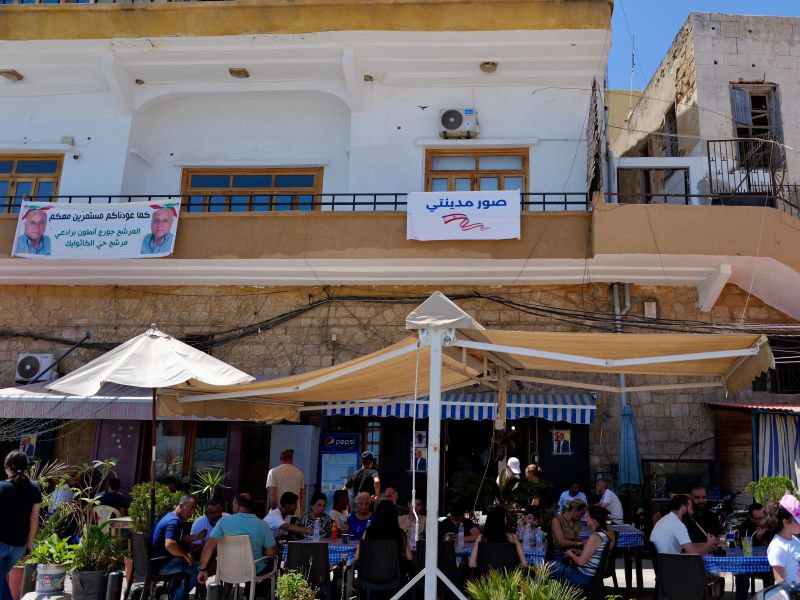
The terrace of cafe on the port of Sour is full on election day. A “Sour madinati” poster hangs above the awning. (Credit: Matthieu Karam/L'Orient Today)
The Ministry of Interior has provided a comparison of the voting turnout between 7 a.m. to 11 a.m. during the last elections, in 2016, and today's, for the South Lebanon and Nabatieh governorates.
In 2016, by 11 a.m., 12.75 percent of eligible voters across both governorates had cast their ballots. Today, 9.53 percent had voted by 11 a.m.
Here's the breakdown:
• Nabatieh — 2016: 12% ; 2025: 9.97%
• Hasbaya — 2016: 16% ; 2025: 9.03%
• Marjayoun — 2016: 12% ; 2025: 8.26%
• Sour — 2016: 9% ; 2025: 9.29%
• Bint Jbeil — 2016: 15% ; 2025: 7.17%
• Jezzine — 2016: 17% ; 2025: 14.47%
• Saida — 2016: 10.07% ; 2025: 10.49%
'Reassuring diplomatic contacts' regarding security situation in the South, Hajjar says
Interior Minister Ahmed al-Hajjar reassured voters in southern Lebanon that he had had "diplomatic contacts" that assured him of the security situation in the South, which has been continuously bombed by Israel despite a cease-fire in place since November.
Arriving in Shebaa, in Hasbaya district, to inspect the progress of the electoral process there, Hajjar said, "All diplomatic contacts are reassuring and we are committed to the sovereignty of the state that is present alongside the people," according to an NNA report. “Reconstruction began in spirit before stone, and despite the meager capabilities, the will of the people is stronger.”
Hajjar also addressed “the steadfast people of Shebaa," who are "lifting up their city to say that they are present to renew municipal work.“
"The state will not rest until every part of its territory is liberated," Hajjar added.
Good vibes in Saida, despite skepticism that elections will bring change
In Saida, the atmosphere is overall very calm and positive, our correspondents Tasnim Chaaban and Marguerita Sejaan report. Soldiers stand near the voting stations to make sure people aren't blocking the cars’ way. Delegates and voters alike are mingling, talking and laughing.
A woman in her 70s, speaking anonymously, tells L'Orient Today that today's elections are unlike those of the past: "Before, candidates and voters would fight each other," she recalls, "and create so many problems and disputes over who deserves to win."
"Today’s elections are so comfortable and relaxed. I feel like there's no violent competition going on," the woman says. "As voters, we feel like we have full liberty to vote for whoever we want, there's almost no pressure."
Fifty-five-year-old lham Asheash says she voted for a mix of people from different lists. "The first thing I'd like to see happen is waste management, and more calm and peace for this city and country," she says.
On the other hand, a woman in her twenties, who also wished to remain anonymous, says that she doesn't think anything will change. Still, she'd like to see the city "more alive" as it is "very dead" now. "I go to Sour and Beirut, and i see them full of life," she says. "I'd like to see activities happen here. Saida is forgotten, everything goes quiet at 7 p.m."
Saida voters want a solution for kids begging, stray dogs, and dim streets
After voting for the "Saida badda" list, a woman in her 60s who wished to remain anonymous told L'Orient Today that what drew her to vote today was the "fight for security and change."
"Saida is one of the most forgotten cities in Lebanon, just like Tripoli," she said. "I just hope that the people we voted for today can keep their promises."
Abu Majd, a 23-year old man with two kids, listed the things that he wants to see happen: "I'd like the municipality to find a solution for the kids who beg on the street and for the stray dogs, the municipality should light the streets because in-roads are extremely dim."
He said that he did not vote for a complete list but picked names of people he knows will work for Saida. "There is an obvious majority in Saida that will win, all the people in Saida know that… so what we’re doing is trying to get a couple of people to break through the list," he explained, adding, however, that he doesn't "have much hope."
'Amazing' turnout in Saida, where hope for change is in the air
From the Aisha polling station in Saida, Abou Amir, who is a delegate for mokhtar candidate Ahmad Sobhi Habli, called the turnout "amazing" so far.
"There’s a lot of excitement today," he said. "People in Saida want change way more than people in Beirut, I feel. They want younger people.”
Abou Amir added that he met four young women who were voting for the first time today, not because they are in their early twenties (and the last election was nearly 10 years ago) but because they are motivated to support those lists which they feel are “fighting for change."
Forty-year-old Mariana was also motivated by a shift in the political landscape in Saida, telling L'Orient Today: "I voted today for change, it feels good to vote for young people who are fighting to change the set ideology in Saida.”
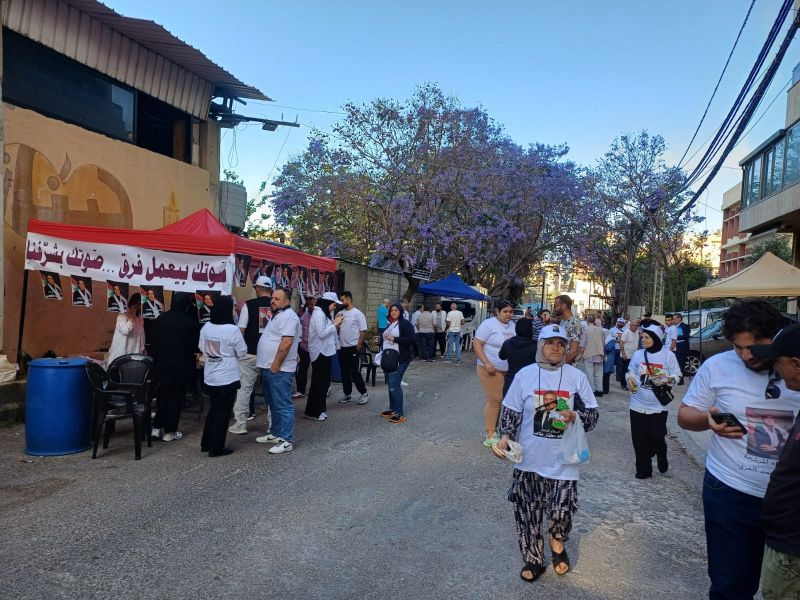
A busy street in front of a Saida polling station. (Credit: Muntasser Abdallah/L'Orient Today)
Hajjar inspects the polling stations so far only burdened by 'some logistical shortcomings'
"The municipal elections have started safely," Minister of Interior Ahmed Hajjar announced. While all three previous municipal election rounds in the rest of the country have been marked by some sort of dispute, bribery, logistical setbacks, in the South, where Israel continues to strike targets it claims are Hezbollah members or infrastructure, the most significant threat is external.
“Lebanon always rises from the rubble, and municipalities give local development work the most importance and we are working to refinance the municipal fund," Hajjar declared. "There are some logistical shortcomings in some villages, such as in [Sour district's] Bazourieh," Hajjar noted, which the ministry is looking into resolving.
After inspecting the Kfar Kila, Odaisseh and Nabatieh city polling centers, Hajjar then headed to the Marjayoun where he was welcomed by the district's commissioner (or kaymakam in Arabic) Wissam Hayek, the state-run National News Agency reported. ”We saw the steadfastness of the people of Marjayoun," Hajjar said, "and their adherence to democracy through their votes.”
Here are the latest turnout rates in South Lebanon and Nabatieh governorates, according to the Ministry of Interior:
•Jezzine: 7.32%
•Saida: 4.94%
•Hasbaya: 4.56%
•Sour: 4.23%
•Nabatieh: 4.15%
•Marjayoun: 3.47%
•Bint Jbeil: 3.00%
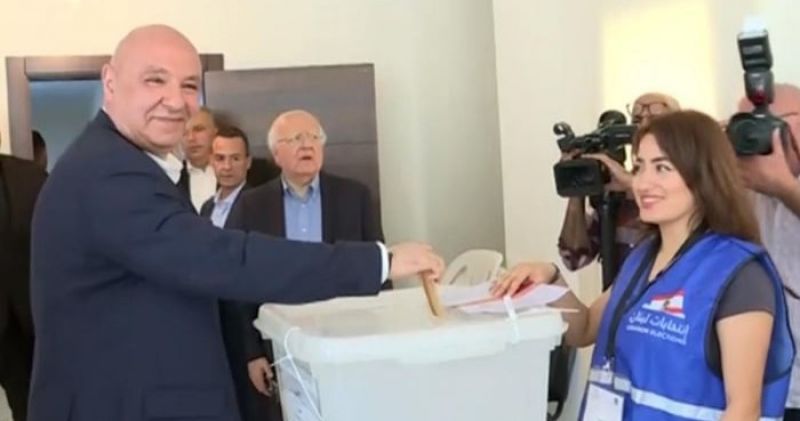
After Nabatieh, Aoun went to his hometown of Aishieh, in Jezzine district, where he cast his vote for mokhtar (the municipality had already won by acclamation).
“Whoever wins will represent me,” he said, calling once again on all citizens to ”vote heavily in all areas in the South and Nabatieh governorates.”
Aoun does the rounds, encouraging voters to show up and 'vote heavily'
Speaking at the municipal government building in Saida this morning, President Joseph Aoun paid tribute to the "souls of the martyrs on this day, to the work of the security and judicial authorities, and to all those who contributed and are contributing to the completion of the electoral process."
He called on Saida residents to "vote heavily for those who represent their aspirations for the development of the city," calling the elections in the South as proof that "the will to live is stronger than death, and the will to build is stronger than demolition.”
Aoun then headed to the Nabatieh Serail, where he again encouraged voters to participate in "building the town and building tomorrow's Lebanon for the future generation," calling this participation "a duty and responsibility."
"I congratulate those who won by acclamation, and I congratulate in advance those who will win in the ballot boxes, the position is not a privilege but a responsibility, and you must be worthy of the trust, serving the people of your district with sincerity and dedication.”
Pre-election consensuses
Some municipalities in the South and in Nabatieh have already been won by acclamation by the Hezbollah-Amal joint lists. These include:
• 44 municipalities for Hezbollah
• 42 municipalities for the Amal Movement
• 7 municipalities shared between both parties
• 8 municipalities by family consensus
Pre-election consensuses
Some municipalities in the South and in Nabatieh have already been won by acclamation by the Hezbollah-Amal joint lists. These include:
• 44 municipalities for Hezbollah
• 42 municipalities for the Amal Movement
• 7 municipalities shared between both parties
• 8 municipalities by family consensus
On-the-ground in Saida
The head of one Saida polling station told our correspondent that as far as ballot-casting goes: so far so good, with no obstacles or issues. "Everything is secured," he asserted, "and we are in contact with the operations room if we need anything."
Twenty-five-year-old Sara Sanjar looked excited after casting her vote. "I have the right to vote and choose who represents me in my city," she affirmed confidently. "I have great hope for positive change. I am very excited and I call everyone to vote and participate in this entitlement."
Another voter, Abdul Rahman, said he got up early to vote because he's optimistic about the results. "It is my duty to participate in the formation of the municipal council. I have hope for the new era, that's why I'm participating this early."
The municipal elections kicked off in southern Lebanon at 7 a.m. this morning with the arrival of the heads of polling stations. According to our correspondent in the South, Muntasser Abdallah, it has been a conflict-free election morning so far.
There are tight security measures in place in Saida and its suburbs, in addition to a heavy deployment of the Lebanese Army, especially in the streets surrounding the polling centers.
President Joseph Aoun and Interior Minister Ahmad al-Hajjar arrived to the Saida Serail to check in on the electoral process.
Good morning! Welcome to today's live coverage of the last round of municipal elections in Lebanon. Today voters in the governorates of South Lebanon and Nabatieh are casting their ballots today for municipal council members and mokhtars, local officials who manage town records.
The South was devastated by Israeli bombardment during the war and even up until Thursday, when there was a wave of at least 15 intense strikes, the Israeli air force has continued bombing the South, violating the cease-fire agreement it reached with Hezbollah in November. Understood by observers as Israel's attempt to pit southerners against Hezbollah ahead of voting, the effects on turnout remain to be seen.
Here are some articles that might put you on solid ground as we navigate today's election:
👉 Salah Hijazi's "South Lebanon, Nabatieh municipal elections: Battles to watch for"
👉 "Qassem urges Hezbollah supporters to participate massively in municipal elections"
👉 Sahar Ghoussoub and Joelle el-Khoury's "Hacking Lebanese Politics #9: A quick catch-up on the municipal elections"
Already have an account? Login here
You have reached your article limit
Stay informed about a Middle East in crisis.
Subscribe now and save 30%: just $8.9/month instead of $12.9.
This article is only available to L’Orient Today subscribers.
Already have an account? Login here
