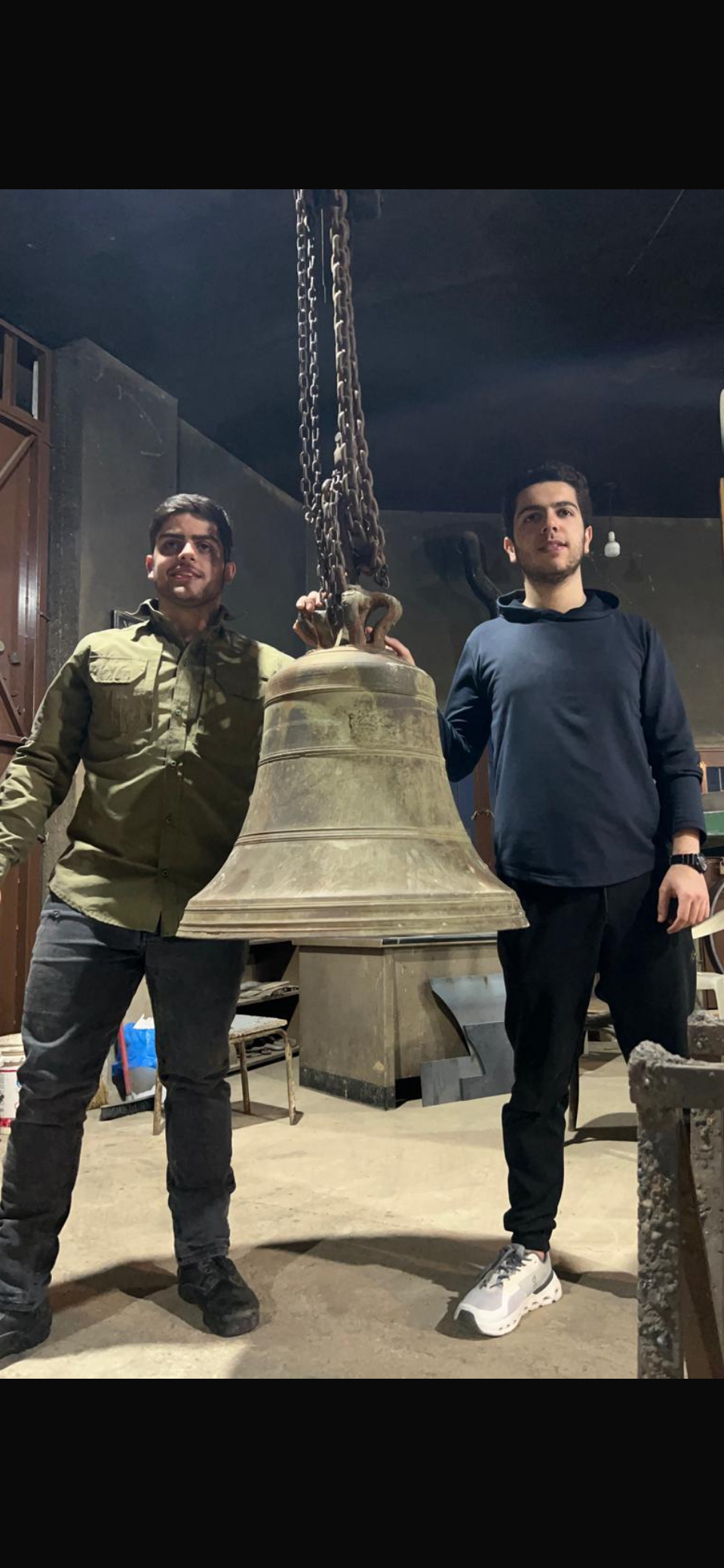
The two Naffah brothers.






When asked why he chose to pursue bell founding instead of a university education, high school senior Youssef Naffah responded: "My university is my father, Naffah Naffah. He has patiently taught me the intricacies of this craft since I was a child, passing down knowledge inherited from his father, grandfather, and great-grandfather."
In this village with 14 churches, the history of bells was a legacy passed down through generations within a single family, the Naffahs, who have jealously guarded the secrets of their trade.
"Until the 19th century, Beit Shabab was known for its traditional crafts of pottery, weaving, and bell foundry, with about 40 artisans, including 10 bell workshops and a single bell founder named Youssef Ghobril," stated Sharbel, Youssef's older brother, who was studying medicine at the Lebanese University. "Youssef Ghobril learned the craft from Russians who came to Lebanon, to the village of Dhour Shoueir in 1700. Skilled with his hands, he made guns and pipes from the tin he melted. He was then nicknamed 'Youssef Naffah' because the word 'naffah,' derived from the Arabic verb 'yanfah,' means to be useful."
During that time, more than 13 families were making bells in Beit Shabab. But after World War I, many artisans left the village, some died, others fled to Akkar, and a few even moved to Egypt.
"Today, there is only one bell foundry artisan left in the village and a single foundry in the whole country and the Middle East: my father, Naffah Naffah," said Youssef, who is preparing to take over from his father once he finishes school.
We have this craft in our blood
At age 9, while other kids played outside, Youssef and Sharbel spent their free time watching their father work in the factory below their house in Beit Shabab.
"We have this craft in our blood. It's part of our childhood. We grew up to the sound of hammers and the noise of this bell being forged for days," stated Youssef, his eyes fixed on the large tin molds that take all their time to dry and take shape. "Our father always took us along when delivering his bells. We were so proud to be part of this family that possesses this unique expertise in the region and the village."
Over the years, the two brothers split their time between their studies and working with their father in the family factory. But when it came time to decide on their future careers, Sharbel, talented in scientific subjects, chose to study medicine, leaving the factory to Youssef. "With the economic crisis and the country's challenges, this craft couldn't support two families. Plus, my university studies were time-consuming. A choice had to be made."
Youssef, passionate about the trade, knew from an early age that he would continue in the foundry. "My friends think I'm crazy and don't understand my decision. I tell them I'm lucky to have a clear future in a trade I'm immediately passionate about, while they embark on long studies unsure if they'll love the profession they've chosen!"
Staying to save the heritage
For Youssef, making bells is more than just a craft; it is a long and sacred ritual done with love and, most importantly, in stages.
"Each bell takes 40 days to two months to make, depending on the drying time for the clay," he explained. "You have to start by building the outer mold and then make another inner mold that matches the hollow imprint of the future bell, which is filled with molten metal, clay, copper, and tin — metals resistant to high temperatures."
"Once both molds are ready, we tackle the bell's crown in the same way. Then, we must smooth and erase the small cracks that can form on the drying molds to give them that smooth, scratch-free shine. Once the molds are dry, we'll fire up the kiln to full capacity at temperatures reaching 1,200 degrees," he added.
"No bell emits the same sound as those produced in Beit Shabab," Youssef said proudly. "By making our molds, we already know the sound we want the bell to have because we work with high precision, unlike other countries that work in series. Each bell produces a different sound according to its weight. The heavier it is, the deeper its chime."
Have they been affected by the economic crisis and the country's difficulties?
"Certainly," Youssef stated. "In the past, my father made 30 to 40 bells a year that he sold in Iraq, Egypt, Jordan, and Syria, where Christians still resided. Today, we produce between 10 to 15 bells annually."
This situation does not scare the young man, who intends to improve and perfect these techniques, maintaining the unique sound of these bells not found in any other factory.
"If I'd followed my friends' footsteps, most of whom are leaving the country to study and work abroad, who would be left to save this heritage and Lebanon's riches going to waste?" said the young man, convinced of his choice.
This article was originally published in French in L'Orient-Le Jour.