






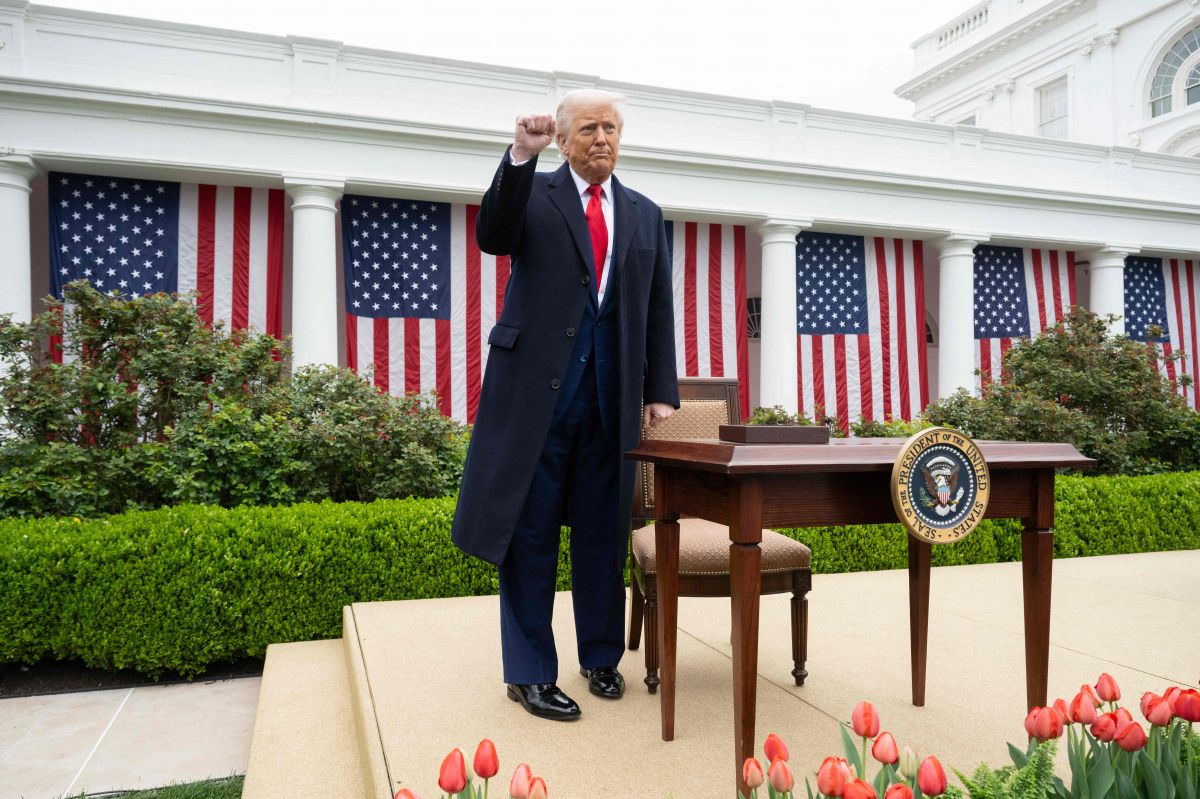
U.S. President Donald Trump after signing an executive order at the White House in Washington, on April 2, 2025. (Credit: Saul Loeb/AFP)






At least 10 percent for everyone starting Saturday, an additional 34 percent for China, 20 percent for the European Union (EU) ... U.S. President Donald Trump promised a mountain of new tariffs on most goods imported into the United States.
The sweeping penalties announced against the serene backdrop of the White House Rose Garden on Wednesday immediately unleashed turbulence across world markets and drew condemnation from other leaders now facing the end of an era of trade liberalization that has shaped the global order for decades.
The new import taxes are expected to bring in several hundred billion dollars per year to the U.S. federal government and are added to previous announcements by the president, determined to reverse the course of international trade.
As Asia digested the news on Thursday, stock markets in Beijing and Tokyo sank to multi-month lows, with U.S. and European stock futures also pointing to sharp losses as investors scrambled to the safety of bonds and gold.
What Donald Trump announced
The U.S. president declared that April 2 would be the “Liberation Day” for the United States, marked by sweeping tariffs almost across the board, with the highest taxes hitting countries deemed particularly hostile in trade matters.
Starting Saturday, April 5 at 4:01 a.m. GMT, products entering the United States will be subjected to an additional tariff of 10 percent (more precisely 10 percentage points), according to the presidential decree. A few days later, on April 9 at the same hour, dozens of countries will be targeted by custom surcharges based on calculations made by U.S. government teams.
Thirty-four percent for China, 20 percent for the EU, 46 percent for Vietnam, 24 percent for Japan, 26 percent for India, and 31 percent for Switzerland. All these tariffs are added to those that existed before Trump returned to office in January. China's increase is particularly severe seeing as the 34 percent is added to the 20 percent in place since Trump’s inauguration, reaching an astronomical 54 percent.
Even some tiny territories and uninhabited islands in the Antarctic were hit by tariffs, according to a list posted by the White House on X.
The exceptions
The White House noted that certain categories are not affected by the new tariffs: gold bars, pharmaceuticals, semiconductors, copper, lumber, energy products, and rare minerals on American soil. Steel, aluminum, and cars are also not included, but they are targeted by other surcharges.
The U.S.' neighbors, Canada and Mexico, covered by a free trade agreement (USMCA), are subject to a specific regime.
Canada and Mexico, the two largest U.S. trading partners, are covered by a free trade agreement (USMCA), already face 25 percent tariffs on many goods and will not face additional levies from Wednesday's announcement.
Other countries (Belarus, Cuba, North Korea, Russia) are also not on the list unveiled Wednesday because they are subject to U.S. sanctions, already blocking significant trade, the White House explained.
What has been implemented or is about to be
On March 12, Trump put in place an additional 25 percent tariff on imported steel and aluminum, regardless of their origin. These taxes have been expanded to apply to aluminum canned beers starting April 4.
An additional 25 percent tariff on imported cars came into force Thursday morning and similar taxes on auto parts are set to be enforced by May 3.
The case for China is once again particular: the 25 percent on steel, aluminum, and cars is added to the 20 percent surcharges which the U.S. imposed on Chinese products starting in February. This means cars and metals from China face an additional 45 percent tariff. The last batch announced Wednesday (up by 34 percent) will not increase this total.
What's in the pipeline
While Lumber, copper, semiconductors and pharmaceuticals weren't included on Wednesday's list, they are still in Trump's sights.
Trump also threatened countries buying Russian or Venezuelan oil with punitive tariffs.
Trump also signed an order to close a trade loophole used to ship low-value packages — those valued at $800 or less — duty-free from China, known as "de minimis." The order covers goods from China and Hong Kong and will take effect on May 2, according to the White House, which said the move was intended to curb the flow of fentanyl into the U.S.