






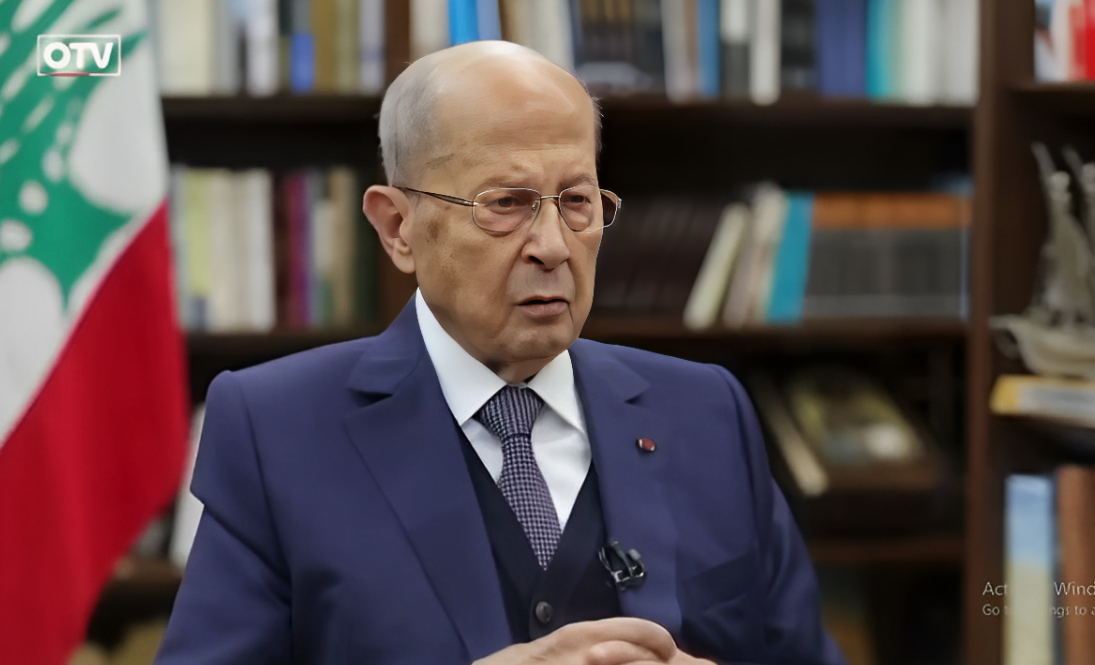






In an interview on the OTV channel, former President Michel Aoun, founder of the Free Patriotic Movement (FPM), stated that the political class must adhere to the rules set forth by the Constitution and opined that if an amendment was necessary to unblock the election, it should be done according to the rules established by the text.
He further called for not "renewing the experience of 2008," a reference to the consequences of the Doha Agreement which ended an unprecedented political and institutional crisis in Lebanon and established the return to dialogue and consensus as substitutes for the logic of confrontation. The implementation of the agreement, born following the power move initiated on May 7, 2008, by Hezbollah, with whom the FPM was allied, in an unprecedented attempt to counter a decision by the government of Fouad Siniora, led to the election of Michel Sleiman to the presidency.
As the parliamentary session on Jan. 9 approaches, intended to end two years of presidential vacuum that followed the end of Michel Aoun's term on Oct. 31, 2022, the controversy surrounding the amendment of the Constitution, notably Article 49, resurfaced. This text stipulates that judges and first-category civil servants (including the army chief) cannot be elected as head of state during their term or before two years have elapsed after their resignation from their post. This provision constitutes an obstacle to the candidacy of the army's commander, Joseph Aoun, who is among the favorites in the presidential race. 'The Constitution must be respected, and its modification should not be temporary nor for personal ends," Michel Aoun emphasized.
'Geagea has the right to run'
The comments made by the former president during this interview suggest that he wished to close the Baabda door to the army's commander. He, however, said that he was not fundamentally opposed to the candidacy of his political rival Samir Geagea, leader of the Lebanese Forces, and that he did not wish for the parliamentary session on Jan. 9 to be postponed, according to a transcription of the interview.
"Geagea has the right to run. We live in a democratic country," Aoun stated. Noting that none of the potential candidates for this election, supposed to end more than two years of presidential vacancy, "has a majority," he added that he "was not in favor of a postponement" considering the time that has elapsed since the end of his term on Oct. 31, 2022. "A president must be elected during a session comprising successive voting rounds," he added.
Commenting on the two-month cease-fire ongoing since Nov. 27 between Hezbollah and Israel, which has been violated several times by Israel, Aoun also judged that the fate of this agreement was "unknown" and that the current situation was "abnormal," criticizing the "ineffectiveness" of the monitoring committee linked, in his opinion, to its partiality.
Regarding the fate of Hezbollah's or other groups' weapons on Lebanese soil, Aoun stressed that "weapons must be placed under the authority of the state." He added that "the entry into the war [by Hezbollah and Israel] morally divided the country, but even those who disagreed fulfilled their social duties, which is important for national unity."
"I was against the war, but I do not judge and I refuse mockery. I advise everyone to do the same," he stated. "Palestinian weapons, inside and outside the camps, must be handed over to the state, as they are no longer useful. All weapons must be placed under the exclusive authority of the state. Regarding Hezbollah's weapons, the cease-fire agreement must be respected."
Fate of Lebanese detainees
On the question of regime change in Syria, after the fall of Bashar al-Assad following an offensive by the rebel coalition led by Hay'at Tahrir al-Sham (HTS), Aoun said that "stability remains to be achieved" and that "the errors committed until now must serve as lessons not to be repeated." When asked about sending a Lebanese delegation to Syria, the former president sidestepped, stating that this decision was up to the government. "It is the state that manages relations. Agreements can be concluded in various fields. We aspire to maintain a relationship with the Syrian State that goes beyond the previous regime and includes the people," he said.
Regarding the Syrian displaced persons in Lebanon, he said that they were not political refugees but people "displaced for security reasons," adding that it was up to the state to "communicate with the new Syrian authorities on this subject."
Finally, on the issue of Lebanese detainees in Syria, whose fate returned to the forefront with the fall of Assad, Aoun said that he had "a clear conscience."
"Say what they will, I fought and lost martyrs to drive Syria out of Lebanon [at the end of the civil war from 1975-1990], while others supported the opposing camp. From the first day, I said that a positive relationship with Syria should be established after its withdrawal from Lebanon,' he stated.
Since the opening of the prisons of Assad's regime, a hashtag accusing Aoun of being a "traitor" circulated on social networks. In 2008, the former president met Assad, who told him that there were no Lebanese detainees in Syrian prisons.
"My conscience is clear regarding the detainees. No leader before me had shown interest in this issue. During my first meeting with Assad, I asked him the question. He replied that there were convicts for crimes [of common law], but that no Lebanese political detainee was held," he said.
