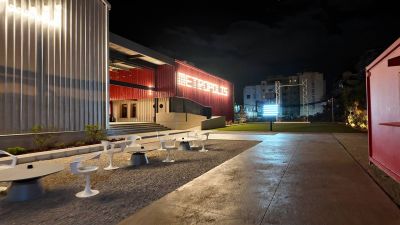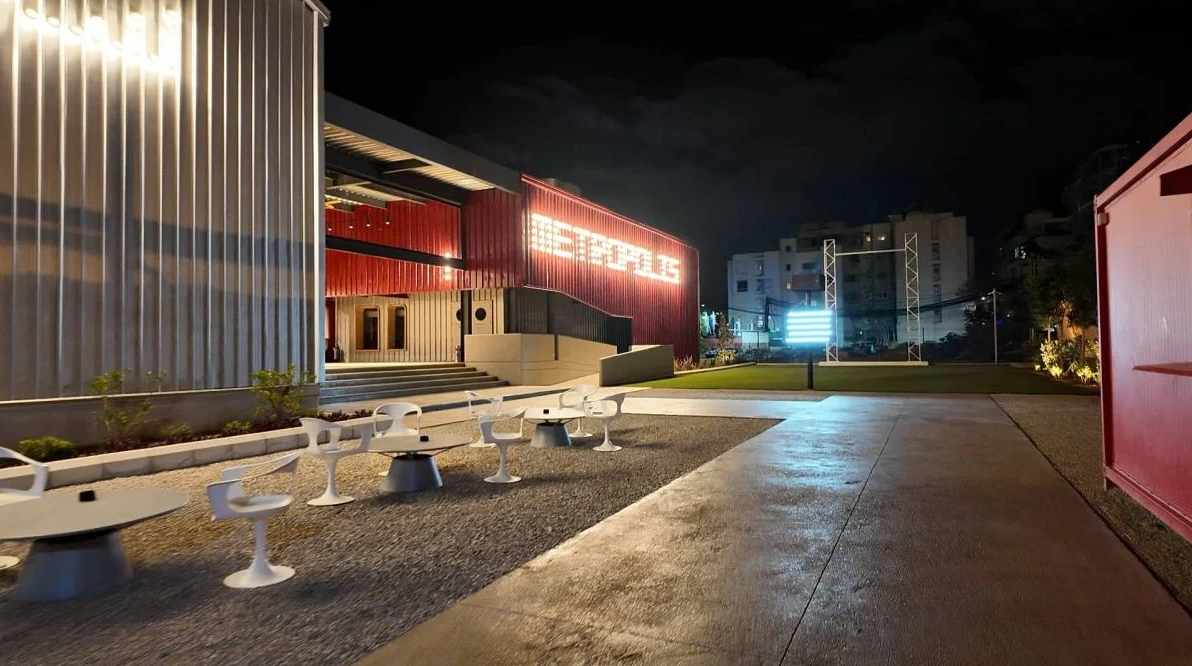
The new Metropolis premises in Mar Mikhaël. (Credit: Laurent Selinder/L'OLJ)






From war to crisis to war again, the Metropolis Association's adventure parallels that of Lebanon. Created in 2006, it was launched in a small theater in Hamra on July 11, 2006, on the eve of the outbreak of the Israeli war in Lebanon. The space was then transformed into a shelter for the displaced. To keep the families’ children from going outside and risking danger, the cinema-turned-shelter’s team showed them films. To this day, bringing young people into the world of cinema is still at the heart of the association’s mission.
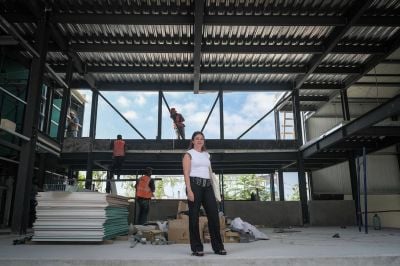
Despite the turmoil, Metropolis is holding firm, even after having to contend with the closure of the Empire Sofil cinema, whose theaters were sold off amid the economic collapse. It has now found a new home, in a new, lightweight structure that has taken shape on a vast plot of land in Mar Mikhael, not far from the sea. The prefabricated structure was designed by architect Sophie Khayat, who worked within specific parameters to meet the technical requirements of both a cinema and a variety of weather conditions.
Now, a fresh start, after five years as a nomad, and with a host of projects lined up. A return to the cinema and the collective experience opens up new horizons at a time when, in this part of the world, they may seem limited.
Focus on a fight
In 2020, as the economic crisis worsened in Lebanon, the Empire Sofil cinemas were sold, leaving Metropolis without a venue for its screenings. It was the pandemic and all the movie theaters were closing their doors.
This was followed by a double explosion at the Beirut Port on Aug. 4. “We didn't know what to do as Lebanese,” says Hania Mroueh, president of the association. “We wondered if we had the strength to go on. With coronavirus, everyone was telling us that cinemas were a thing of the past. We had great doubts. We talked to each other, then said we wanted to stay in this country and that, if we stay, it's to do what we like to do and what we know how to do.”
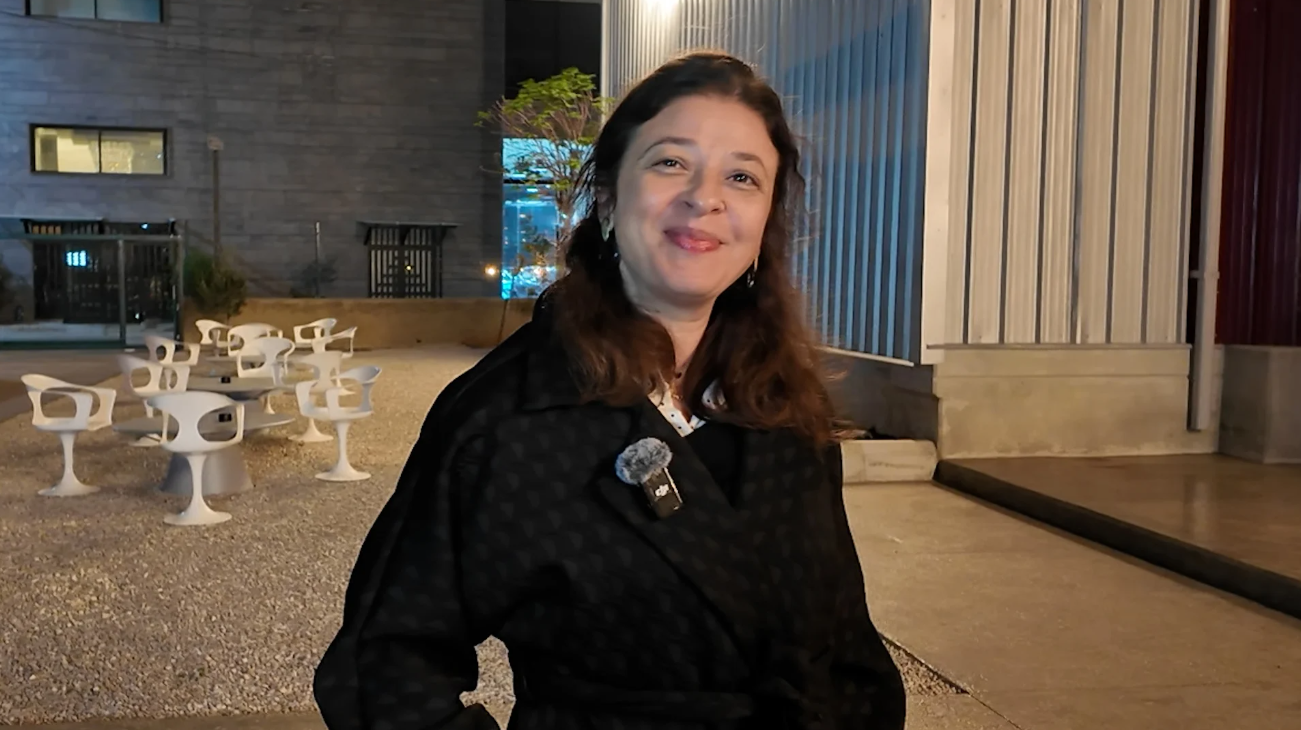 Metropolis Association President Hania Mroueh. (Credit: Laurent Selinder/L'OLJ)
“We decided collectively that we wanted to embark on this new adventure. At the end of 2020, we started looking for a venue, a hall, a factory or a school. We couldn't find one for various reasons: it wasn't technically suitable, or it was difficult to find a long-term lease, and so on,” she recounts. “In a moment of despair, we said to ourselves, never mind, let's build. Let's build a very simple tent if we can't afford it.”
Walking in Mar Mikhael, Hania Mroueh spotted this large plot of land. She made inquiries, and it turned out to be owned by the Unifoncière Company, whose shareholders include the Obegi Group and Peter Hrechdakian, who are making the land available to the association.
The road to reopening was littered with construction issues, permits, and other administrative delays, compounded by the withdrawal of promised support from certain European donors following the war in Ukraine, and again following the war in Gaza and then Lebanon, and by rising costs due to higher raw material and transport costs.
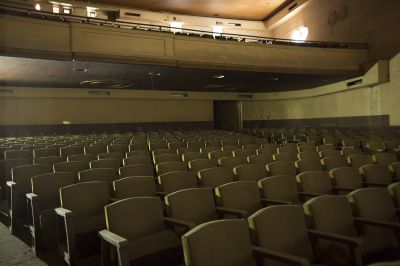
In spite of this, the Metropolis team is pressing ahead with its project, which has been made possible with the support of numerous individual and corporate sponsors, the Swiss Cooperation and the Norwegian Embassy, and above all the substantial support of the French Embassy and the CNC (Centre national du cinéma et de l'image animée in France) for the technical equipment. Other donors enthusiastic about the project contributed fabrics, aluminum, metal and tiles. Italian cinema operator Cinesuite sent beautiful wide, comfortable purple seats. After a year's work, it finally came together. “In other circumstances, it would have taken only six months,” says Mroueh says.
If Metropolis has managed to hold out, without walls, for four years, it's because the association has been able to program elsewhere. “One of the things that has saved us is that we haven't lost touch with the public,” Mroueh says. “We are very grateful to the structures that have welcomed us, such as the esplanade of the Sursock Museum, Ishbilia in Saida, Hammana Artist House and the Galaxy Center.”
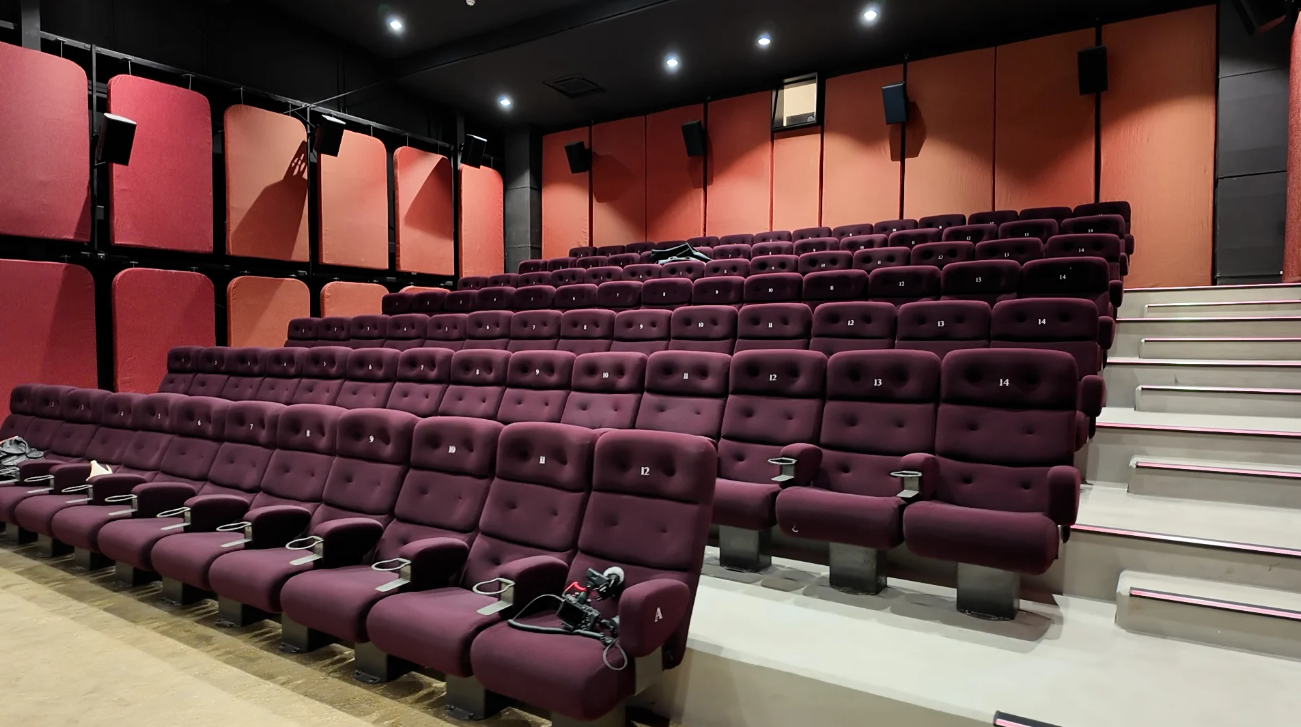 A 100-seat screening room with large retro-style seats in the new Metropolis premises. (Credit: Laurent Selinder/L'OLJ)
These on-the-job partnerships have enabled them to decentralize their activities and strengthen their investment in teaching. With partnerships forged with 65 schools, mainly French-speaking, Metropolis is committed to “staying in touch with tomorrow's audience,” young people to whom, in addition to activities in schools, it offers training in the various film professions in partnership with the Berlinale, also aimed at young film professionals.
An archive project and highly political decisions
During these roofless years, Metropolis’ Cinémathèque Beirut project, initiated in 2018, continued its work of archiving Lebanese cinema. It currently includes 500 films and the digitization of magazines, articles and film posters.
“When we wanted to organize retrospectives of Lebanese filmmakers, films we'd heard of but hadn't necessarily seen, we realized the concern for accessibility,” Mroueh says. “Films were scattered and sometimes lost. That's how we came up with the idea of listing them.”
In the absence of an official body responsible for preserving this heritage, many filmmakers, their heirs and cinephiles have taken it upon themselves to do so, as in the case of Jocelyne Saab and Maroun Baghdadi. “Their cinema is the history of Lebanon,” Mroueh says.
Cinémathèque Beirut mainly houses films produced from the 1980s to the present day, such as those by Ghassan Salhab, Hady Zaccak, Randa Chahal and many others. “We wanted to preserve them before we go looking for them in twenty years' time and say only yarét, if only.”
“The project isn't finished, it's ongoing,” she says. “What's special about this cinémathèque is that it's open to everyone, researchers and the general public alike, and anyone can discover or rediscover these cult — or not so cult — heritage films.”
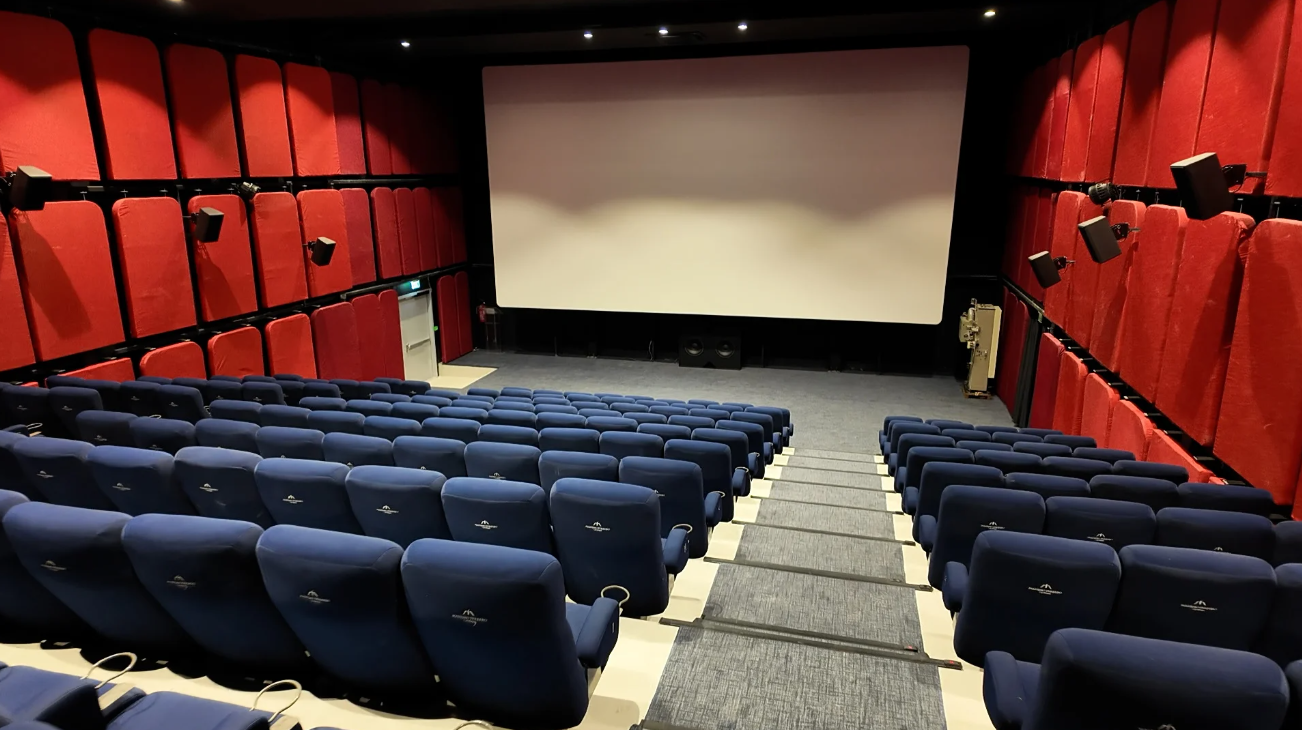 The 200-seat screening room of Metropolis in Mar Mikhaël. (Credit: Laurent Selinder/L'OLJ)
The Cinémathèque Beirut is not just a place for preservation and consultation, but also for exchange and reflection, she says. “It's very important for us to organize meetings and seminars … We also have to ask ourselves what it means to archive: what do we keep? What are we letting go? For what is not preserved — as we are obliged to let go given our means — will de facto be destroyed in the long term. The choice is a very political one.”
An audience that will bring it to life
Will audiences follow suit in this still uncertain post-war environment? Hania Mroueh believes “deeply” that they will. It's the public that's going to bring life to the two auditoriums, one with 200 seats, the other with 100, and a large garden area where there are plans for dynamic programs, including on opening night (Dec. 21) which will include film-concerts.
“I think we underestimate the experience of being in the theater, of being in the dark with strangers,” she says. “After the pandemic, we'd say it's time to stream at home. And yet, at the screenings we did, it was packed with young people I didn't know and who I was delighted to see in the room. You don't just go to see a film, but also not to be alone.”
Apart from the public, European filmmakers and programmers — such as those at Venice and Cannes — immediately showed an interest in coming to Lebanon. Mroueh says she is moved and delighted by this, and has some surprises in store for the public, as long as the security situation allows.
Fritz Lang's 1927 film of the same name, after which the association is named and which is listed on Unesco's Memory of the World international register, ends with a symbolic reconciliation marking the beginning of a new era of cooperation and harmony between the inhabitants of Metropolis — a megalopolis imagined in 2026 in a dystopian society — after the divisions and chaos. Here’s to hoping that fiction whispers to reality of this same rebirth.
Opening weekend program
Four short films made with archive footage from Egypt, Palestine and Lebanon are scheduled for Saturday Dec. 21 at 8pm. The filmmakers are Vartan Avrakian, Rania Stephan, Cynthia Zaven and Rana Eid, Joanna Hadjithomas and Khalil Joreige.
The silent films will be accompanied by a concert featuring live music by Anthony Sahyoun. On Sunday Dec. 22, at 7pm, the documentary A State of Passion, Ghassan Abou Sitta by Carole Mansour and Muna Khalidi will be screened, followed by a discussion with the directors and the Palestinian emergency doctor, the film's main character.
Upcoming programming
The year 2025 boasts a rich program, with "Les Écrans du réel" in January, featuring a majority of Lebanese documentaries, a children's festival followed by an Italian film festival in collaboration with the Italian Cultural Institute, an English film festival in collaboration with the British Council in June, and a new festival focusing on the Deep South: Africa, Asia, Latin America and the Arab world in April.