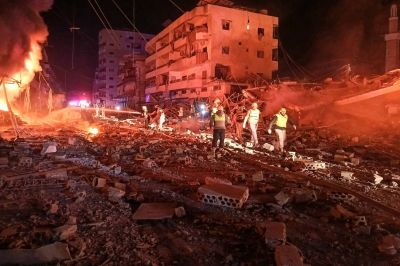
Rescuers battle flames after an Israeli airstrike targeted the industrial area of the village of Abbassiyeh, in southern Lebanon, near Sour, on Oct. 30, 2024, as part of the ongoing war between Israel and Hezbollah. (Credit: Kawnat Haju/AFP)






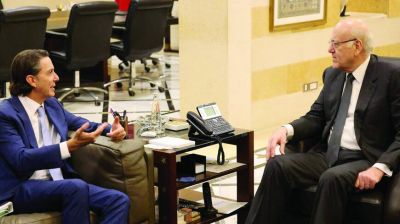
A draft of a U.S. proposal for a cease-fire between Israel and Lebanon has recently leaked to the Israeli press. Dated Oct. 26, 2024, this proposal was conveyed by the United States to Israel as part of discussions on the final version. It does not specify a date for the cease-fire to take effect, but U.S. negotiator Amos Hochstein arrived in Israel on Thursday as the Biden administration continues its efforts to secure a cease-fire and an agreement on hostages between Israel and Hamas in Gaza.
Additionally, outgoing Lebanese Prime Minister Nagib Mikati stated on Wednesday that he hopes for a cease-fire "in the hours or days to come."
This proposal notably includes an extended mandate allowing the Israeli army to enter Lebanese territory to counter threats from Hezbollah or any other organization. It also emphasizes the implementation of Resolution 1701, the deployment of the Lebanese army in southern Lebanon, and the role of the Lebanese army in disarming Hezbollah and any other militia.
The text specifies that "following discussions with the governments of Lebanon and Israel, the United States understands that both states urgently seek a lasting end to the current escalation of hostilities along the Blue Line and are both prepared to take actions to promote the conditions for a permanent and comprehensive solution."
Here are the key points of the proposal:
- The Israeli army will withdraw from southern Lebanon within one week at the latest after the cease-fire takes effect, and the Lebanese army will deploy its forces along the country's borders.
- The Israeli army will retain the freedom to attack Hezbollah and respond to threats along the border and inside Lebanon if the Lebanese government or any monitoring body under U.S. auspices fails to do so. Threats include the production and storage of weapons, movement of heavy arms, ballistic missiles, or medium and long-range missiles.
- The Israeli air force will be allowed to continue to fly over Lebanese airspace to gather intelligence and monitor the situation.
- The Lebanese army will be the only armed body, aside from UNIFIL, allowed to operate on Lebanese territory. It will be responsible for blocking the entry of unauthorized weapons and munitions at its borders and dismantling weapon and ammunition production facilities operated by armed groups in the country.
- From the moment the cease-fire is declared, the parties will have 60 days to fully implement it. During these 60 days, the Lebanese army will gradually increase its forces in southern Lebanon.
- The U.S., Israel, and Lebanon will establish a joint mechanism to oversee and enforce the terms of the agreement. Israel and Lebanon will be able to report any violations of the agreement to a monitoring body.
- The proposal calls for the implementation of U.N. Security Council Resolution 1701 from 2006 and affirms U.S. support for Israel in ensuring that Hezbollah and other armed groups do not establish themselves in southern Lebanon.
- Israel and the U.S. will share sensitive intelligence regarding violations or suspicions of violations of the agreement from the Lebanese side. This intelligence will be passed on to the Lebanese government or another monitoring mechanism for action against the violations.
According to the U.S. media outlet Axios, negotiations for a cease-fire between Israel and Hezbollah have significantly progressed in the past 24 hours, but the Biden administration has not reached a final agreement with either Israel or Lebanon, said two U.S. officials with direct knowledge of the matter. Axios also reported that a cease-fire agreement would end more than a year of fighting between Israel and Hezbollah and significantly defuse regional tensions in the Middle East for the first time since the Hamas attacks on Israel on Oct. 7. This would be a significant achievement for President Biden in the final months of his term.