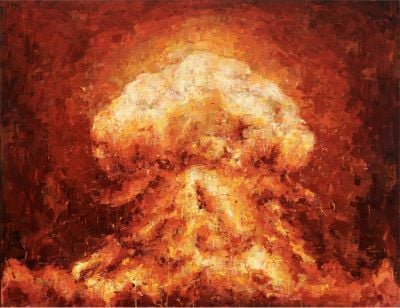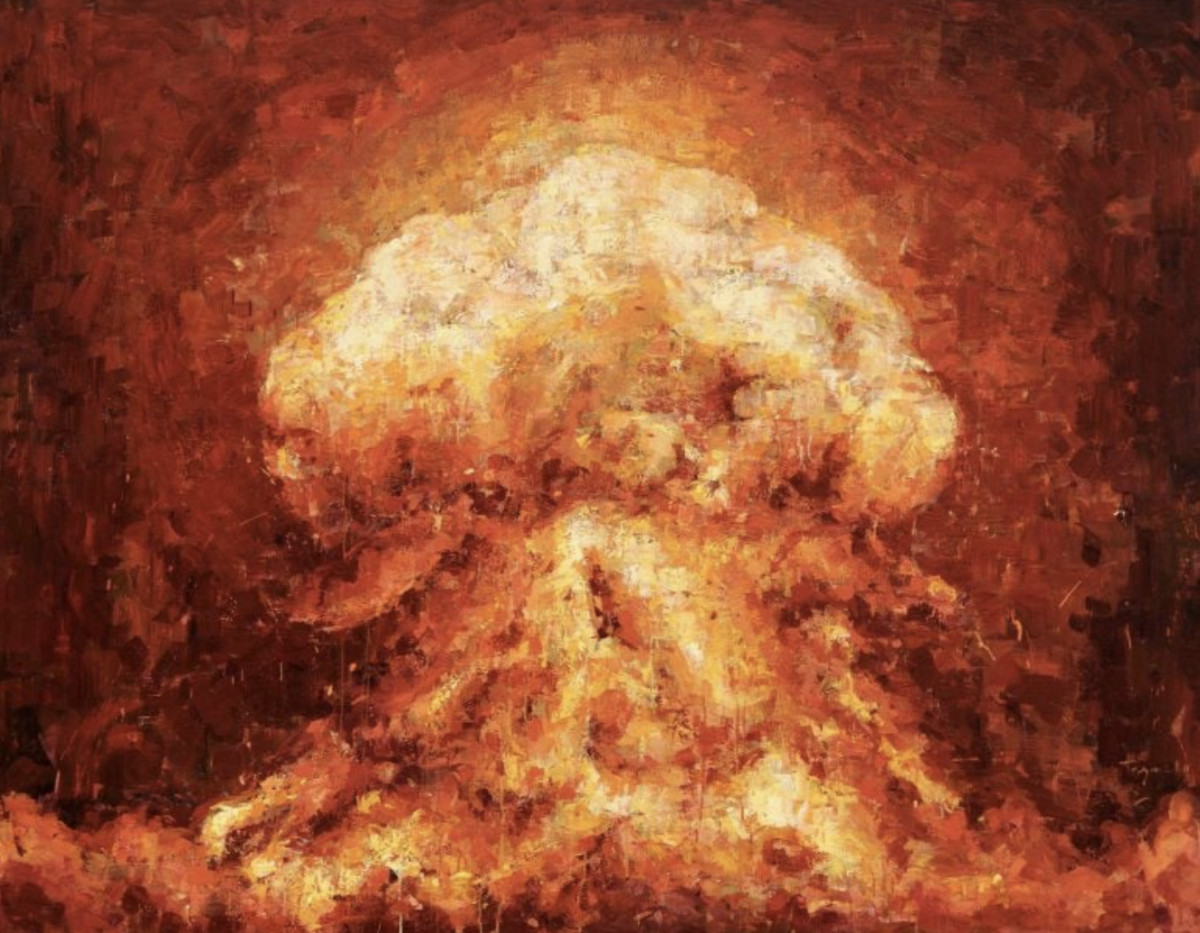
A canvas from the "Brighter Than a Thousand Suns" series by Tagreed Dargouth (150 x 200 cm ; 2011; Dalloul Foundation collection). (Credit: Courtesy of the artist and the Saleh Barakat Gallery)






Night after night, the southern suburbs of Beirut blaze under Israeli strikes. Night after night, the images of these glowing orange masses rising into the darkness of the sky and broadcast on social networks inflame the retinas and twist the guts of those lucky enough not to be direct victims.
 Flames and smoke rising over the southern suburbs of Beirut on Sunday night, Oct. 6, after a violent strike by the Israeli air force. (Credit: Fadel Itani/AFP)
Images of the hell of war par excellence, these mushrooms of smoke and fire above the southern suburbs captured by the cameras of press photographers strongly evoke a series of canvases painted by Tagreed Dargouth some 15 years ago, entitled "Brighter Than a Thousand Suns."
The Lebanese artist, who has often painted war, its instruments and its corollaries, talks to L'Orient-Le Jour about the genesis of this series representing variations on the theme of explosions, as well as her feelings at seeing her apocalyptic paintings become the mirror of a terrible Lebanese reality.
"In 2009, I began my first series of atomic mushroom paintings in response to the growing fears and discussions surrounding the Iranian nuclear project. My research into the nuclear weapons industry took me back to the Second World War, where I discovered the fanciful nicknames attributed to bombs, particularly as part of the British nuclear program known as the 'Rainbow.' This 'rainbow of terror' lined up color palettes associated with random animals and objects, such as 'Blue Bunny,' 'Green Grass,' 'Red Moustache.' Giving such cute, childlike names to instruments of mass destruction deeply disturbed me. It highlighted a dark truth: To inflict massive damage on innocent people, you first have to dehumanize them."
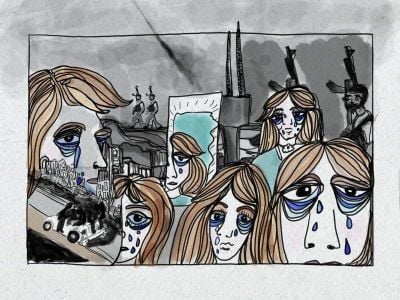
"To me, the aim of this series was to remind us of the horrors of the bomb. Unfortunately, the tragedy of Aug. 4, 2020, rekindled this fear. On that day, I left my studio in Mar Mikhael a few hours before the double blast in the port of Beirut. When I returned, it was completely destroyed. It made me realize that witnessing such a terrible scene is profoundly different from simply depicting it on canvas. I felt compelled to paint a new series of explosions, this time directly inspired by the one in the port. This double explosion was a wake-up call for us Lebanese, especially after the financial collapse and the persistent failures of the current system," the artist said.
"Today, once again, these canvases have resurfaced. Seeing Beirut and the whole country endure such violence breaks my heart. I did these paintings to archive past atrocities, not to document the current bombardment. Sadly, I see once again that to inflict massive damage on innocent people, you must first dehumanize them,” she concluded.