






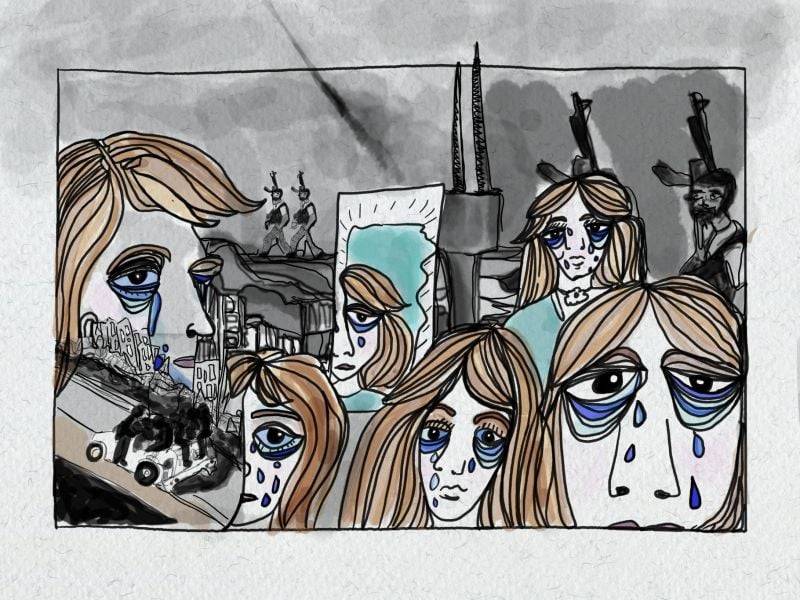
Feyrouz, Lebanon's only "symbol of national unity"? (Illustration Jaimee Lee Haddad/L'Orient-Le Jour)






Sitting in the middle of a dusty balcony decorated with a few pots of dying flowers, Nouhad starts her second pack of cigarettes of the day. It is not even noon that this flirtatious octogenarian with violet eyes "like Elizabeth Taylor" is already getting ready for a quick nap before lunch.
"For ten days, I have done nothing but smoke, eat and sleep. These are the only activities that do not make me cry or die of grief," said the woman who, on Sept. 25, had to once again leave her residence in Sour in a south Lebanon besieged by incessant Israeli strikes.
Taking refuge with her sister Claudette in a cramped village on the mountains of Kesrouan, Nouhad does not hide her concern at seeing her "house of happiness" destroyed by a war whose "stupidity" she cannot describe without holding back.
"Have you seen what they did to Gaza? Why let them do the same to our south? We didn't ask for anything, we didn't cause anything!" she stated, the veins on her face showing and a Vogue held between the tips of her silver-colored nails.
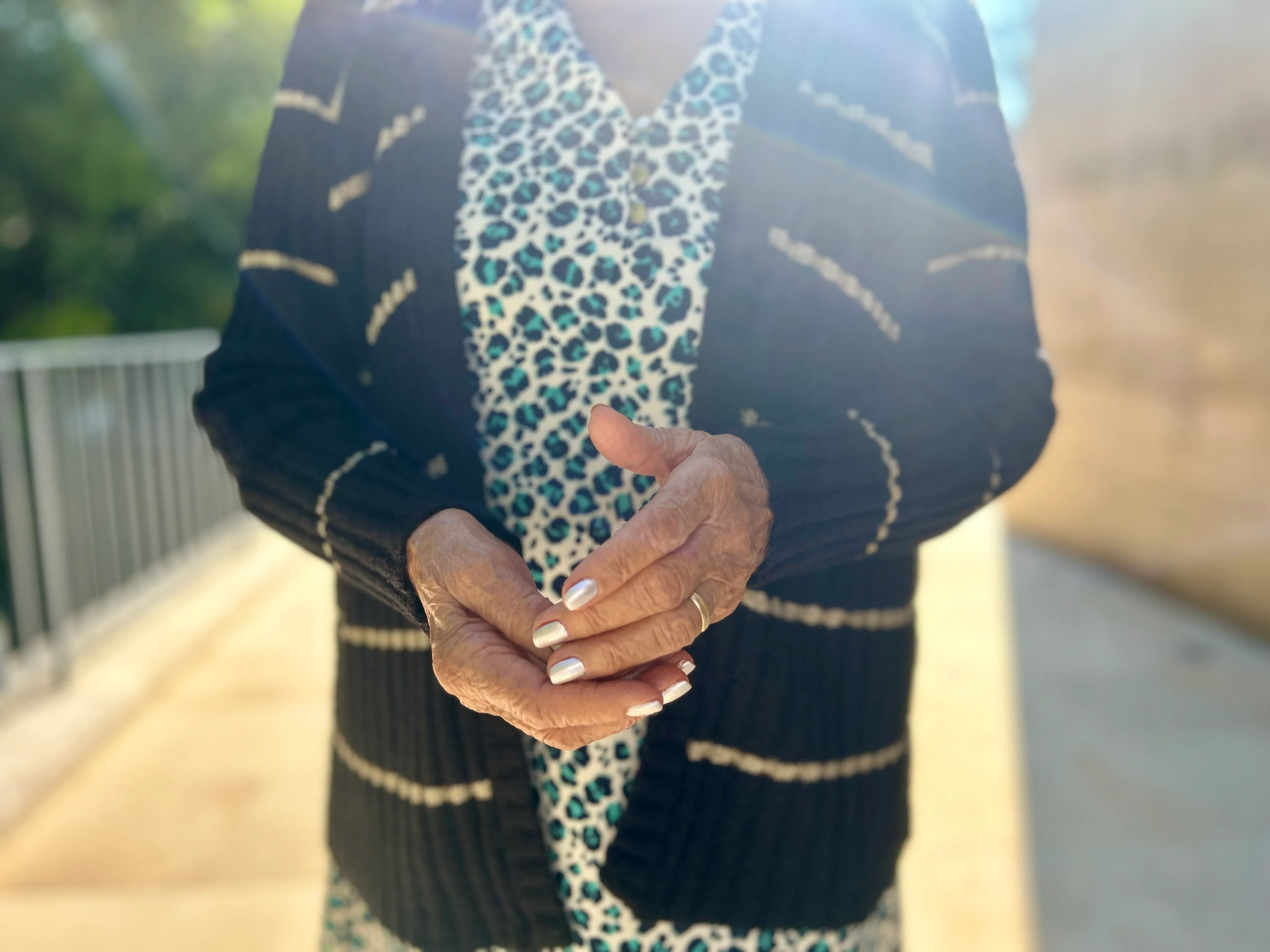 Nouhad, displaced from south Lebanon, does not want to show her face. (Credit: Karl Richa)
For ten months, the grandmother of five little girls refused to give in to the screams and worries of her sons, both of whom live on the African continent, calling on her to immediately leave the land on which she grows her apples and pomegranates.
While the city of Sour has been relatively spared since Oct. 8, 2023, and the opening of Hezbollah's “support front” for Gaza along the border with Israel, the intensification of the conflict and the rapid escalation that followed the explosions of pagers and walkie-talkies of relatives and leaders of the party made the Byblos native understand that a “scenario worse than that of 2006” would be inevitable.
“So I put clean clothes in a bag, begged and paid a family friend to drop me off in Saida and took the rest of the way by taxi to here,” she explained, her gaze lost.
Living alone since her husband died one morning in October 1989, a collateral victim of a clash between two Christian militiamen while he was out shopping in Beirut, she continues: "Like many Lebanese, like all those who live in this south Lebanon of heroes, I spent my life between two wars, two deaths. However, I was a local star at one time," she is keen to point out. "I who sang behind Feyrouz, I who have known the most beautiful lights of the stages of the Arab world, I am now nothing more than an old woman who sheds tears for her homeland."
Go back to town
With photo albums left in her living room, the desire to remain discreet intact, "for fear that Rima Rahbani might get involved," Nouhad claimed, without much conviction, that she wanted to preserve the modesty of her late husband, a man of different faith and beliefs than hers, whom she married in the 1960s.
"He was Shiite, I am Maronite. He only knew Sour, I had never been lower than Beirut," she said, adding that she met her "darling" in a trendy club in a bustling capital that vibrated to the rhythm of jets transporting French starlets and transalpine socialites.
"We were in love, convinced that our parents would be understanding. As a result, they didn't speak to us until our children were born," Nouhad stated.
"I am anything but fatalistic. If you are looking for unfortunate stories of displaced people, I am not the one who will tell them to you," she warned. "Because I refused to comply with the rules of my husband and my very conservative environment. I had a grain of voice, I wanted to sing. Even from my terrace in Jnoub where only the birds could hear me, I wanted to sing."
It was then her well-planned meeting with Halim al-Roumi – Majida's father and a scout for great voices including Feyrouz – during a talent competition in Jezzine, one summer evening in 1969, "when I was married, with my eldest," who would open the doors to the shiny parquet floors.
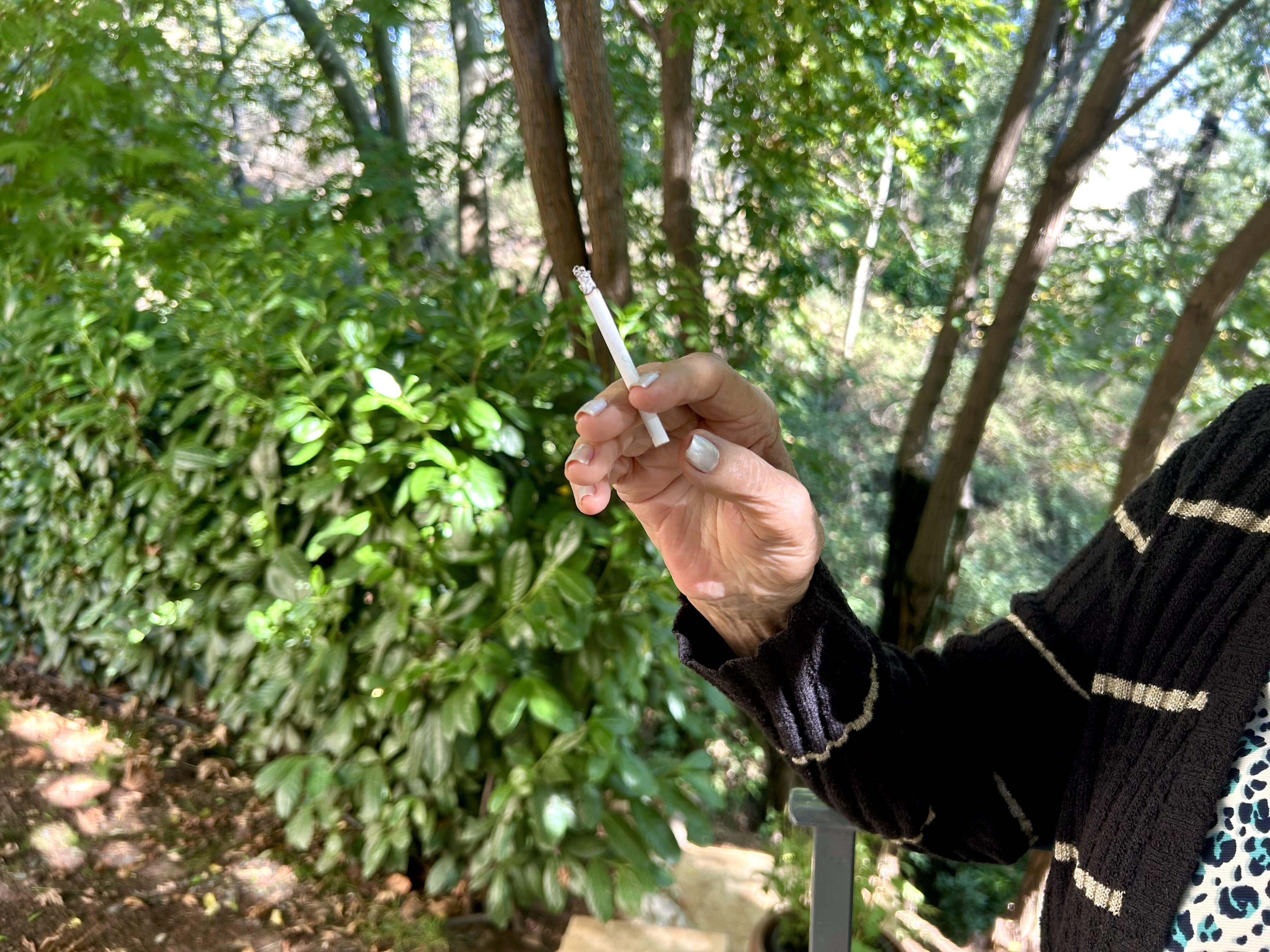 On the balcony, Nouhad smokes one cigarette after another to “kill time.” (Credit: Karl Richa)
Charmed by the explosive frankness of a horde of semi-ambitious teenage girls, the latter secured her a meeting with the Rahbani brothers and a place of choice in one of the many choirs orchestrated by the composer duo.
Promise kept. Nouhad then found herself, baby in her arms and sober outfit on her back, four meters from the one with whom she shares a first name and an incandescent desire to shout her attachment to the Palestinian cause. "Like her, I needed to chant a pan-Arab patriotism through hymns-tributes to Jerusalem," she admitted between two anecdotes about an omnipresent spouse, only half-accepting to "lose his wife" for the duration of rehearsals that often lasted all night. "We had to find a small apartment near Hazmieh that I paid for myself with the money I made in the restaurants where I sang. Working with giants was a huge life lesson, but everything was not rosy. Far from it."
Vocation ruined
From recitals to plays, the lesser-known of the two Nouhads cultivated a fascination for the "first lady of Lebanese song," as the press between Amman and Damascus nicknamed her at the time. Careful not to disturb an icon shaping her myth in the firmament of the seventies, the singer nevertheless witnesses Assi Rahbani's violent fits of rage as well as the weariness that Feyrouz feels on a personal level.
"At the time I worked with them, it was clear that their union was dead and buried, but their artistic collaboration had to be their absolute priority," she recalled.
But if she accompanied part of the troupe for the diva's triumphant tour of Canada and the United States in 1971, the latter would hardly speak to her. "It must be said that she was not really interested in the staff and the people around her. Feyrouz, we cannot criticize her, but well, she was getting lost in a disconcerting, disturbing traditionalism and melancholy."
Following the American episode, cooperation became rarer, the phone rang less and Nouhad, who was expecting her second child, returned to Sour under pressure from her partner.
"I didn't hold it against him. I was in my thirties, it was too late to make a career. The start of the civil war in 1975 only confirmed my choice to become a full-time mother again."
Then begins one of the most tragic chapters of an already frail nation, "made of bombs, traitors and fragile lulls. We managed to hold out until the Israelis came to haunt our nights and our alleys like yet another snub," Nouhad said. "After the invasion of 1982, I never thought I would live this nightmare again. But here we are, more than 40 years later. Still victims of the Israeli government. But Feyrouz, where is she? What does she think of all this? She is the definition of our national unity. She has to say something!"
The age of comfort
With her moujadara on the fire, a recently adopted kitten on her lap and an unchanging cheekiness rediscovered, it is in front of her sister, more discreet, that stormy or happy memories come back to punctuate a chaotic discussion, from her arguments with the impressive mustachioed impresarios backstage at some of her performances in the Kaslik pubs to her "reckless love" for this post-2006 south Lebanon, vibrant with hope and youth.
"I saw kids helping their parents rebuild their stone house when they came home from school. How can you not love these people?" she asked, readjusting her freshly dyed hair.
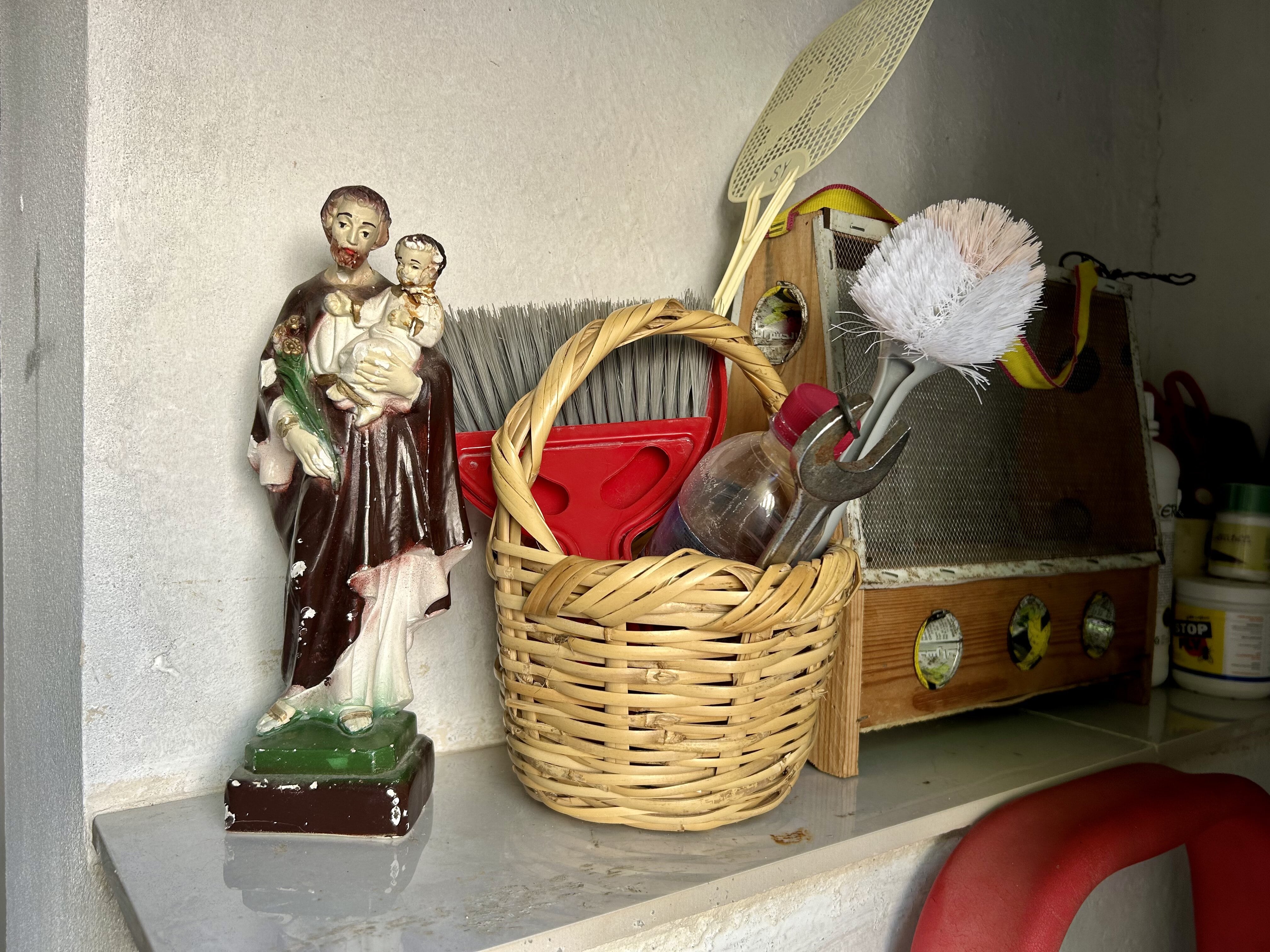 At his sister's in Kesrouan, Nouhad says she "barely stays away from the south." (Credit: Karl Richa)
For this former voter of the Amal movement – she said she distanced herself from Nabih Berri's political party since her "democratic awakening" during the Oct. 17 popular uprising – the announcement of the assassination of Hezbollah leader Hassan Nasrallah in an Israeli raid in the southern suburbs of Beirut on Sept. 27 "will only make the situation worse and lengthen my stay far from my wardrobe, my bed, the lemons and the sun of Sour."
Physically weakened since a major back operation, worried about her elderly neighbors who struggle to move and preoccupied with having to assess the possible damage from the strikes that have already targeted her vast garden, Nouhad no longer hides her anger.
"When you're almost 83, you'd like to be able to enjoy life, your descendants. But here in Lebanon, that's clearly too much to ask ... Where did my lighter go?"
This article originally appeared in French in L'Orient-Le Jour.