






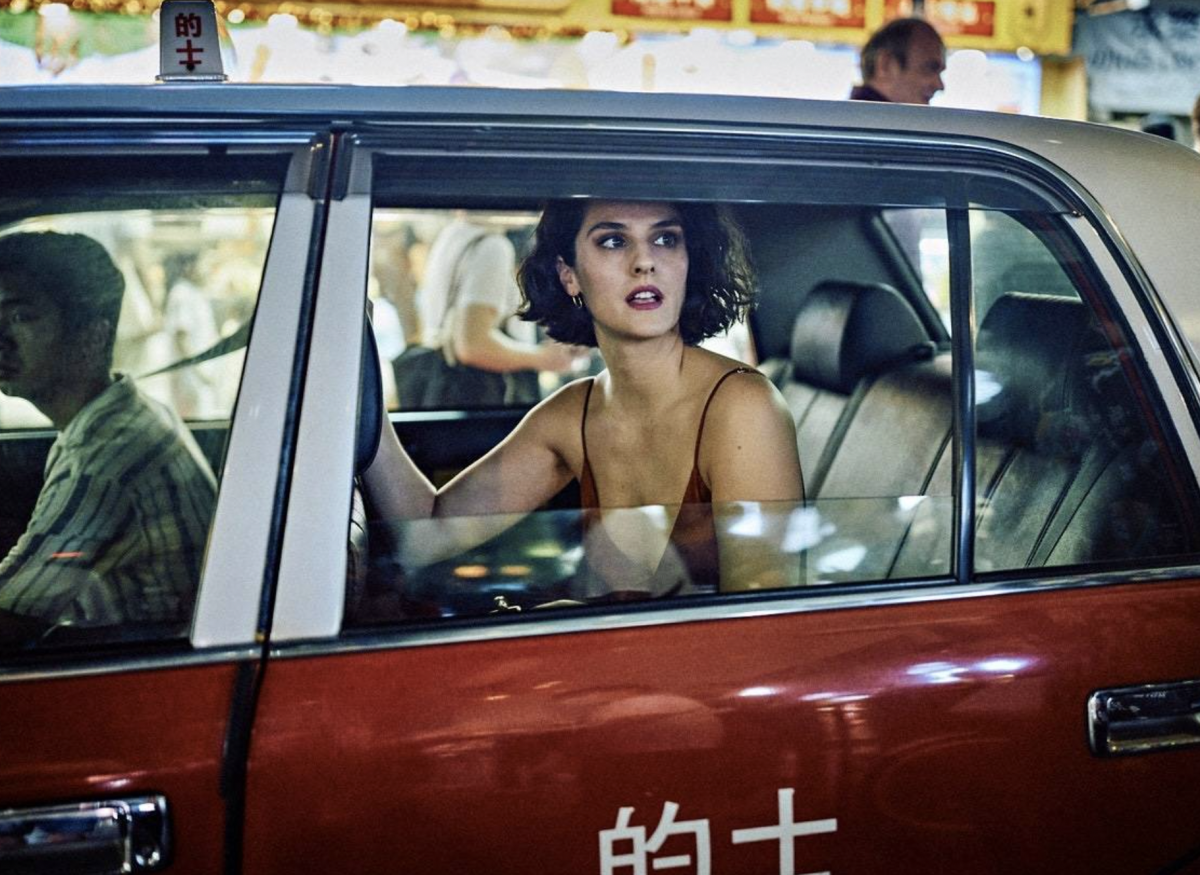
For Audrey Diwan, Noémie Merlant is "Emmanuelle." (Credit: Pathé)






She observes, seduces, assumes herself. On board a plane linking the frigidity of Paris to the muggy heat of Hong Kong, a stranger's interested gaze lingers on her silhouette. With a wink and a discreet gesture of the hand, she invites him to follow her into the first-class toilets, where, without a word spoken, without any desire to know the identity of the other, a sexual romp occupies the confined space.
Faced with the mirror and this reflection of eternal dissatisfaction, the young brunette guides her partner and abandons herself. It's time for satisfaction. The satisfaction of giving more than receiving. The satisfaction of proving to yourself that you can please without feeling any desire whatsoever. In half a century, the story "Emmanuelle" has changed.
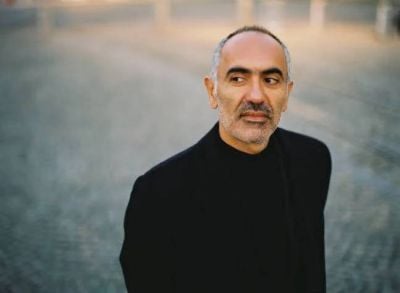
Behind the camera, Audrey Diwan lets things happen. Demanding but in symbiosis with Noémie Merlant, her lead actress, strict but open to discussion as well as compromise, the director readjusts the myth in her own image, feminist and totally in tune with an era constantly analyzing itself. "With this film, I wanted to find out whether eroticism invariably has its place in our societies, whether we could tell a story about the body by showing less of it, by restricting the frame to engage the viewer's imagination," she explained to L'Orient-Le Jour.
 Audrey Diwan and Noémie Merlant on set in Hong Kong. (Credit: Pathé)
Fifty years after Just Jaeckin's film adaptation of Emmanuelle Arsan's 1959 novel, the opus continues to arouse curiosity and delectable scandal. With its rattan armchair, crude dialogue and Pierre Bachelet soundtrack, the legend persists. But can it be adapted to the contradictions of the 21st century?
Repressions and curiosities
"Emmanuelle" is first and foremost the story of a naked physique that offered itself to a conservative France stuck in its prejudices. Frustrated and repressed in the land of the Enlightenment, thinkers and creators still faced censorship under de Gaulle and Pompidou. To transgress, the intellectual alibi must be solid. Arsan's book, published without the author's name and without any mention of the publishing house, was sold underground for almost a decade, until the month of 1968 liberated speech, but not yet bodies.
Giscard's promise of more "public freedoms," Bernardo Bertolucci's "Dernier tango à Paris," Marco Ferreri's "Grande bouffe" — to a much lesser extent — attracted a bourgeois audience, signaling the openness of traditionalist right-wing voters to an auteur cinema where pornography was not the issue. With these successes bolstering their desire for artistic violations, a handful of powerful producers approached Jaeckin, a famous fashion photographer, with the idea of adapting the sultry bestseller for the big screen. In this novel, which has sold 10 million copies, a diplomat's wife has a series of whirlwind adventures, lost in a relationship that can no longer support itself.
 Sylvia Kristel in 1974, the first "Emmanuelle." (Credit: AFP)
The filmmaker, also up against the established order, fought to have his feature film shown in cinemas. Although the film was banned for under-18s, Jaeckin won the politico-social tug-of-war that shook both the government and Paris's upper class. What followed was a steamy, torrid summer in 1974, marked by stormy debates about hitherto undiscussed female sexuality, and by the innovative gestures and spirit of an unknown Dutchwoman, Sylvia Kristel (who would later describe the saga as "a gift and a burden") whether hailed for her acting or decried for her role as a woman-object.
Free or liberated?
"I had only watched 20 minutes of the first film. When the producers handed me the book, I first read it recreationally with no ulterior motive. But it got me thinking. I imagined a new setting, a woman without pleasure. Because they do exist," explained Diwan, who then set about writing with Rebecca Zlotowski a modern, ambitious, stunned Emmanuelle 2.0. "I wanted to make a clean sweep of the past, to forget the injunctions previously made to her story, even if I certainly underestimated the significance of the name," admitted the director.
Emmanuelle, played by Noémie Merlant, is no longer waiting for her husband. As a single woman, she surveys the world's skyscrapers, commissioned by a major group to assess the quality of five-star hotels. In the heart of China's financial capital, an icy universe emerges and is captured like a long advertisement for luxury fragrances.
Between endless meetings chaired by Naomi Watts' character and supervising the work on an expanding establishment, Emmanuelle tries to reconnect with her desires. With men, women, in twos, threes or alone, her self-exploration is uninhibited, but shown in moderation. "In dedicating myself to my task, I've noticed that we've only let directors make films about women's enjoyment if women could give it. I was fascinated and upset by this," confessed Diwan. "It wouldn't have been done my way if #MeToo hadn't existed," she added.
 Audrey Diwan watching the day's rushes. (Credit: Pathé)
If she admits that French actresses had no trouble getting naked, it's "mainly because they had no choice." Under the yoke of a silent constraint, female performers found themselves forced to flaunt, often in spite of themselves, their plasticity in order to continue acting, and to meet the demands of all-powerful gentlemen who portrayed them as prey. "It's only in recent years that the industry has started to listen to the victims. On set, we worked with intimacy coordinators to make sure that every sex scene made sense," argued the 2021 Golden Lion winner.
Cuddly nights and reviews
Diwan's often chilly, sometimes cerebral script allows her Emmanuelle to wander in an overly air-conditioned atmosphere, even if it means annoying the die-hards of the 70s epic. "The divide is above all generational. The older girls won't touch, the younger ones hold back or are devoid of desire, while others will say that Emmanuelle isn't sexy anymore. It's not a question of holding back, but of understanding that eroticism lies in what we hide," said the filmmaker, as the harsh criticisms piled up in the columns of French newspapers and magazines.
The feature-length film previewed at the 72nd San Sebastian Film Festival did not receive the praise expected by international cinephiles, who predicted a place for it in the Cannes or Venetian awards lists earlier this year. "I assume that. This feminist vision is part of my intellectual make-up, my complexity, my experience and my Lebanese roots. Provocation is easy, and it's too late to give in to it," said Diwan.
 Noémie Merlant, the "Emmanuelle" of her time. (Credit: Pathé)
A sensual narrative takes shape in a sip of water, a masturbatory ice cube, a storm and immediate embarkation on forbidden journeys in camera-monitored cabins. "Emmanuelle in 2024 is about a woman reconnecting with pleasure and the rediscovery of a body: Plain and simple," analyzed the originally Lebanese screenwriter. "But now it's your turn to tell me. What's it like in Beirut?" she asked on the eve of the film's release in French cinemas on Sept. 25.
This article was originally published in L'Orient-Le Jour.
