







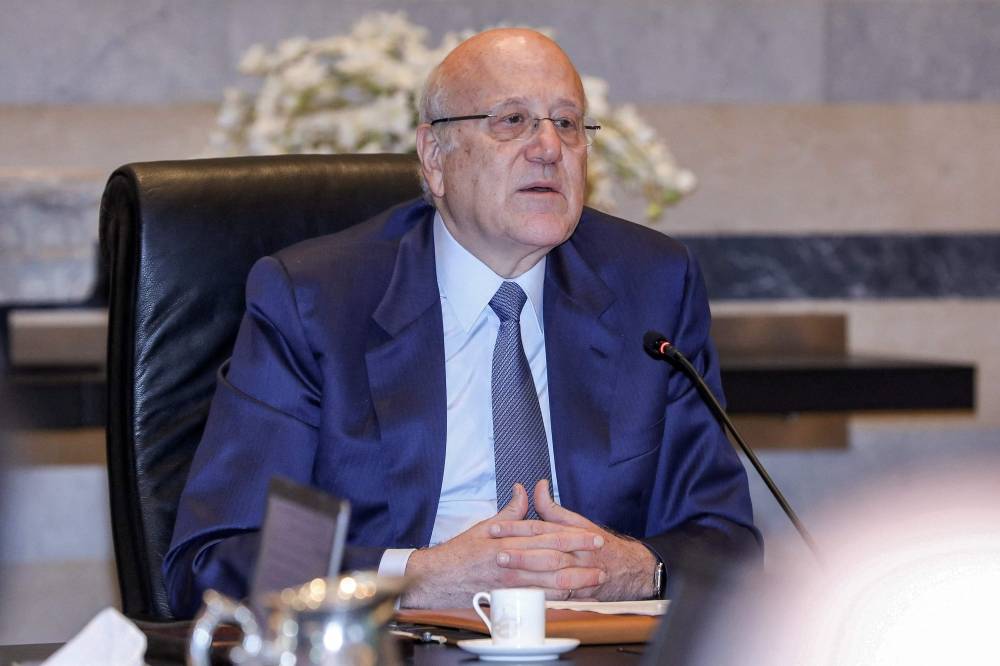
A handout picture provided by the Lebanese photo agency Dalati and Nohra shows prime minister Najib Mikati chairing a cabinet meeting at the in Beirut on Dec. 5, 2022. (Credit: AFP/HO/Dalati and Nohra)






Want to get the Morning Brief by email? Click here to sign up.
The cabinet approved funding for the Lebanese Army, medicine imports, Health Ministry-insured patients’ treatment costs and road maintenance yesterday, during a session boycotted by seven of the government’s 24 ministers. Caretaker Prime Minister Najib Mikati said that holding the meeting was a matter of “responsibility,” referencing the potential harm wrought by unsettled bills on state-insured patients receiving dialysis and cancer treatments. Critics, namely the Free Patriotic Movement, said that convening a caretaker cabinet amid a presidential vacuum constitutes something between an overstep and a power grab; Mikati, after the meeting, restated his disinterest in exercising presidential prerogatives.
Mobile network operators Alfa and Touch employees either launched an open-ended strike yesterday or are working as usual, depending on who you ask. Alfa and Touch employees and management issued contradictory statements, the former claiming “a work stoppage” in response to unhonored promises and the latter announcing yesterday “would be a normal working day, as well as the days to come.” Cell phone employees’ union head Marc Aoun cited a backlog of annual salary increases unimplemented since 2018 and disparate raises and promotions received by only one-fifth of employees. An undisclosed agreement between the Telecommunications Ministry and mobile operator employees in September ended a strike to demand increased wages. Earlier this year, new mobile telecom tariffs came into effect with a significant increase to customers’ bills; mobile telecom employees’ salaries did not meet a similar increase, apparently.
A depositor who handcuffed himself in a Metn bank in an attempt to retrieve his own funds left the premises with a verbal commitment from the manager. “Internal Security Forces were deployed to the scene and the bank was evacuated,” the depositor told L’Orient Today after leaving the Lebanese Bank for Commerce (BLC Bank) branch with a promise from the manager to respond “within a few days” to his request for a withdrawal to cover medical expenses. Depositors have repeatedly attempted forcibly withdrawing their foreign currency funds after their access was heavily limited by informal banking restrictions in 2019. A World Bank report published last month claimed Lebanon’s financial losses are “too big to bail,” linking “bank raids'” to “the delay in the implementation of a meaningful and equitable banking resolution.” While local depositors struggle to access their accounts, foreign judiciary rulings have repeatedly declared Lebanese banks must return funds to clients.
Al Saqi Books, a Lebanese expatriate-founded London bookstore specializing in Middle Eastern books and a “home for the Arab diaspora,” announced that financial difficulties have forced the decision to close the establishment's doors at the end of this year. Lebanese emigrants André Gaspard and Mai Ghoussoub founded Al Saqi in 1978, amid Lebanon’s Civil War, which proceeded to become a “specialist Arab-world bookseller sourcing our stock from the Middle East and North Africa,” as described by bookstore owner/director Salwa Gaspard. Al Saqi is survived by two publishing houses: the London-based English-language Saqi Books founded in 1983 and the Beirut-based Arabic-language Dar al Saqi founded in 1991.
In case you missed it, here's our must-read story from yesterday: “The fight against corruption: Where to begin?”
Compiled by Abbas Mahfouz