






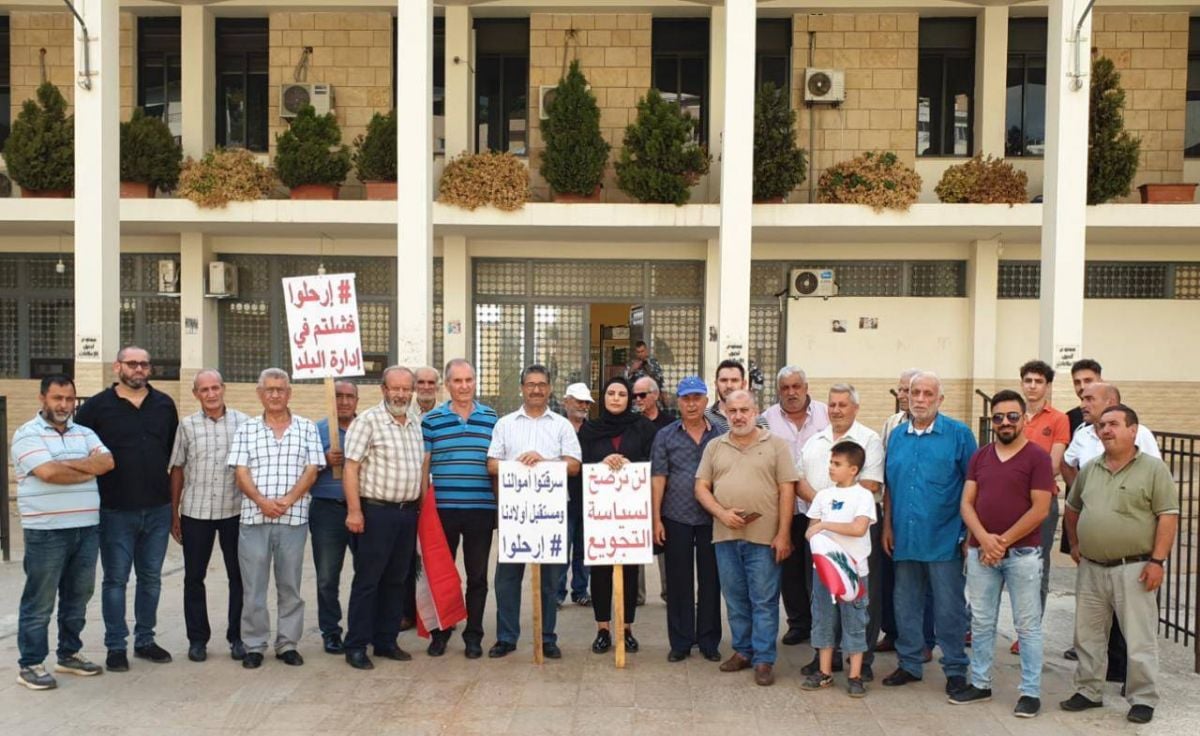
Activists in Akkar carried out a sit-in in front of the Halba Serail Thursday, in protest against the collapsing situation the country has reached. (Credit: Michel Hallak)






Want to get the Morning Brief by email? Click here to sign up.
The Finance and Budget Committee will resume discussing the 2022 budget draft as early as next week after being handed crucial missing information. Finance Minister Youssef Khalil on Thursday provided the committee with data concerning the use of multiple exchange rates in forecasting revenues and expenses. MP Ibrahim Kanaan, chair of the Finance and Budget Committee, said Monday that the committee has already completed the review of the 2022 budget draft but was anticipating the Finance Ministry's input on why it had used the official rate of LL1,507.5 to the US dollar for expenses and the Sayrafa rate — last at LL25,600 to the US dollar — for revenues, causing an unrealistic mismatch. The 2022 budget was voted on by the government last February and sent to the Finance Committee a month later. The adoption of the budget by the Parliament will violate the constitutional deadline, which expired in Jan. 2022. Khalil also proposed a reassessment of an additional credit line of LL10 billion. This amount includes transportation costs for the military and civil servants, medical costs and funding for the (public) Lebanese University, according to the minister. The International Monetary Fund has demanded that Lebanon pass a draft budget as part of an economic overhaul to get access to a loan of three billion dollars over four years to help the crisis-stricken country get back on its feet.
The fire at the Beirut port grain silos ignited again Thursday, with billows of dark smoke alarming still-traumatized residents, less than two weeks before the anniversary of the Aug. 4 port blast. Rescue teams arrived later to the scene to extinguish the fire following a decision from the Interior Ministry. The silos have been catching fire on and off for two weeks which is reportedly caused by “the exposure of fermented wheat to heat,” according to the director general of the Beirut port. Caretaker Economy Minister Amin Salam during a visit to the site told local news channel Al Jadeed last Friday that “fires will continue as long as wheat remains,” noting that the wheat is what stabilizes the silos, and “if emptied, could collapse.” Meanwhile, "Forces of Change" MP Paula Yacoubian submitted an urgent draft law Thursday to classify the silos as a national monument amid what she claimed were “vigorous and serious attempts to demolish the wheat silos.” Cabinet approved the demolition of the silos on March 16 in blatant disregard of protests from civil society groups and relatives of the port blast victims, who held a sit-in earlier in the day at the Justice Ministry to protest the delay in judicial assignments stalling the blast investigation.
The Maronite Patriarchate condemned General Security’s arrest of the Archbishop of Haifa and the Holy Land Moussa al-Hage. The press release called on the Lebanese state to put an end to “the security, judicial and political farce of which the bishop was the object.” On Monday, General Security members at the southern border post of Ras al-Naqoura, on the orders of the government commissioner at the Military Court, Fadi Akiki, arrested Hage as he was returning “as usual from his bishopric in the Holy Land.” Hage was detained for 11 hours, interrogated, and had his passport and cell phone confiscated, the statement said, adding that medical and cash aid he had “transported on behalf of some needy and sick in Lebanon from all communities,” was also taken from him. This aid, the statement said, was “sent by Lebanese and Palestinian benefactors because the government has not run the country well and haven’t enured the basic needs [of its citizens].” The Maronite Patriarchate concluded by calling on “the public prosecutor at the Court of Cassation to refer Judge Akiki to the Judicial Inspectorate and to dismiss him.”
Parliament Speaker Nabih Berri has scheduled a Parliament session for next Tuesday to elect seven MPs to the Supreme Council, Berri’s office reported Thursday. The Supreme Council, which is authorized to prosecute members of Parliament and ministers, is made up of 15 members — seven MPs and eight judges. This election is of particular interest to MPs connected to the Aug. 4, 2020 port blast investigation as its head, Judge Tarek Bitar, has summoned several former ministers and current MPs, who have all refused to appear before him. Some parties, including the Amal Movement, headed by Berri, believe that the matter of prosecuting MPs and ministers should not fall under Bitar’s responsibilities and should instead be handed over to the Supreme Council. Tuesday’s Parliamentary session will also see MPs vote on amending the banking secrecy law, one of the International Monetary Fund’s main demands to unlock crucial funding and a law allowing Lebanon to receive a World Bank loan of $150 million to finance wheat imports. Also on the agenda, MPs will review the urgent draft law on the port silos submitted by Yacoubian.
Consumer prices in Lebanon showed a 210.08 percent increase in the last year, from June 2021 to June 2022. According to the latest report on consumer prices by the Central Administration of Statistics, inflation has continues to rise at triple digits in Lebanon, with overall prices increasing twelve-fold since October 2019, as the lira trades at the parallel market at 20 times the peg of LL1,507.5 to the US dollar. This compares to other countries like the US, which saw a 9.1 percent increase in the last year, while Eurozone and Britain increased by 8.6 percent and 9.4 percent, respectively. Last week, managing director of the IMF Kristalina Georgieva said in a blogpost that “countries must do everything in their power to bring down high inflation” because “persistently high inflation could sink the recovery and further damage living standards, particularly for the vulnerable.”
Hundreds protested across Lebanon against the deteriorating living conditions as the country is reeling from an unparalleled economic meltdown. A protest in Riad al-Solh square, a prominent gathering place during the Oct. 2019 protests, attracted the largest crowd and was joined by MPs Yacoubian and Yassin Yassin. “They approved a law to increase the telecommunications’ prices before the elections but implemented it after on purpose,” one protestor said. New telecommunications tariffs were introduced this month, adding yet another unaffordable basic expense to a population already suffering from Lebanon’s economic collapse and compounded crises, as the country's public sectors are disintegrating. Protesting crowds were also spotted in Akkar, Jal al-Dib, Nabatieh and Saida.
The state-run National News Agency on Thursday announced an open strike starting today, after a strike that commenced one week ago failed to result in having their demands met. According to Information Minister Ziad Makari, the announcement came “after the employees of the organization and myself sensed the impossibility of arriving at the workplace to continue their message, which they never abdicated from doing.” Last Thursday, NNA employees announced a one-week strike after reports surfaced of a scheme concocted by Banque du Liban allowing judges and MPs to withdraw their salaries at the LL8,000 to USD exchange rate, rather than at the official LL1,500 rate, effectively raising their salaries five-fold. In a statement, Makari said that “after a week of the warning strike by the general assembly of the Information Ministry, and after I exhausted with the authorities all the methods [for solutions] for the situation of the employees … It is unfortunate that I’m announcing that the initiatives were not fortunate to break the wall of the difficult crisis, and were not fortunate to avoid it.”
In case you missed it, here’s our must-read story from yesterday: “A less bad year: Pace of decline in Lebanon’s agriculture sector slows.”