







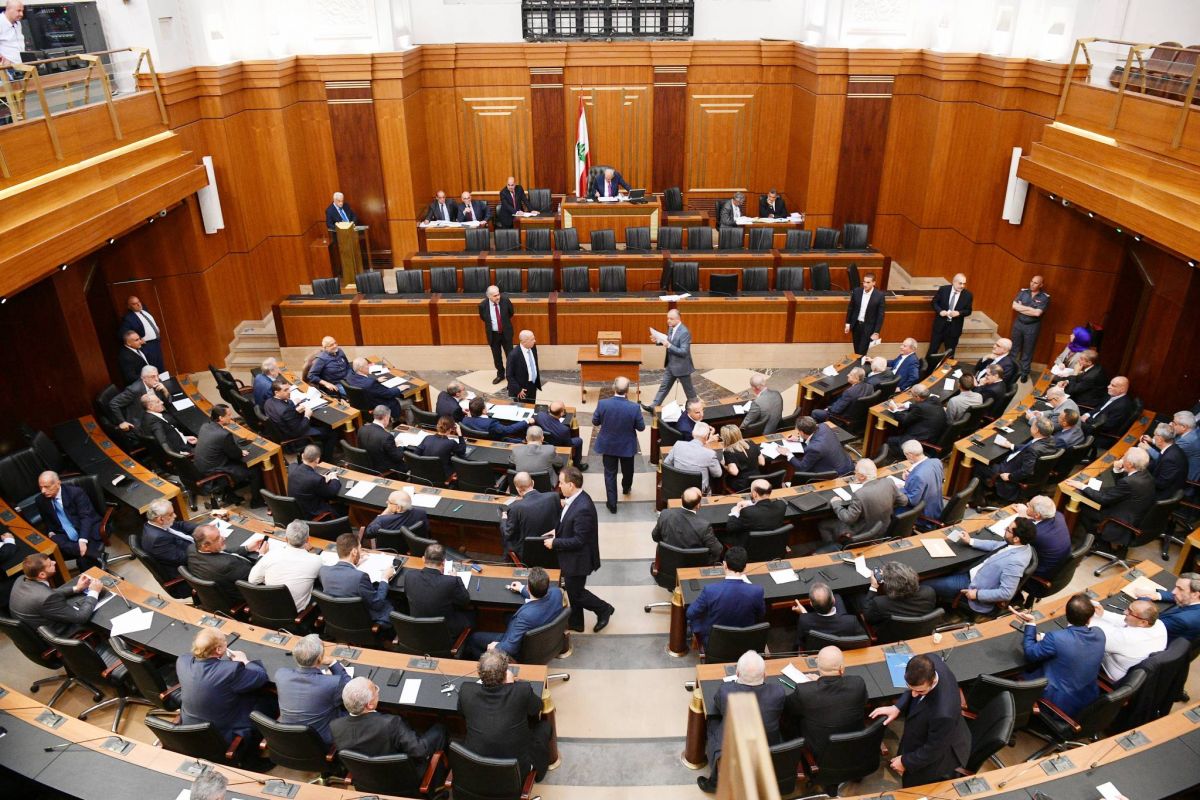
Parliament convenes on Tuesday. (Credit: Lebanese Parliament)






Parliament elected members of parliamentary committees yesterday during its second session since legislative elections on May 15. Although most members of the newly elected Finance and Budget Committee belong to the traditional parties, opposition MP Ibrahim Mneimneh also has a seat on what many consider to be the most crucial committee, considering the country’s dire economic situation. The inclusion of Ali Hassan Khalil and Ghazi Zeaiter was met with some indignation on social media, due to the fact that both MPs and former ministers have brought complaints against Judge Tarek Bitar who has tried to prosecute them as part of the investigation into the 2020 Beirut port blast. Both MPs are also part of the newly appointed Justice and Administration Committee, as is FPM MP Ibrahim Kanaan. There will likely be fierce debate within the committee given that, among others, it also includes opposition MP Oussama Saad. The Media and Communications Committee includes two opposition MPs: Paula Yacoubian and Yassine Yassine. Parliamentary committees play an important role on a legislative level in negotiating and approving bills before they are voted on by the full legislature. Once all committees are elected, President Michel Aoun will reportedly summon MPs for the parliamentary consultations to appoint a new prime minister. The committee election process is expected to continue for several days.
Hezbollah yesterday appointed former MP Nawaf al-Mousawi as its representative for the maritime border situation. Mousawi resigned from Parliament after a scandal in July 2019 that involved a violent altercation between his daughter and her ex-husband. On Sunday, a floating production, storage and offloading unit from the power company Energean arrived at a disputed exclusive economic zone between Israel and Lebanon to begin exploiting the Karish gas field on behalf of the Israeli state. Its arrival was met with irate reactions from Lebanese officials from across the political spectrum, in a rare moment of agreement that the unilateral move by Israel was unacceptable. However, different parties have already started to blame each other for either failing to prevent this situation or not handling it quickly enough. Although Parliament Speaker Nabih Berri claimed during a legislative session yesterday that US envoy Amos Hochstein, who has been appointed to mediate Lebanon’s maritime border negotiations with Israel, is expected in Beirut on “Sunday or Monday,” US State Department spokesman Ned Price had said Monday that no such visit is planned at this time. The maritime border situation has tensions running high in Lebanon, with Hezbollah’s deputy leader Naim Qassem telling Reuters that his party is ready to take action “including force” against Israeli gas operations in disputed waters once the Lebanese government clarifies its stance.
Sixty-four people of Lebanese, Syrian and Palestinian origins were prevented by the Lebanese Army from illegally departing the country from a beach between the areas of Kleiaat and Cheikh Zinad in North Lebanon. In a statement released yesterday, the army said that a pregnant woman, who was suffering from bleeding, was among the would-be migrants and was subsequently transferred to a hospital in the area. The others were handed over to the authorities and an investigation into the matter has been opened. A growing number of residents of Lebanon have been trying to illegally escape the country amid an unprecedented economic crisis. In April, a migrant boat was shipwrecked off Qalamoun in North Lebanon, leaving at least six dead, while around 30 others are still missing.
Three private generator owners were detained Tuesday in Saida by State Security for disregarding official pricing set by the Energy Ministry. The three offenders signed a pledge to reimburse citizens for additionally paid fees for the month of May and to stick to the pricing set by the Energy Ministry, which tries to regulate the market, as a condition for their release. Lebanon’s crippled power sector has become dependent on private generator owners, who provide a crucial backup as the state electricity provider is vulnerable to blackouts, and in some areas only manages to deliver electricity for two hours a day. Given the long hours of state power outage and the high cost of fuel, private generator operators are also regularly obliged to ration their supply. The Energy Ministry on Friday asked that they provide at least 16 hours of electricity per day, “particularly after improving the fixed amount of the pricing.”At a sit-in in support of the detainees, private generator owner Imad Saad said, “We submitted a request to the municipality to provide us with diesel at the [central bank’s] Sayrafa [exchange] rate, but no one helped us.”
During a sit-in in front of the courthouse in Beirut yesterday, residents of Ansar village, South Lebanon, called for the two men suspected of being involved in the murder of a woman and her three daughters in late March to be sentenced to death. The two suspects, Hussein F. and Hassan Gh., were being questioned by the first investigating judge in Beirut, Charbel Abu Samra, yesterday. After disappearing for 25 days, the lifeless bodies of Bassima Abbas and her daughters Rima, Tala and Mana, aged 16 to 22, were found in a cave in an orchard. The alleged murderer, Hussein F., 36, admitted to abducting and killing the four women with a Syrian accomplice. The motive for this tragedy that shook the country remains unknown. Since 2004, there has been a moratorium on the application of the death penalty in Lebanon.
In case you missed it, here’s our must-read story from yesterday: “Love and sex in a Lebanon in crisis: dating apps to the rescue, or not.”