






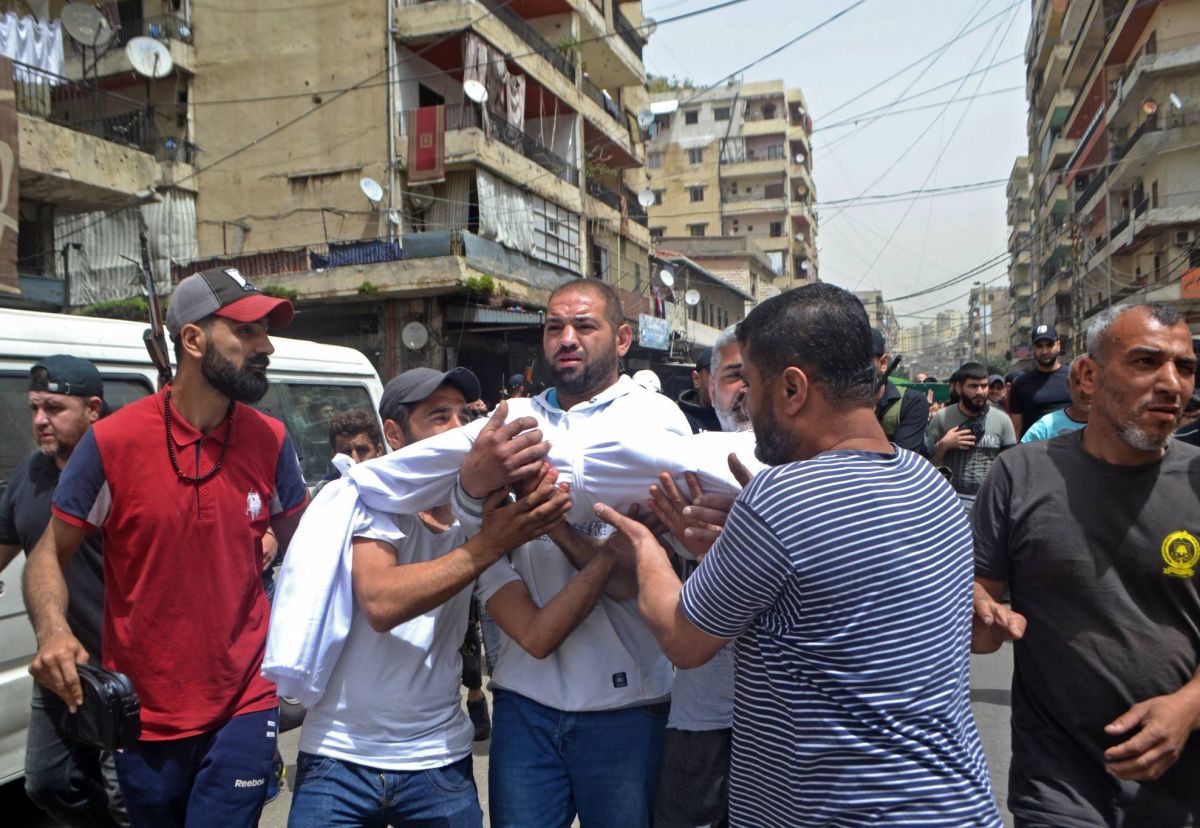
Mourners carry the body of a child, killed after a boat loaded with migrants capsized near the coast of the northern city of Tripoli, during a funeral on April 25, 2022. (Credit: Fathi al-Masri/AFP)






Want to get the Morning Brief by email? Click here to sign up.
Tensions in the country remain high after at least six people were killed when a boat carrying migrants seeking to depart the country sank off the Tripoli coast late Saturday night. An intense search by land, sea and air continues for the missing. Among the victims, for which funerals were held yesterday morning, were a one-and-a-half-year-old girl and a mother of three young children, who are still missing. While the official Lebanese Army statement claims that the shipwreck resulted from “high waves and the overload of the boat,” a survivor told AFP that the boat was struck twice by an army patrol boat prior to sinking. Sit-ins, some of which turned violent, were organized in Beirut and Saida to protest the ruling class, which many hold responsible for the conditions that led to the tragedy. Prime Minister Mikati, a billionaire who hails from Tripoli, was vilified on social media after a photo of a banner hung on his luxury yacht docked in Nice, France, circulated. On Sunday night, the Energy Minister Walid Fayad was accosted by demonstrators while leaving a bar in Achrafieh for “being drunk” when people are still missing. One person has been arrested on suspicion of involvement in the human smuggling operation according to the army, and an investigation has been launched into the incident. Tripoli had to contend with an additional tragedy when, on Sunday, a man was shot dead in the Qubba area in an apparent pre-election scuffle involving the hanging of a politician’s picture. The shooter fled the scene and is being pursued by security forces personnel.
The lira took a nosedive while the Association of Banks in Lebanon rejected the latest draft of the government’s financial recovery plan. The plan, which includes key financial reforms demanded by the International Monetary Fund, is designed to kickstart the road to economic recovery for Lebanon. In a statement shared with Reuters, the ABL called the plan “disastrous,” and said it would lead to banks and depositors shouldering the “major portion” of financial losses. Lebanon's banks have been major lenders to the government for decades, financially aiding and abetting a wasteful and corrupt state that went into a financial meltdown in 2019. While the ABL's approval is not actually required for the government to begin implementing a plan, experts claim that its support could go a long way in solving the crisis. The current draft lays out a series of financial reforms, including an overhaul of the banking sector and caps on how much depositors would be able to recover from their accounts. Earlier this month, Lebanon reached a staff-level agreement with the International Monetary Fund for a 46-month extended fund facility, under which Lebanon has requested access to some $3 billion. But access to those funds is heavily contingent on implementing a slew of economic reforms and restructuring of the financial sector. The lira rapidly deteriorated on the parallel market over the past week, reaching a low of LL28,000 to $1 not witnessed since the end of January.
Israeli artillery hit southern Lebanon after a rocket was reportedly fired from Lebanon across the border in the early hours of Monday. More than 20 shells were fired at various locations south of the town of Qalila, and between Majdal Zoun, Zebqin and other areas. No injuries were reported, according to the Lebanese Army which, to the astonishment of many, didn’t issue a statement about this massive security breach until late into the morning. The projectile fired from Lebanon fell in an open area, the Israeli military said. The incident follows clashes over the past two weeks between Palestinians and Israeli police at the Al-Aqsa Mosque compound in Jerusalem that have fueled Arab anger, particularly during the holy month of Ramadan and Easter celebrations, and international concern. Almost exactly a year ago, in mid-May, after Israel shelled Gaza after weeks of protests, a Lebanese demonstrator was killed by Israeli fire near the border of occupied Palestine. It remains unclear which group is responsible for firing the rocket from Lebanon this time around.
Protestors blocked the highway near southern Sarafand to protest the arrest of a man accused of opening fire in the village the week before to intimidate activists launching an opposition list for the upcoming May 15 legislative elections. The mobilization came two days after the Lebanese Army announced it had arrested a suspect in the case, who fired shots after members of the “Together for Change'' list were locked up, beaten and their phones were taken away to prevent them from contacting the media, according to a candidate. Several witnesses claimed they were supporters of the Amal Movement, led by Parliament Speaker Nabih Berri, but the party denies any involvement. Sarafand has traditionally been an Amal stronghold.
The first day of Eid al-Fitr has been set for Monday, May 2, by Shiite cleric Mohammad Hussein Fadlallah’s office. Eid al-Fitr marks the end of the Muslim fasting month of Ramadan, which began on Sunday, April 3, for the Shiite communities in Lebanon and other countries such as Iraq or Iran. It is not yet clear when Eid al-Fitr will commence for the Sunni community, in and outside of the country. Eid-al-Fitr is considered a public holiday in Lebanon.
In case you missed it, here’s our must-read story from yesterday: “Orphanage and school, church and mosque: remembering Saida’s Armenian legacy.”
