






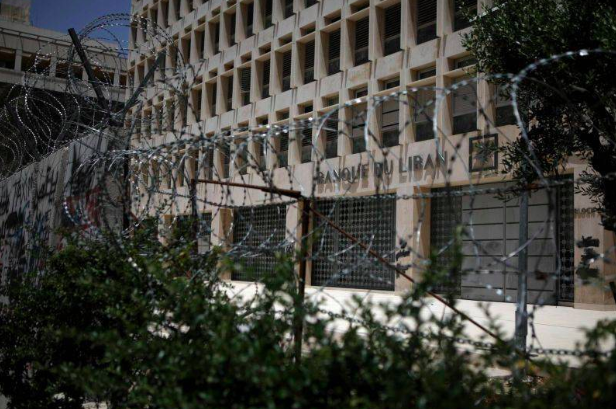
The offices of Banque du Liban in Beirut. (Credit: Patrick Baz)






Want to get the Morning Brief by email? Click here to sign up.
A leaked document purportedly detailing the Lebanese government’s economic rescue plan circulated on social media late Monday. The authenticity of the document remains uncorroborated, but experts L’Orient Today spoke to unanimously agreed on its validity. The plan includes the approval of a capital control law, assesses financial sector losses at over $72 billion, and says that central bank losses exceed $60 billion. It calls for an evaluation of the 14 largest banks to determine the value of their deposits and losses. For other banks, the plan aims to recapitalize some and liquidate others. Under the plan, deposits up to $100,000 made before March 31, 2022, will be guaranteed, and anything above that will either be converted into bank shares or partially written off and converted into Lebanese lira at different rates. The plan also calls for an increase in the VAT, and will assess and collect other taxes at the central banks’ Sayrafa rate. These and other financial sector reforms are a key demand of the IMF, required before the fund will approve a recently-reached staff-level agreement with the government of Lebanon to provide the country with $3 billion over four years. Last week, the country dipped into its IMF granted Special Drawing Rights to pay for wheat imports.
Meanwhile Tuesday, angry depositors gathered in Downtown Beirut to demonstrate against the draft capital control law. Protestors prevented some MPs from attending a joint parliamentary committee session of the Finance and Budget Committee and the Administration and Justice Committee, which was scheduled to begin at 10:30 a.m. The demonstration followed a similar protest last Wednesday by the collective Cry of the Depositors. The capital control law aims to formally legalize banking restrictions that were illegally put in place by banks when the financial crisis began to accelerate in 2019. Moreover, the law retroactively grants legal cover to banks that imposed the de facto capital controls.
American University of Beirut students also protested yesterday, against an anticipated hike in tuition fees. Almost 100 students demonstrated on AUB’s Ras Beirut campus next to key administrative and teaching buildings. The protest started at noon and ended around 2:30 p.m. Last week, students began noticing that tuition for the summer 2022 term was being calculated at the ‘lollar’ rate of LL8,000 to $1, effectively more than doubling the tuition being charged for the spring 2022 term, which was calculated at a previous lollar rate of LL3,900 to $1. In an internal email seen by L’Orient Today, university President Fadlo Khuri told students that AUB could not afford to keep the current tuition rate moving forward. The lollar rate of LL8,000 to $1 has been in place since December 2021. The news comes after AUB launched its twin campus in Paphos, Cyprus almost weeks ago. It also comes after the Lebanese American University decided to dollarize its tuition fees in late March.
The United States State Department announced a $3 million reward for any news related to the 1983 bombing of the American embassy in Beirut. The attack left 52 dead and injured 80 people, and leveled the embassy building, which was located in the Ain al-Mreisseh neighborhood of Beirut, near the AUB women’s gate overlooking the sea. US Ambassador to Lebanon Dorthy Shea said this was not only an attack on Americans, but also took the lives of Lebanese employees and security officers: “Since 1983, we have continued to renew our commitment to peace and security in Lebanon,” she said. “The United States remains committed to bringing justice to victims. We are fighting the harmful influence of terrorist organizations like Hezbollah,” Shea added.
In case you missed it, here’s our must-read story from yesterday: “Deserted by Hariri, Beirut II is in search of a new political identity”