






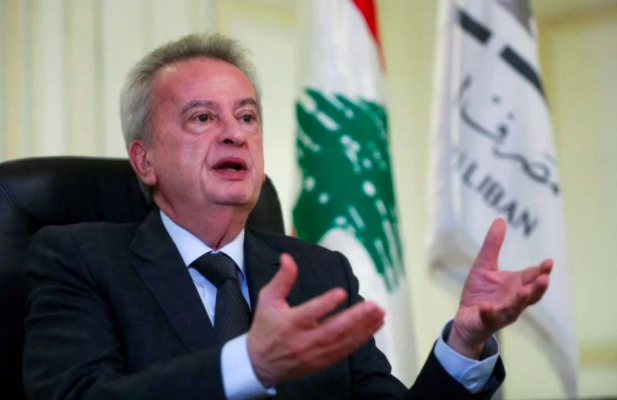
Central bank chief Riad Salameh speaks during an interview for Reuters Next conference, in Beirut, on Nov. 23, 2021. (Credit: Mohamed Azakir/Reuters)






Want to get the Morning Brief by email? Click here to sign up.
Lebanon’s central bank chief is a suspect in a €120 million euro asset freeze case, according to German prosecutors. Eurojust, the European Union’s criminal justice agency, said in a statement on Monday that it had frozen some €120 million ($132 million) of Lebanese assets, linked to five people suspected of embezzling some $330 million. All assets, including bank accounts and properties, were seized in France, Germany, Luxembourg, Monaco and Belgium, the statement said, without identifying any suspects. However, an email from Munich prosecutors seen by Reuters said the statement was in reference to investigations concerning Salameh, whose wealth is being investigated in at least five European states and who was charged last week by a Lebanese judge with illicit enrichment. Meanwhile, the governor’s younger brother, Raja, who has been detained in Lebanon since March 17 in the same case, has applied to the lead investigating judge at the Mount Lebanon Court of Appeal, Nicolas Mansour, for his release. Mansour reportedly referred Salameh’s request to Mount Lebanon Public Prosecutor Judge Ghada Aoun for an opinion, which, according to the law, is not binding and the judge may not comply with it. Judge Aoun can either accept or reject the request for release, or let Mansour make the decision. She may, however, later appeal her colleague’s decision.
The latest version of the capital control law will no longer appear on the agenda of a parliamentary session today after it was rejected by two parliamentary committees yesterday. Members of the Parliament’s Finance and Budget Committee and Administration and Law Committee determined not to embrace the law, while MPs on all sides of the political spectrum sharply criticized the document. MP Ibrahim Kanaan (FPM/Metn) and MP Georges Adwan (LF/Chouf), the respective chairs of the two committees that met, attributed the rejection to a lack of proper procedures in the transmission of the document to the committees and the content revealing a drastic departure from the version finalized by the joint committee in July 2021. Kanaan took issue with the fact that the special committee, designated in the document and composed of the finance and economy ministers, the central bank governor, and chaired by the prime minister, would monopolize the role of the Parliament and the judiciary, ensuring complete discretion over the financial affairs of the country. Hezbollah MP Ali Fayyad said that without a clause reiterating the depositors’ rights, further discussion of any capital control law is pointless. On Monday afternoon, the Amal Movement issued a press release in which it expressed a similar sentiment.
Lebanon’s top prosecutor on Monday overturned a judicial decision instructing customs authorities to bar six banks from moving money out of the country. Last week's decision by Judge Ghada Aoun — which applied to Bank Audi, Bank of Beirut, Creditbank, SGBL, Blom Bank and Bankmed — had the lenders’ assets frozen in separate judicial actions this month as she investigates their transactions. She has also banned the heads of their boards from travel but has not charged any of the parties involved with any crime. In Monday’s ruling, Public Prosecutor Ghassan Oueidat reversed Judge Aoun's decision, a source told Reuters. Banks last week staged a two-day strike in protest against what they called arbitrary judicial decisions. The banking system has been paralyzed with most depositors frozen out of US dollar accounts since Lebanon’s financial system collapsed in 2019; one of the world's sharpest-ever economic meltdowns ensued.
Rafik Hariri University Hospital employees forced their way into the headquarters of the Health Ministry in Beirut yesterday to protest the deterioration of their working conditions and demand their salaries be paid. Health Minister Firass Abiad, who, until he took up his present post in September of 2021,was the director of RHUH, was met by protesters who complained that they had not been given an appointment for more than three weeks to meet with the minister. According to the World Health Organization, 40 percent of doctors and 30 percent of nurses working in Lebanon have left since the onset of the crisis in 2019.
Relatives and survivors of the victims of an explosion of an illegal gasoline depot in Tleil last August blocked roads in several areas in Akkar to protest government negligence. Aside from severe negligence, mostly regarding the treatment of injuries, which prevent them from working, they lamented the fact that cheques of $1,000 for each family of those killed have yet to be paid by the Higher Relief Committee. The Tleil explosion took place on the night of Aug. 14, 2021, when residents stormed an illegal gasoline storage depot, as fuel was extremely scarce at the time. While the Lebanese Army was distributing the fuel to local residents, it is believed an irate individual threw a cigarette lighter into the fray, triggering the blast that would kill more than 30 people. Three suspects were arrested as part of the ongoing investigation
Two independent groups unveiled their candidates for the May 15 parliamentary elections. Independent group Tahalof Watani on Sunday presented its list, which will be distributed over seven districts, and includes Paula Yacoubian — the only independent candidate to win a seat in the 2018 parliamentary elections, while the party had supported 66 candidates. Additionally, Shamaluna, an alliance of independent groups in North Lebanon, registered its list of parliamentary candidates in the Interior Ministry on Monday, This is the first electoral list of independents to register in the North III district for the May 15 parliamentary elections. Very few lists have been announced so far, despite the fact that April 4 is candidates’ final date to form electoral lists and ensure they’re legally eligible to run.
In case you missed it, here’s our must-read story from yesterday: “Endgame for Riad Salameh?”