






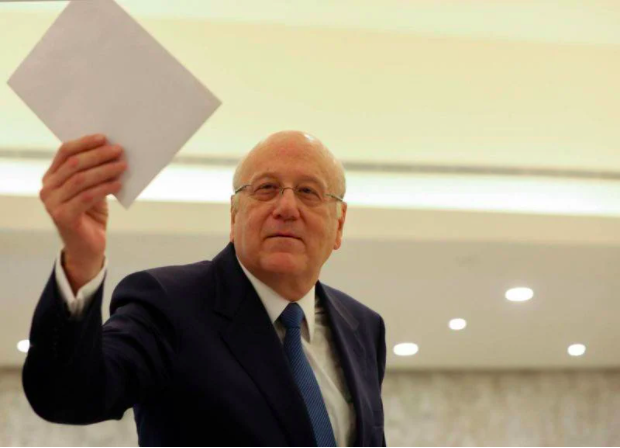
Prime Minister Najib Mikati announced yesterday that he will not be running in the May 15 parliamentary elections. (Credit: Mohamed Azakir/Reuters)






Want to get the Morning Brief by email? Click here to sign up.
Yesterday was a big day in the electoral context for two of the main establishment parties on opposite sides of the Lebanese political spectrum. In the morning, Samir Geagea, leader of the Lebanese Forces, held a press conference launching his party’s electoral campaign. Referring to the elections as ‘an existential battle” Geagea accused the Free Patriotic Movement (the LF’s biggest Christian rival) of being all talk and no action for the past 30 years, conveniently ignoring the fact that the LF was part of the same apathetically inactive political establishment during that same time period. The timing of Geagea’s speech, March 14, was clearly chosen with for its symbolic meaning as he tied it to the Oct. 17 revolution, with which he has been trying to align himself and his party, and the coming elections: “March 14 was a prelude to Oct. 17,” said Geagea, adding that “now the Lebanese people have a big opportunity to make May 15, 2022, a second March 14, 2005, and a complement to Oct. 17, 2019, so do not miss this opportunity.” Later in the afternoon, Parliament Speaker and head of the Amal Movement Nabih Berri also launched his party’s electoral campaign, including the announcement of two of his party’s candidates, former ministers and sitting MPs Ali Hassan Khalil and Ghazi Zeaiter, who have been charged with homicide and summoned for questioning in the Beirut port blast probe.
Further electoral programs and candidates are expected to be announced today. The head of the Syrian Social Nationalist Party, MP Asaad Hardan, will launch his party’s campaign at 1 p.m., while resigned MP Nadim Gemayel will announce the electoral program on which he will run in Beirut I at 4 p.m. at the Kataeb House in Sassine. Opposition party Beirut Madinati will announce its candidate list at 6 p.m. at Grand Cinemas in the ABC mall in Achrafieh. The window for candidate registration for the May 15 polls closes at midnight tonight.
In the latest ‘casualty’ on the Sunni electoral landscape, Prime Minister Najib Mikati announced Monday afternoon he will not run in the upcoming parliamentary elections. The Tripoli MP’s decision throws the Sunni vote into further disarray, as a growing list of Sunni personalities appears to continue to follow in former Premier Saad Hariri’s footsteps by, at least temporarily, withdrawing from politics. Mikati had previously called on the Sunni community not to boycott the vote. Earlier in the day MP Tarek Merhebi also said he would not run in the legislative elections on May 15, “in solidarity” with Hariri, who, upon announcing his withdrawal from political life, asked his party to stay out of the elections. Other Sunni personalities affiliated with Hariri’s Future Movement party, such as Roula Tabsh, Mohammad Hajjar and Assem Araji, have recently announced they would not participate in the elections. Former Prime Minister Fouad Siniora is expected to announce his decision today, the last day for candidates to register.
Judge Ghada Aoun froze the assets of five Lebanese banks and their board members. A judicial document, seen by Reuters, showed that the Mount Lebanon public prosecutor is investigating transactions the banks and their board members undertook with Banque du Liban, the country’s central bank. The asset freezes against Bank of Beirut, Bank Audi, SGBL, Blom Bank and Bankmed applies to properties, vehicles and shares in companies owned by the banks or their board members. Aoun has not charged any of the parties involved with any crime, although she issued travel bans against the CEOs of the five Lebanese banks last Thursday as a precautionary measure while she carried out her probe, she told Reuters.
A scathing report released yesterday alleges that Syrian refugees in Lebanese detention are held in “inhumane” conditions. The Access Center for Human Rights (ACHR), a human rights group that monitors the conditions of Syrian refugees in Lebanon, issued the report, which covers cases in the year 2020 and details instances of torture, unjust trials and “inhumane” conditions while in detention under the jurisdiction of Lebanese authorities. The World Prison Brief ranked Lebanon’s detention system among the most overcrowded in the Middle East, with the number of prisoners reaching 6,670 in 2020, far exceeding its capacity of 3,500 people. Administrative, judicial and legal neglect severely affected Syrian detainees in the country, the report said, while Lebanon’s multifaceted crises exponentially exacerbated their already challenging conditions as refugees now cannot afford to hire legal representatives. A spokesperson for the Internal Security Forces could not be reached for comment.
Lebanon’s poorest families will begin receiving cash under the long-awaited Emergency Social Safety Net program starting this week. Making the announcement, Social Affairs Minister Hector Hajjar said that each household will receive a maximum of $145 per month ($25 for each household with an additional $20 for each household member, up to a limit of six), and that payments will be distributed each week, with families alerted via a text message to collect their payments “in dollars” at money transfer centers. Middle East Regional Director for the World Bank, which is funding the program, Saroj Kumar Jha, said that in addition to the unprecedented economic crisis Lebanon is suffering from, “global events are expected to worsen the situation in Lebanon,” calling the country’s food inflation, which is already at 400 percent, “concerning.” Jha told L’Orient Today that a third-party monitor, an unspecified non-governmental organization, will be overseeing the ESSN payment process. Some on social media questioned the timing of this latest announcement, with the parliamentary elections around the corner, as the $246 million ESSN loan program was approved by the World Bank in January 2021 and by Lebanon’s Parliament in March of that year, but has been delayed in launching, in part because of changes to the deal that were made by Parliament without the approval of the World Bank. After a month of relative stability, the Lebanese lira dropped sharply t0 LL24,000 to the US dollar on the parallel market on March 9. The sudden fall came after several commercial banks stopped selling US dollars to customers at the central bank’s Sayrafa rate.
In case you missed it, here’s our must-read story from yesterday: “The pro-Syrian political forces want west Bekaa”
Clarification: An earlier version of the Morning Brief stated that the ESSN program would provide $20 for each child to beneficiaries, up to a limit of six. The additional $20 is for each family member, not only for children.