






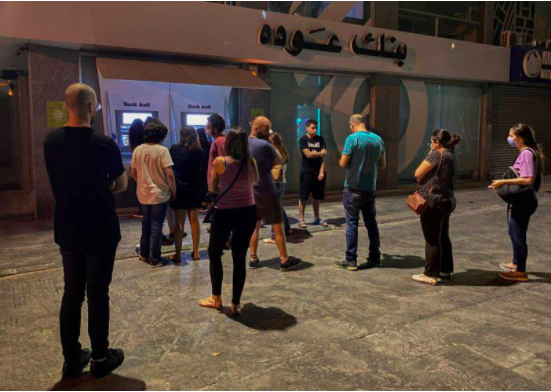
People wait at an ATM in Beirut to withdraw money in June 2021. (Credit: Mohammad Azakir/Reuters)






Want to get the Morning Brief by email? Click here to sign up.
A government plan aimed at tackling Lebanon’s financial crisis projects a 93 percent devaluation of the Lebanese lira and converts the bulk of hard currency deposits in the banking system to local currency, according to a blueprint seen by Reuters. The plan estimates that just $25 billion out of $104 billion of hard currency deposits will be returned to savers in US dollars, with most of what’s left converted to lira at a variety of exchange rates, including one that would eradicate 75 percent of some deposits’ value. The plan sets out a 15-year timeframe for paying back all depositors. Depositors have been largely frozen out of US dollar accounts since October 2019, while the lira has lost more than 90 percent of its value since. Meanwhile, the lira rate on the parallel market rose above the central bank’s Sayrafa platform rate for the second consecutive day. Trading at LL19,600 to the dollar Tuesday evening, the lira has gained around 72 percent since it hit a low of LL33,700 to the dollar in mid-January.
Central bank Governor Riad Salameh was served with a subpoena by Mount Lebanon Public Prosecutor Judge Ghada Aoun yesterday. Aoun issued the subpoena on the grounds that Salameh had failed to appear at a third hearing in the case filed against him by a civil society group, a judicial source told L’Orient Today. Aoun’s subpoena is the latest in a series of measures taken against Salameh. She issued a travel ban against the governor on Jan. 11 and an asset freeze on his real estate and cars on Jan. 18. The hearings scheduled for Salameh are part of a case led by civil society group The People Want to Reform the System, whose lawyers filed a complaint against the central bank chief for embezzlement, wasting public funds, illegal enrichment and money laundering. Despite being the subject of investigations in multiple jurisdictions, Salameh remains in office at the head of Banque du Liban, a position he has held for almost three decades.
As was widely expected, Progressive Socialist Party MP Akram Chehayeb yesterday announced that his party will align with the Lebanese Forces “in many areas” in the parliamentary elections scheduled for May 15. Chehayeb’s comments followed a meeting with Lebanese Forces leader Samir Geagea at the latter’s residence. In the 2018 parliamentary elections, the PSP was also allied with the LF and the Future Movement in many constituencies, including the PSP’s Chouf stronghold. However, since Future Movement leader Saad Hariri last week announced his withdrawal from politics and requested that his party do the same, it is unclear which Sunni representative group the PSP will seek an alliance with.
A Vatican envoy admonished Lebanon’s politicians for the country’s many woes during an official visit to Beirut yesterday. Archbishop Paul Gallagher called for an end to “the few profiting of the suffering of many” in a dizzying financial meltdown that has driven the majority of the country into poverty. The archbishop’s remarks echo the World Bank’s recent severe condemnation of Lebanon's ruling class for “orchestrating” one of history’s worst economic depressions.
Nearly 1.5 million people in Lebanon, or roughly 20 percent of its population, applied for social assistance programs, according to data tracked by the government’s IMPACT platform. Over 582,000 application forms were submitted on behalf of 1,472,411 people before registration closed at midnight Monday. The registration platform for the World Bank-funded Emergency Social Safety Net and the government's ration card program was launched in early December, almost two-and-a-half months behind schedule. The high number of applicants further emphasized the worsening living situation in Lebanon, wherein 82 percent of the population has fallen below the multidimensional poverty line, according to a recent United Nations report. Social Affairs Minister Hector Hajjar told a local radio station on Tuesday that DAEM social support payments will start “on March 1 and [will be] in US dollars.” However, this seems to exclusively refer to the ESSN payments, as the government’s ration card program still has no secured source of funding.
Both the land transport unions and state power provider Electricité du Liban workers and employees are on strike today. As of this morning, roads were cut across Lebanon as workers began their strike, with traffic blocked in Beirut, Tripoli, West Bekaa, Sur and Aley, Khaldeh and Zouk Mosbeh. Both strikes will last three days. The unions’ strike aims to pressure the government to “respect the agreement of October 26, 2021,” concerning the reallocation of a $295 million loan from the World Bank to benefit the public transport sector, land transport unions head Bassam Tleis said Monday. EDL workers and employees are protesting against taxes and expenses included in the 2022 draft budget as well the lack of any terms regarding compensation for workers’ salaries that “evaporated in banks,” according to an EDL statement issued last week.
In case you missed it, here’s our must-read story from yesterday: “New passport appointment site raises questions about digital security and political influence”