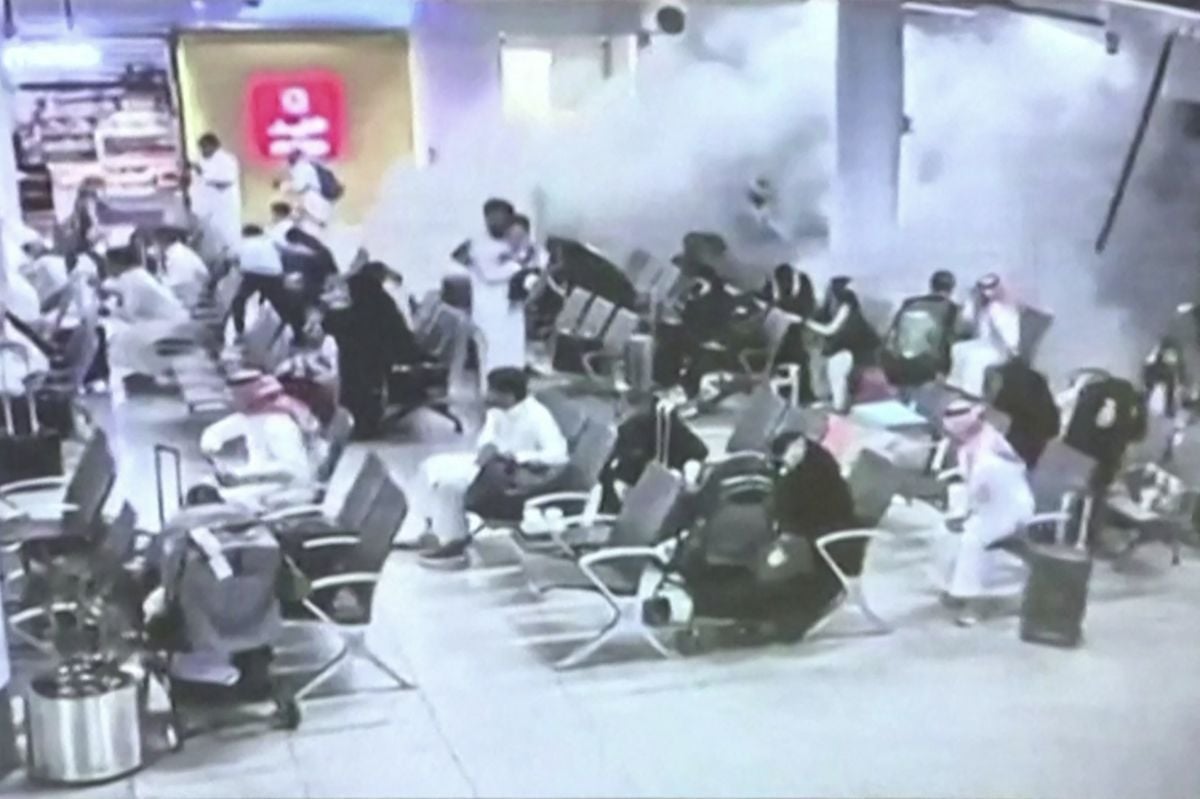
This screenshot from surveillance footage, released during a press conference by the Saudi-led coalition in Riyadh on October 15, 2026 and made available via AFPTV, shows what the coalition presents as a Houthi attack on Abha International Airport, which occurred on October 7, 2026. Photo AFPTV / AFP This screen grab taken from CCTV footage played on a screen during a press conference by the Saudi-led coalition in Riyadh on October 15, 2026, and made available via AFPTV, shows what the coalition says was a Houthi attack on Abha International Airport on October 7, 2026. Saudi Arabia, the world's top crude oil exporter, has come under sustained attack by the Houthis in recent days, shifting the focus of the Middle East war that erupted with US-Israeli strikes on Iran in February. (Photo by AFPTV / AFP)






News of the day
Egyptian President Abdel-Fattah al-Sissi on Saturday urgently summoned Parliament to approve any potential request from Riyadh for military assistance, according to the Egyptian daily Al-Ahram, as Saudi Arabia has faced near-daily attacks by Yemen’s Iran-backed Houthi rebels since early October.
Sissi said Egypt was ready to take the measures requested by Saudi Arabia to defend its security and sovereignty, subject to parliamentary approval and a request from Riyadh, Al-Ahram reported. He added that ‘‘Egypt and Saudi Arabia are at the heart of the Arab and Islamic nations,’’ asserting that ‘‘any harm caused to one would affect the other.’’
’’Egypt will accept no threat against the security or borders of the [Saudi] kingdom,’’ he said, adding that Gulf security was an integral part of Egypt’s national security.
According to the Egyptian presidency, Sissi also rejected threats to the security of the Red Sea and international maritime routes, identifying Saudi Arabia’s stability and regional de-escalation as Egyptian priorities.
Against the backdrop of profound geopolitical shifts in the region, the Egyptian president said his country was ready to take the necessary measures to ease regional tensions, resolve the Gulf crisis, preserve the security and stability of regional countries, and ensure the safety of maritime navigation, according to the presidency.
Why this matters
Egypt’s decision to urgently summon Parliament to authorize potential military assistance to Saudi Arabia sends an important political and strategic signal amid rising regional tensions. In response to Houthi attacks, which are backed by Iran, Cairo has affirmed that Riyadh’s security is an integral part of its own national security.
The move does not mean Egyptian military intervention is imminent, but signals that it could be considered at Saudi Arabia’s request. Such an intervention could risk widening the conflict and escalating tensions between Iran and Arab countries allied with Riyadh.
Egypt is also seeking to protect its economic interests, particularly maritime traffic in the Red Sea and revenues from the Suez Canal. The announcement could also serve as a deterrent to the Houthis and strengthen Saudi Arabia’s diplomatic position. It underscores Cairo’s ambition to play a central role in regional security while publicly maintaining its commitment to de-escalation and stability.
Other news
Lebanon: Army reinforces deployment in Beirut’s southern suburbs after incident involving Hezbollah members
The Lebanese Army began a ‘‘reinforced deployment’’ in Beirut’s southern suburbs on Saturday morning following an incident in the Galerie Semaan area, on the outskirts of the suburb, in which dozens of armed Hezbollah members surrounded a judicial police patrol conducting a seizure of medications from warehouses, according to a military source. The group withdrew after the army arrived at the scene.
’’We are carrying out a bigger deployment than usual given the situation and the frictions that happened yesterday [Friday, Ed.],’’ the source told L’Orient-Le Jour, while also citing ‘‘routine measures to keep the security situation under control.’’
Amateur videos circulating online on Saturday morning showed military vehicles entering the southern suburbs from Choueifate, just south of the capital.
Two tankers targeted off Saudi Arabia, UKMTO reports
The United Kingdom Maritime Trade Operations (UKMTO) agency reported Saturday that two tankers were targeted off Saudi Arabia in Gulf waters on Friday.
‘‘The first vessel, located 68 nautical miles [125 km] northeast of the Saudi city of Jubail, was struck by a ‘‘projectile of unknown origin,’’ prompting the evacuation of its crew, the agency said. It added that ‘‘the crew members were safe’’ and that no environmental impact had been reported at that stage.
UKMTO subsequently reported a second incident involving a tanker located 78 nautical miles (144 km) from the Saudi city. ‘‘The captain of a tanker reported being targeted by a rocket-propelled grenade [RPG] fired from a small boat, which damaged the rear port side,’’ the agency said. ‘‘The crew members were located and are safe,’’ it added, noting that the extent of the damage and any environmental impact remained unknown.
Meanwhile, Iran’s powerful Islamic Revolutionary Guard Corps said Saturday that a tanker was on fire in the Strait of Hormuz after striking a mine in the strategic waterway, which lies at the center of the conflict between Tehran and Washington.
Israeli army blows up journalist Radwan Mortada’s house in Aita al-Jabal, continues attacks in southern Lebanon
The Israeli army blew up several homes in Aita al-Jabal, in the Bint Jbeil district, at dawn on Saturday, including those belonging to investigative journalist Radwan Mortada, who writes for Al-Akhbar newspaper, and resident Hussein Najm, according to L’Orient-Le Jour’s South Lebanon correspondent.
Other demolitions targeted structures in Beit Yahoun, near a religious site. An explosion was also heard in Jabal Hilal, between Khiam and Ibl el-Saqi in the Marjeyoun district, between Friday and Saturday evening, following the demolition of several homes. The blast was so powerful that it was heard across the region.
Gaps at Beirut airport risk delaying resumption of direct flights between Lebanon and the United States
A new obstacle threatens to delay the resumption of direct flights between Lebanon and the United States. Although US President Donald Trump lifted restrictions in early October that had hindered the resumption of these connections for decades, a report by the International Civil Aviation Organization (ICAO) identified several shortcomings at Beirut International Airport (AIB), including the lack of valid certification and an emergency plan.
According to the report seen by Reuters, the airport’s firefighting capabilities are adequate for single-aisle aircraft but insufficient for the twin-aisle planes used on long-haul flights. The document also notes the absence of an emergency plan and the expiration of the airport’s conditional certification.
The ICAO further found that Lebanon’s civil aviation authority lacked qualified inspectors to oversee the licensing of air traffic controllers.
The findings follow a technical assistance mission to Lebanon in July, which identified shortcomings at the airport and within the country’s civil aviation system. Conducted at the request of Lebanon’s civil aviation authority, the internal report was submitted to Lebanese officials in September.