






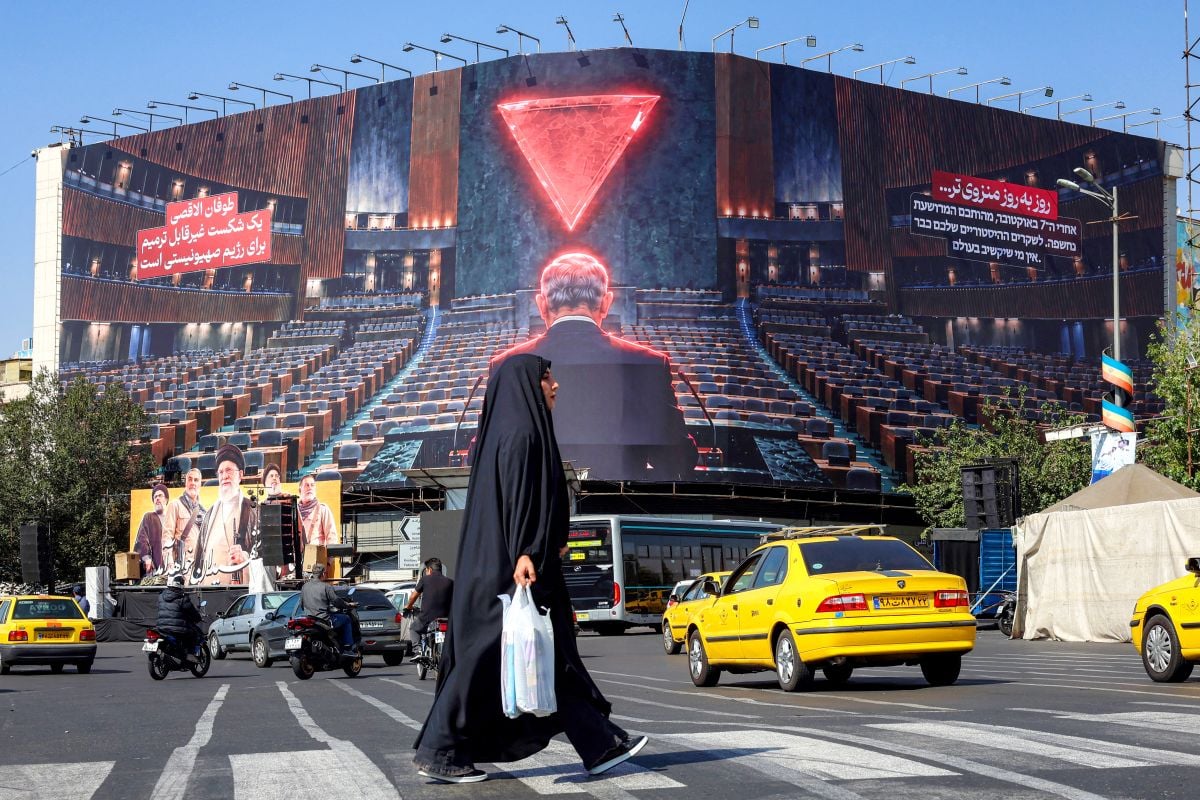
A woman crossing Enghelab Square, in downtown Tehran, on Oct. 12, 2026, in front of a large anti-Israeli billboard. (Photo: AFP)






Iran is reinforcing its sensitive nuclear and military sites, as well as border areas, rebuilding its missile and drone capabilities and threatening to strike U.S. interests and those of their Gulf allies more forcefully. Tehran is convinced that Washington could launch new attacks after the U.S. midterm elections on Nov. 3, the Wall Street Journal (WSJ) reports. According to the U.S. daily, Iran is seeking to deter a resumption of strikes, even raising the possibility to regional officials of ground incursions into neighboring countries, attacks on Saudi oil facilities, or operations targeting U.S. warships.
Satellite images analyzed by the Institute for Science and International Security and cited by the WSJ show that Iranian authorities have installed defenses around several sensitive sites, including the Natanz nuclear facility and "Pickaxe Mountain." These defenses, such as earthen mounds, are intended to complicate possible ground operations. At the same time, Iranian officials are reported to have privately warned Arab leaders that Iran may strike regional targets, including Saudi oil installations, if the U.S. attacks again. Mohsen Rezaei, a senior Iranian security official, also raised the possibility Sunday of targeting the United Arab Emirates, as well as data centers and internet cables in the region.
The Iranian regime has also warned mediators that it could target U.S. personnel more aggressively, including attempting to sink U.S. warships in the Middle East and kill their crews, according to people familiar with the warnings cited by the WSJ. Some Iranian officials have further suggested their forces could launch ground incursions into neighboring countries. In recent months, according to the U.S. outlet, Iran has taken advantage of the pause in hostilities with Washington to rebuild its missile and drone facilities and replenish part of its arsenal.

Inside the country, the regime is also trying to mobilize the population for a possible return to war: pro-regime rallies, civilian weapons training, highlighting female units trained by the Revolutionary Guards, and paramilitary forces reading war stories in schools. The goal, according to the WSJ, is both to prepare the country and to send a deterrent signal to Washington.
Since the start of the regional conflict, sparked at the end of February by U.S. and Israeli strikes against Iran, tensions have flared on multiple fronts in the Middle East, from the Gulf to Yemen via the Red Sea. Washington has reinforced its military presence in the region and increased economic pressure on Tehran, while Iran has issued more threats and stepped up attacks against U.S. interests and those of its allies. In the Gulf, the Strait of Hormuz remains one of the main flashpoints, with the Islamic Republic claiming control and regularly targeting ships venturing there without its authorization.

 1 p.m. recap: Hezbollah offers extensive aid package for the displaced; ICRC warns of 'disaster' in Middle East; explosive device found in the Bekaa