





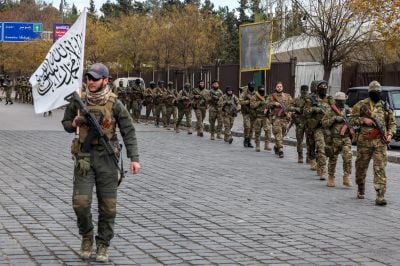
Fighters affiliated with the new Syrian authorities, who succeeded the Bashar al-Assad regime, take part in a military parade in Damascus on Dec. 27, 2024. (Archive photo: Omar Haj Kadour/AFP)






Syrian authorities announced Tuesday that they had arrested three members of a cell allegedly “affiliated with Hezbollah” in the province of Deraa, in the south of the country near the Israeli-occupied Golan Heights, claiming they had been planning attacks, including rocket fire.
Hezbollah denied on Wednesday any link to this cell, condemning the allegations, which it suggested might have originated in Israel in an attempt to sow discord between Lebanon and Syria.
Hezbollah points finger at Israel
As with previous announcements by the Syrian authorities regarding the dismantling of cells linked to Hezbollah, the party has "categorically denied" "any link or connection between Hezbollah and the alleged cell."
The party reiterated that it has "no presence on Syrian territory nor any connection with any security or military activity whatsoever in Syria." It further called on Damascus to exercise caution in the face of “attempts to drag Hezbollah’s name into the matter in order to stoke tensions and sow discord between Lebanon and Syria, and to verify the facts and the individuals behind these allegations," pointing the finger at Israel, which “is stepping up its attacks on Syria and Lebanon and seeking to destabilize security and stability in the region.”
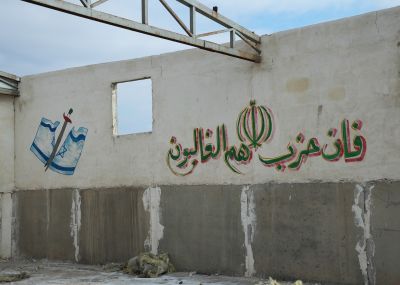
The new Syrian authorities are hostile towards Hezbollah which fought alongside the previous regime of Bashar al-Assad during the Syrian civil war. The announcement of the arrest came just hours after Israeli Prime Minister Benjamin Netanyahu said there were "indications" of possible attacks on his country ahead of the Oct. 27 elections.
Intelligence and security forces "foiled a sabotage attempt in the Yarmouk Basin, in Deraa province, and arrested a cell affiliated with Hezbollah composed of three individuals," the security forces' statement said. The region, where Syrian state media have already reported Israeli incursions and bombings, borders the Syrian Golan Heights annexed by Israel as well as Jordan. The statement reports a "cell's attempt to prepare rocket launch platforms to carry out attacks intended to destabilize security and stability," without specifying the intended targets.
Syrian authorities have previously claimed to have dismantled several Hezbollah-linked cells preparing attacks in Syria, allegations the movement has denied. They have also announced several seizures of weapons, allegedly intended for Hezbollah, which lost a key supply route from Iran following the fall of the Assad clan in December 2024.
Several times in recent months, Washington has hinted at a role Damascus might play in putting an end to Hezbollah. In response, Syrian President Ahmad al-Sharaa stated that his country has no intention of intervening militarily in Lebanon. Last week, from New York, he stressed that Syria wants "to strengthen the Lebanese authorities, so they have better institutions, so that no weapon is used outside the rule of law," while Lebanese authorities have pledged to disarm the pro-Iranian group.
Hezbollah fired rockets at Israel, prompting Israel to re-escalate the war on March 2, with relentless deadly bombings and a ground invasion. While Israel continues strikes in Lebanon, occupying more than 600 km2 along the southern border, Hezbollah has not claimed any further attacks against that country since a nominal "cease-fire" was reached between Washington and Tehran on June 20.
Since the fall of Bashar al-Assad, Israel has carried out hundreds of strikes in Syria and deployed troops in a U.N. buffer zone that used to separate its forces from Syrian troops on the Golan. It has also conducted deeper incursions inside Syrian territory and is demanding a demilitarized zone in the south. Israel captured most of the Golan Heights in 1967, then annexed it, a decision recognized only by Washington and Bogota.

 7 p.m. recap: Katz threatens Beirut south suburbs; London seeks to protect Riyadh; Netanyahu discusses ‘eliminating’ Iran’s regime