





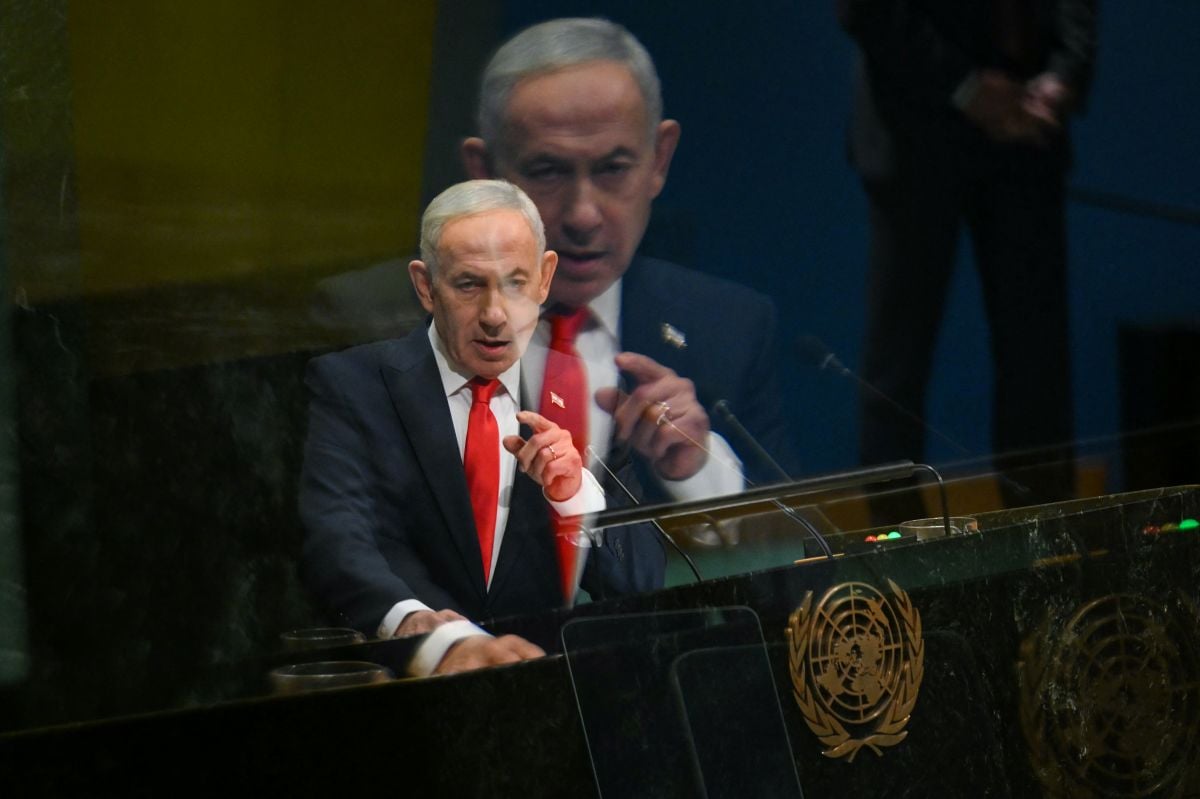
This photograph made using a lens teleconverter set to its mid-range position causing an image refraction shows Israel's Prime Minister Benjamin Netanyahu speaking during the 81st United Nations General Assembly at the United Nations Headquarters in New York, on Sept. 24, 2026. (Credit: Angela Weiss / AFP)






BEIRUT — Israel had reportedly received a second warning of an imminent Hamas attack before Oct. 7, 2023, this time from Egyptian intelligence, after already being warned by the United Arab Emirates, according to the U.S. outlet The Atlantic.
The report comes after Israeli newspaper Haaretz revealed that Emirati President Mohammed bin Zayed personally warned Israeli Prime Minister Benjamin Netanyahu about 10 days before Oct. 7 that Hamas was preparing a major operation. The latest investigation adds to the debate over what information Israeli leaders had ahead of the attack, which killed more than 1,200 people in Israel.
According to The Atlantic, Egyptian intelligence chief Abbas Kamel secretly traveled to Israel on Sept. 26, 2023 to warn of a possible escalation in Gaza. Netanyahu denies receiving such warnings.

67 minutes in Tel Aviv
On Sept. 26, as Israeli leaders were in Jerusalem marking the 50th anniversary of the Yom Kippur War, a Cessna chartered by Egyptian intelligence landed at Ben Gurion Airport, according to the U.S. magazine.
On board was Abbas Kamel, then head of Egypt’s General Intelligence Service and one of Israel’s main regional interlocutors on Palestinian affairs. The aircraft, whose journey was confirmed by airport records and flight-tracking data reviewed by The Atlantic, reportedly remained in Tel Aviv for just 67 minutes.
According to several Israeli, Egyptian, Arab, American and European officials interviewed by the outlet, Cairo believed at the time that "Hamas was gearing up for a significant attack."
Kamel reportedly provided no date, target or operational details that would have allowed Israel to anticipate the assault precisely. But his message was alarming enough for him to recommend that Israel quickly agree to economic measures for Gaza to prevent an escalation.
In essence, without a change of course, the situation risked "blowing up" in Israel’s face.
The Atlantic could not establish with certainty which Israeli officials Kamel met during his brief visit, or exactly how far his warning traveled up the political chain. The magazine notes, however, that Netanyahu soon afterward participated in a classified meeting and approved certain economic concessions for Gaza.
For a former Israeli official interviewed by The Atlantic, the Egyptian intelligence chief’s presence in Israel should itself have signaled the urgency of the situation: “the messenger was the message.” Tzachi Hanegbi, who was then Israel’s national security adviser, denies that Kamel visited Israel or that any such Egyptian warning was delivered.

Another warning on Oct. 5
The new information adds to revelations published by Israeli daily Haaretz in early September. The newspaper reported that UAE President Mohammed bin Zayed spoke with Netanyahu for around 45 minutes at the end of September 2023, warning that Hamas leader Yahya Sinwar was preparing a large-scale operation that could ignite the region.
According to the report, Netanyahu responded calmly and considered the main threat to be in the occupied West Bank. His office called the account “an absolute lie,” and Netanyahu announced plans to sue the opposition newspaper.
A UAE source later confirmed to the Times of Israel that a warning had been sent to the Israeli prime minister. Kamel’s trip from Cairo to Tel Aviv was not an isolated warning, The Atlantic reports. Egypt continued to alert Israel until two days before the attack.
On Oct. 5, another Egyptian message again referred to an untenable situation and the possibility of an attack.
At the same time, the head of Jordanian intelligence reportedly expressed concerns to his Israeli counterparts. U.S. intelligence agencies also produced two reports, on Sept. 28 and Oct. 5, warning of the risk of Hamas escalation, although they mainly anticipated rocket fire rather than the coordinated offensive that followed.
Three years after Oct. 7, Netanyahu continues to oppose calls for an independent commission of inquiry, including from some victims’ families and opposition figures.

 7 p.m. recap: Katz threatens Beirut south suburbs; London seeks to protect Riyadh; Netanyahu discusses ‘eliminating’ Iran’s regime