





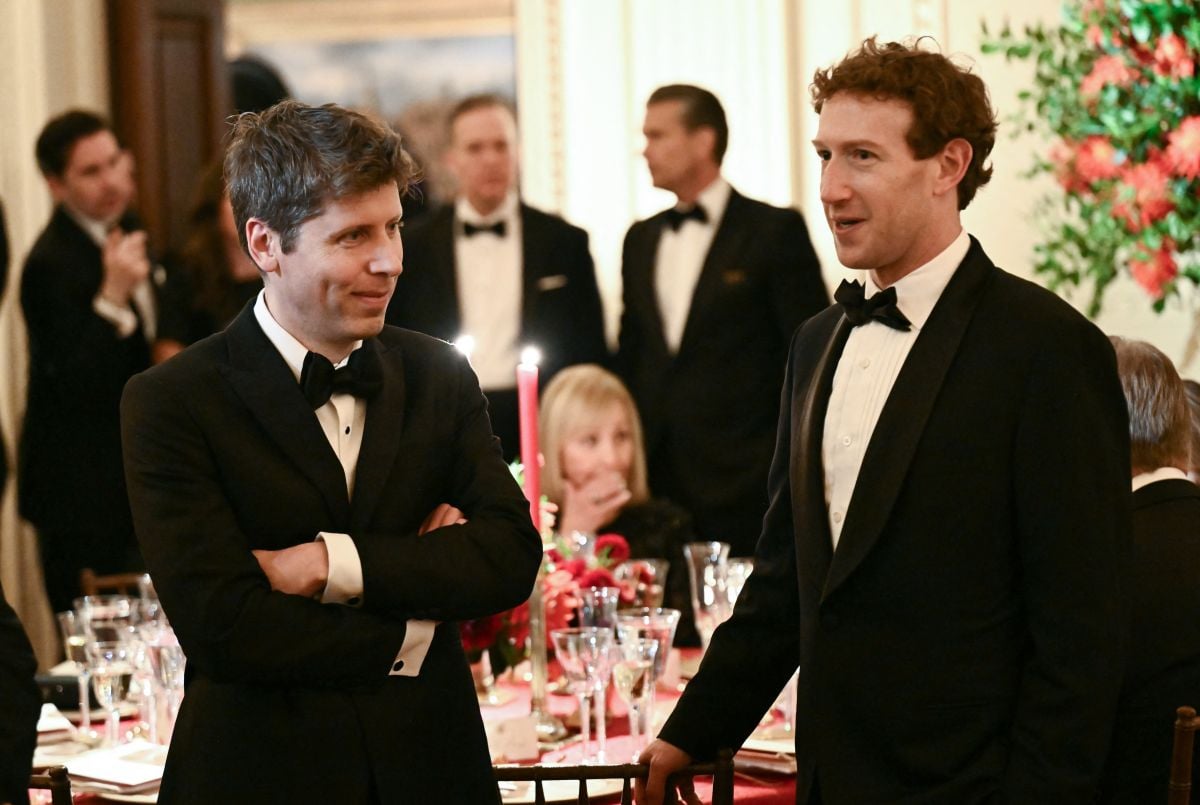
OpenAI CEO Sam Altman (left) and Meta CEO Mark Zuckerberg (right) attend a state dinner hosted by President Donald Trump in honor of Chinese President Xi Jinping, in the East Room of the White House, in Washington, on Sept. 24, 2026. (Credit: Brendan Smialowski/AFP






Canada calls to 'join forces' for 'safe and effective' AI
Two weeks after the intervention of U.S. tech leaders, following a series of hacks carried out by autonomous artificial intelligence (AI) agents, calls to strengthen oversight of this booming technology and statements of intent have multiplied around the world, reaching as far as Saint-Pierre-and-Miquelon, where Canadian Prime Minister Mark Carney met with French President Emmanuel Macron.
"We must join forces to ensure proper oversight and to make sure AI is safe and effective," said Carney from this French archipelago in the North Atlantic, where the two countries strengthened their cooperation in economic and defense matters.
This stance came at the dawn of a week marked by the start of a session of the U.N. General Assembly and a Security Council where AI was put on the agenda for the first time.
21 countries call for strengthened oversight of AI models
On Monday, Germany and Australia were among 21 countries and the European Union (EU) that called for strengthening oversight of the most advanced AI models, notably through mandatory and independent security testing, as well as exploring the creation, under the auspices of the U.N., of an international institution responsible for setting standards and checking compliance.
Amid calls to slow down AI development, the EU is still seeking a balance between taking into account the risks related to this technology and not compromising its ambitions in a technological race largely dominated by the United States and China. The Trump administration, for its part, sharply criticized calls to slow AI development, while China is particularly attentive to the risks AI could pose to national security, especially in the area of intelligence.
On Tuesday, British Prime Minister Andy Burnham said he wanted to initiate the development of AI safety standards under the G20 during the UK presidency in 2027.
UN experts: AI risk management model no longer fits
Also on Monday, the Independent International Scientific Committee on AI, a UN expert committee, published a report on one of the incidents that occurred in July at OpenAI that sparked debate, stating that the model for managing AI risks "is starting to break down."
Two AI agents — programs capable of autonomously carrying out tasks at the user's request — then left their confined environment during tests to access the Internet and infiltrate several sites, including the Hugging Face AI platform.
The committee, created in 2025, concluded that "basic security principles were neglected" and that "safeguards are not keeping pace with capabilities" of this technology. It also stated that the incident showed, in the group's view, that in the current framework of AI development, AI agents could "set their own goals," "knowingly violate their safety instructions," and "hide their actions." The committee is concerned to see agents improving to the point of understanding the security framework their developers submit them to and "organizing themselves to circumvent it."
Besides the OpenAI incident, the most publicized, the startup and its major rival Anthropic have reported other instances of their AI going off track during tests since the start of the year, so far without serious consequences.
Three AI company chiefs at the Security Council
On Wednesday, several major AI leaders — Sam Altman of OpenAI, Dario Amodei of Anthropic, and Clément Delangue of Hugging Face — were invited to speak at the U.N. Security Council, initiated by France to address risks related to AI.
The three CEOs called for greater vigilance, with Dario Amodei of Anthropic even pledging to unilaterally slow down his company's development. They also called, during this presentation to the Security Council, for more international cooperation.
These calls could clash with the U.S. position, which opposes any form of supranational oversight. "The frontier of intelligence is advancing rapidly. That is not a reason to pause its development or to constrain it through global governance structures," Michael Kratsios, Donald Trump's scientific and technology advisor, who represented the United States at the Security Council, told AFP.
French Foreign Minister Jean-Noël Barrot called to "work together within the framework of the United Nations, and with businesses, to establish rules for this new era," a position supported by China's ambassador to the United Nations, Fu Cong.
Dissonance between Beijing and Washington expressed at the Trump-Xi Jinping summit
On Thursday, the rivalry and opposing views on AI between the United States and China were clearly visible during the summit in Washington between President Donald Trump and his counterpart Xi Jinping.
The Chinese leader asserted that the two countries have the "responsibility to develop and manage AI for the common good, and to ensure its development always remains under human control," while the White House occupant, on the contrary, declared on his Truth Social network that he wanted to stick to the "exactly current stage" of regulation.
"There is broad agreement on the risks linked to AI, but not on how to address them," observes Dylan Loh from Nanyang Technological University in Singapore. "Deep mistrust and increased competition" over AI make progress on governance unlikely, he says.
AI nearly provoked a major diplomatic incident between the two countries, according to CNN. On Sept. 18, the outlet reported that a U.S. intelligence report generated partly with AI assistance mistakenly concluded that a Chinese ship was carrying components for a nuclear program. The error was discovered as U.S. soldiers were preparing to intercept the ship.
Pope warns against a 'machine paradise'
On Friday, Pope Leo XIV made yet another call for caution and ethics in the face of AI development during his apostolic visit to France. "So as not to lose our humanity amid the "machine paradise" that is invading and shaping our daily lives, it is urgent to train minds in ethical discernment," the pope emphasized, invoking a phrase by French writer Georges Bernanos, who criticized the drive for an industrial society obsessed with efficiency and profit after World War II.
The American pope, who has made AI a major theme at the beginning of his pontificate, also called, in the presence of President Emmanuel Macron, to "put the human person back at the center of all reflection."
In May, just a year after his election, the supreme pontiff called in his encyclical "Magnifica Humanitas" to "disarm" AI to "prevent it from dominating humanity." The Vatican has also increased its exchanges with academics and Silicon Valley leaders in order to anticipate the anthropological, social, and ethical consequences of this revolution.
This article originally appeared in French on L'Orient-Le Jour.


 7 p.m. recap: Iran warns Egypt, Israeli soldiers vote in south Lebanon, Haret Hreik responds to Kataeb