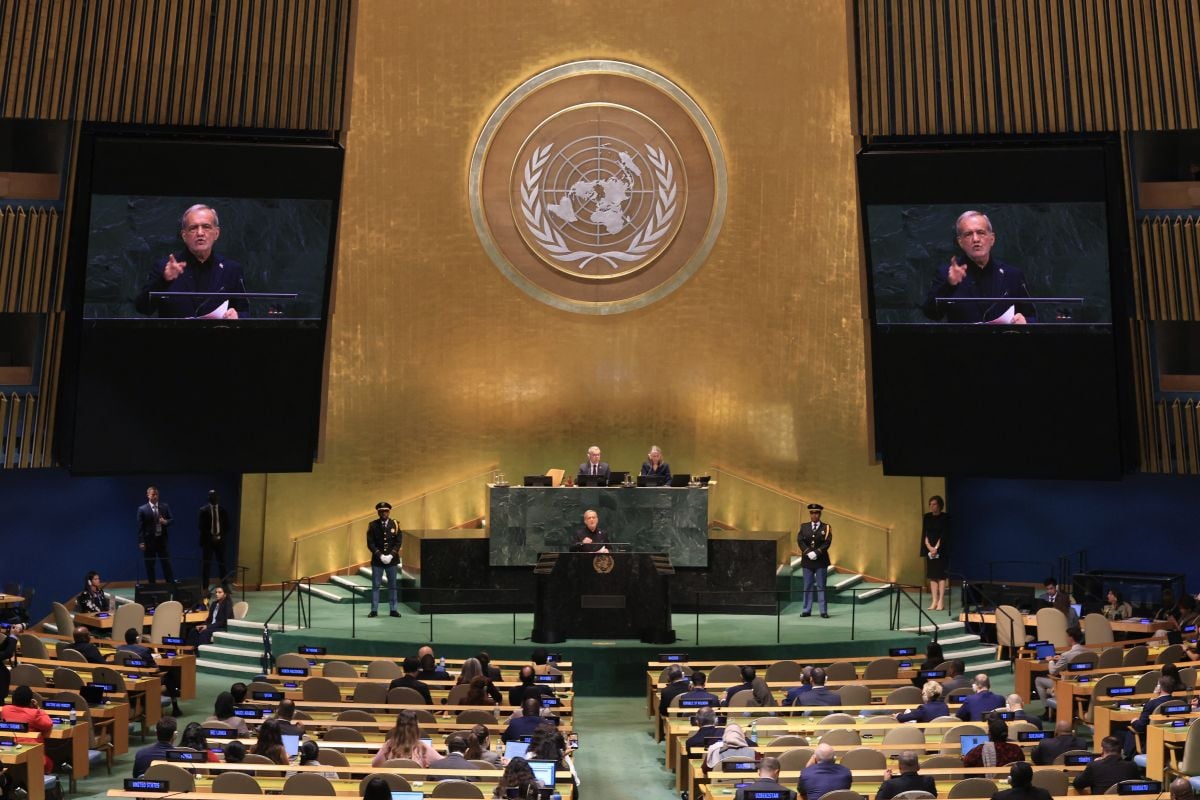
Iranian President Massoud Pezeshkian speaks at the 81st United Nations General Assembly at the U.N. headquarters in New York on Sept. 23, 2026. (Credit: Timothy A. Clary/AFP)






Top story
In a much-anticipated and ultimately defiant speech at the U.N. General Assembly podium, Iranian President Massoud Pezeshkian told President Donald Trump on Wednesday that his country would "not bow its head to aggression," claiming Iran was a victim of American "terrorism." He warned that "the resistance of the Iranian people will only intensify against [American] sanctions, mounting pressure, and increasing intimidation." "We have never been an aggressor ... never started a war," the Iranian head of state insisted.
Pezeshkian said Iran would not tolerate the Strait of Hormuz being used for "aggression" against his country. "They have shut us off from our own territorial waters," the leader of the Islamic Republic said of the United States, also accusing it of using "missiles and lethal technologies to spread insecurity throughout all the areas bordering this sea passage."
Why it matters
At a time when the Middle East fears another large-scale regional escalation, Pezeshkian was responding to Trump, who had threatened the day before to "annihilate" his country. "I hope they make the right decisions before it is too late," Trump said during a meeting with Middle Eastern leaders. The Iranian president is the highest-ranking Iranian official to set foot on American soil since the war began, triggered in late February by Israeli-American airstrikes.
The reopening of the Strait of Hormuz, the strategic maritime route through which a fifth of the world's oil passed before the war, remains at the heart of the conflict between Tehran and Washington. Tensions over the global economic repercussions of this conflict have escalated in recent weeks due to the Islamic Republic's support for Yemen's Houthi rebels in the Red Sea.
What to watch for
Also in New York, Syrian President Ahmad al-Sharaa centered his remarks on the relationship with Israel. He told the U.N. that the Golan region, largely occupied by Israel, would remain "Syrian territory." "Any attempt that violates our sovereignty and international law will be stopped. Any other attempt will be thwarted in accordance with Security Council resolutions," the Syrian official added.
The United Nations considers the plateau to be Syrian territory under Israeli military occupation. In July, U.N. Secretary-General Antonio Guterres reiterated that the Golan was part of Syria, calling the Israeli occupation "totally unacceptable." On Tuesday, Sharaa had jokingly claimed to have proposed that Trump "give the State of New Jersey to Israel" instead of the Golan Heights.
However, the Syrian president said that despite his neighbor's repeated "aggressions," "the chances of a historic peace remain for those who want to live in peace — a just peace that guarantees the rights of all." A response from the Israeli side is expected.
In Beirut, President Joseph Aoun warned of a "security vacuum" in southern Lebanon if no force is present in 2027 after the U.N. Interim Force in Lebanon peacekeepers' mandate ends in December 2026, "particularly if the Israeli occupation of villages and localities in the South continues," according to a statement from the Lebanese presidency on X. "Lebanon is open to any force that could replace it," he reiterated during a meeting with the British government's principal adviser on defense affairs for the Middle East, Adm. Edward Ahlgren.
With talks between Lebanon and Israel stalled since August, Aoun accused Tel Aviv of "not implementing the framework agreement" signed in late June between the two countries. "Israel therefore does not respect the cease-fire, nor the commitment to refrain from destroying and leveling homes, resolving disputed points along the Blue Line, and returning Lebanese prisoners to Lebanon," he said.
Elsewhere in the news
- The United States has just delivered $16 million worth of ammunition to Lebanon to enable the Lebanese Army to "strengthen Lebanon's sovereignty, secure its borders, confront internal threats, and disrupt activities facilitating terrorism," according to a statement on X from the U.S. Embassy in Beirut. Over the past six years, the United States has provided the army with more than $800 million in military aid, the embassy noted. Washington remains determined to "support the Lebanese government and the Lebanese Armed Forces in strengthening state authority," the statement added.
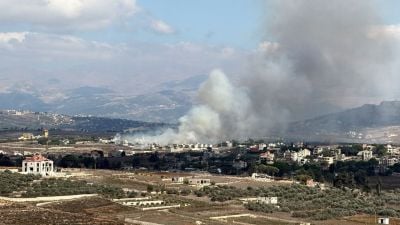
- The Directorate General of General Security (GS) reopened its Nabatieh center on Wednesday, serving residents of the city and surrounding areas amid ongoing security concerns in the region. At the same time, regional centers under the GS office in southern Lebanon will continue, "exceptionally," to accept applications from Nabatieh residents "considering the security situation," the institution said. The Israeli military continued its attacks throughout the day in several sectors of southern Lebanon, including the Nabatieh area.