






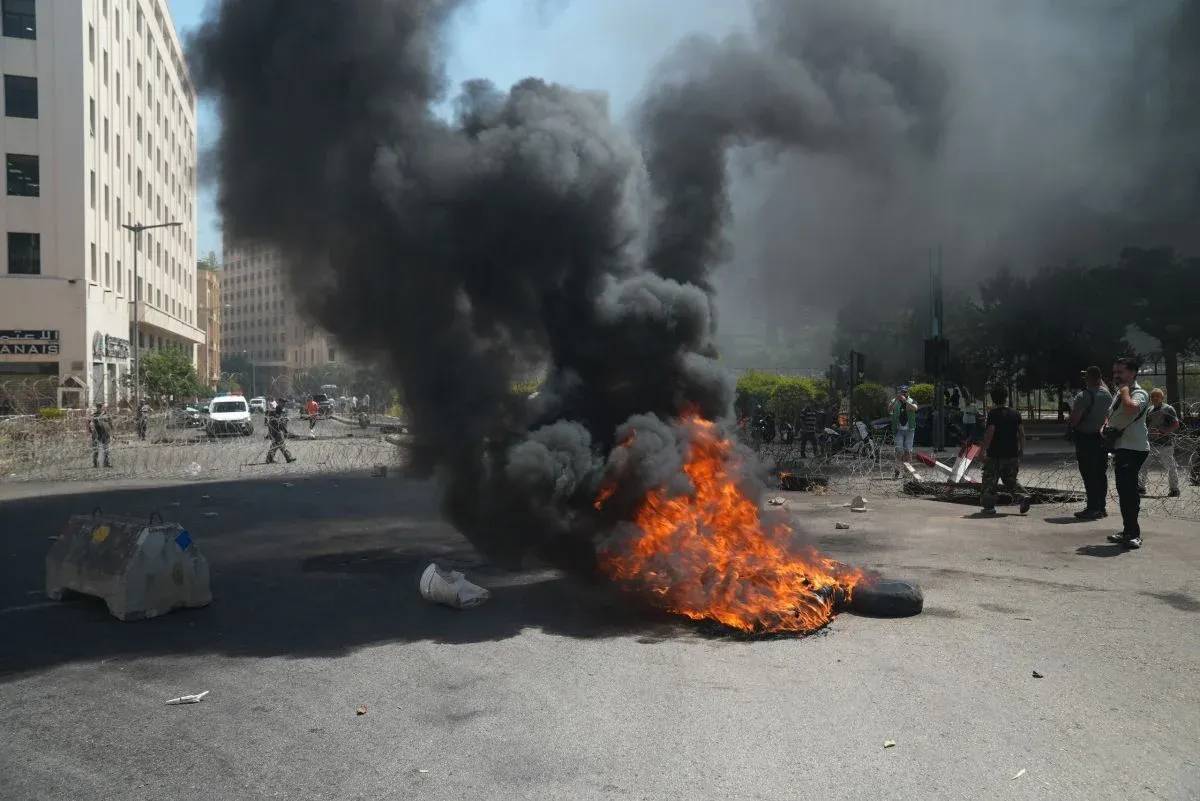
Burning tires in downtown Beirut during a sit-in by former soldiers, on Sept. 9, 2026. (Credit: Tea Ziade/L'Orient-Le Jour)






Although no major protest movement has erupted yet, social discontent appears to be rising in Lebanon. Several sectors have announced strikes and demonstrations in recent days to voice their demands amid a sharp rise in fuel prices during recent weeks.
Lebanese civil servants are holding a two-day strike on Wednesday and Thursday and have confirmed that public administrations will close every Friday to demand an increase in their transportation allowances. "All employees of official administrations and municipalities" are called to join the strike. Pickup truck drivers, for their part, blocked the Dahr al-Baidar road, which connects Beirut to the Bekaa, to protest the increase in fuel prices.
General strike on Sept. 30
Following an extraordinary meeting of Lebanese land transportation federations and unions devoted to the issue on Wednesday, Bassam Tleiss, president of the land transport sector unions and associations, announced a nationwide general strike, mobilization and sit-in involving all categories of the land transport sector next Wednesday, Sept. 30, according to the state-run National News Agency (NNA).
Tleiss also denounced "the government's delay in implementing decisions and laws," particularly in carrying out what had been agreed upon last February and decided by the Parliament concerning the transport sector. At that time, Tleiss had called off a strike planned for the end of February after reaching an "agreement" with Prime Minister Nawaf Salam and Transport Minister Fayez Rassamny. That agreement provided for the government to cover a fuel price increase of 300,000 Lebanese liras for legal public transport drivers.
For his part, General Confederation of Lebanese Workers (CGTL) head Bechara Asmar lamented during the meeting that "things have reached an intolerable level," saying that "the suffering of workers and people will lead things to situations with dire consequences."
Jaafarite Mufti Ahmad Qabalan, an ally of Hezbollah, said in a statement that Lebanon "is heading toward social, financial and sovereign suicide." "The executive branch lives barricaded behind the walls of their privileged power, politico-financial service circuits, luxury trips and expenditures, cronyism in political administration, and promises made at the expense of breathless social classes," he said. He lamented "some of the worst inflation and an extremely dangerous paralysis that aggravate financial crises and monetary policies," describing a "historically critical situation."
The surge in fuel prices, which affects the cost of consumer goods and basic necessities, comes as Lebanese people are already exhausted by successive wars and the socioeconomic crisis. The government, which is working on the draft 2027 budget and has set up a "ministerial working group," is trying to find solutions, but these may only be "limited within the budget level," according to a government source contacted this week by L'Orient-Le Jour. Despite authorities' promises, unionists continue to raise the alarm. The price of 20 liters of gasoline shot up to $32 on Tuesday in the wake of the regional war between Iran and the United States. A few days ago, the price of a loaf of bread also increased, as annual inflation in Lebanon has surged above 17%.