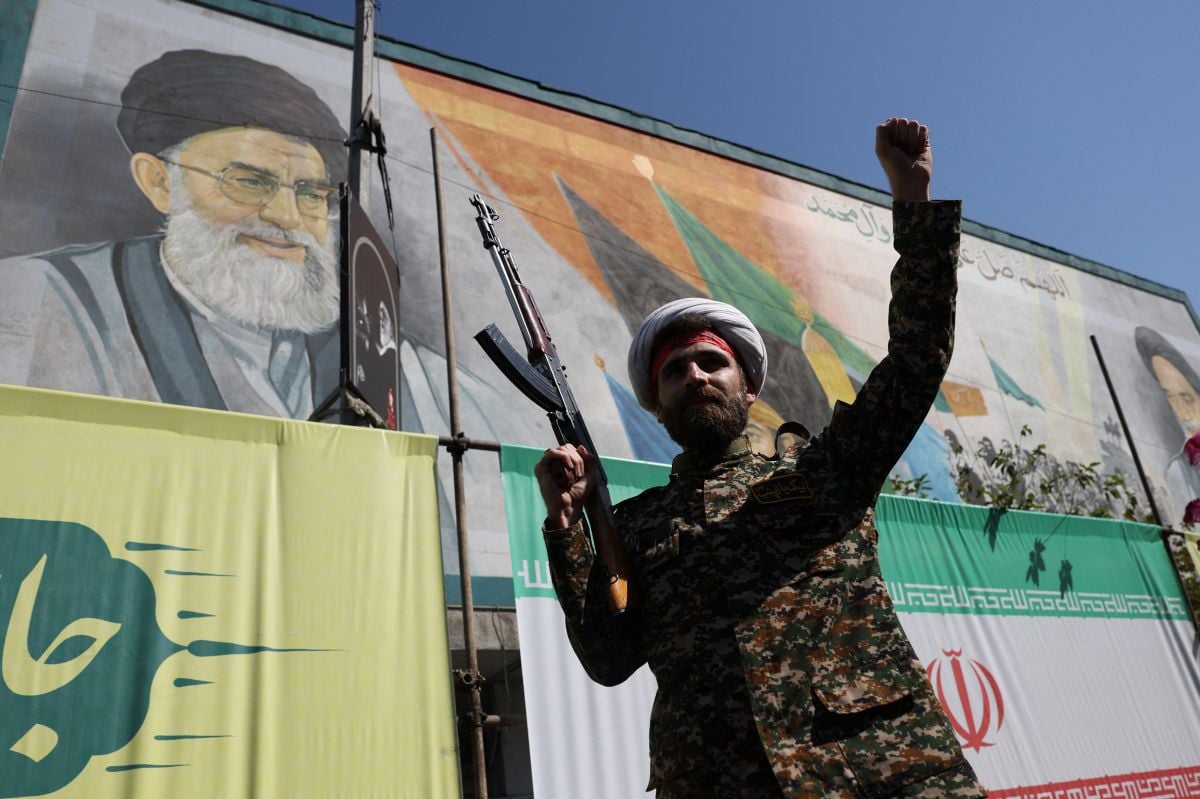
An Iranian cleric attends a military parade in Tehran, Iran, Sept. 18, 2026. (Credit: Majid Asgaripour/West Asia News Agency via Reuters)






Today's news
Washington and Tehran have again stepped up their exchange of threats in recent days, amid ongoing tensions around the Strait of Hormuz and escalating conflict in Yemen. The latest invective came Monday morning, when Iran's Revolutionary Guard threatened to strike "new targets" with "new weapons" should the United States attack Iran.
The powerful Iranian military has regularly issued such warnings since the start of the conflict in the Middle East, especially in recent days. Meanwhile, Iran's central military command said Tehran would "make its American, Israeli, and allied adversaries taste the bitter taste of new defeats" in the event of an offensive, according to Iran's official news agency, IRNA.
These warnings appear to be in response to threats from U.S. President Donald Trump, who the previous day had raised the possibility of "blowing up" Iran. Trump "is making his decision and very big things are going to happen in the fairly near future," Fox News reported.
Why it matters
After more than six months of war between the United States and Iran, negotiations are at a standstill, and the conflict has now spread to Yemen and Saudi Arabia after the Houthis took control of the Bab al-Mandeb Strait. The exchange of strikes between the United States and Iran intensified again at the end of August after a monthlong lull, particularly in the strategic Strait of Hormuz, though it appears to have eased recently.
On Saturday, Washington warned of a feared "rapid escalation" of hostilities in the Middle East amid Houthi attacks from Yemen against Saudi Arabia, whose capital was targeted for the first time in months by these pro-Iranian fighters.
What to watch for this Monday:
- After a tense weekend in southern Lebanon, the Israeli army continued its assault on the region early Monday morning, launching a series of Israeli strikes, notably in the Nabatieh region and the Zibqine valley in the Sour district. The bombings were followed by constant artillery and machine-gun fire across several areas along the border, as well as an incursion at the edge of the still-inhabited village of Kfar Shuba, on the border of the "buffer zone" occupied by Israel.
- As Israeli attacks continue, Lebanese Foreign Minister Joe Rajji has again defended the U.S.-led negotiation process with Israel, which has stalled for several weeks, while acknowledging it is "long and complex." The last round of negotiations, set for early September, was postponed to October. He emphasized that "there is no choice but negotiation to end the Israeli occupation" in the South, where more than 600 square kilometers remain occupied and subject to daily strikes despite a cease-fire that has theoretically been in effect since June.
At a meeting in the Baabda Presidential Palace, MP Alain Aoun said the success of the process led by Lebanese President Joseph Aoun to end the war requires the participation of "all Lebanese" in the effort to ensure the state's monopoly on weapons. He called on Hezbollah — whose disarmament, alongside an Israeli withdrawal from the South, is planned under the framework agreement reached in June between Lebanon and Israel — to come to Baabda and begin dialogue with the president to agree on a "road map."
Elsewhere in the news:
- Gunfire targeting a cafe in the Cola area in southern Beirut wounded several people, an incident that comes two weeks after the murder of a Future Movement official in Burj Abi Haidar. The shooting prompted MP Ibrahim Mneimneh to call on the government to present "a clear plan" to restore security, combat uncontrolled arms and ensure the state has a monopoly on weapons. This follows a call made several months ago to make Beirut a "weapons-free city."
- Amid rising inflation, fueled in part by the increase in fuel prices due to the regional conflict, the president of the General Confederation of Lebanese Workers, Bechara Asmar, met with the confederation's executive office to examine the price surge and the issue of salaries.
- This morning, a series of explosions at a military site near Aleppo in northern Syria injured four people. This is the fourth such incident involving explosions in less than a month in a country that has experienced a protracted civil war since 2011.