






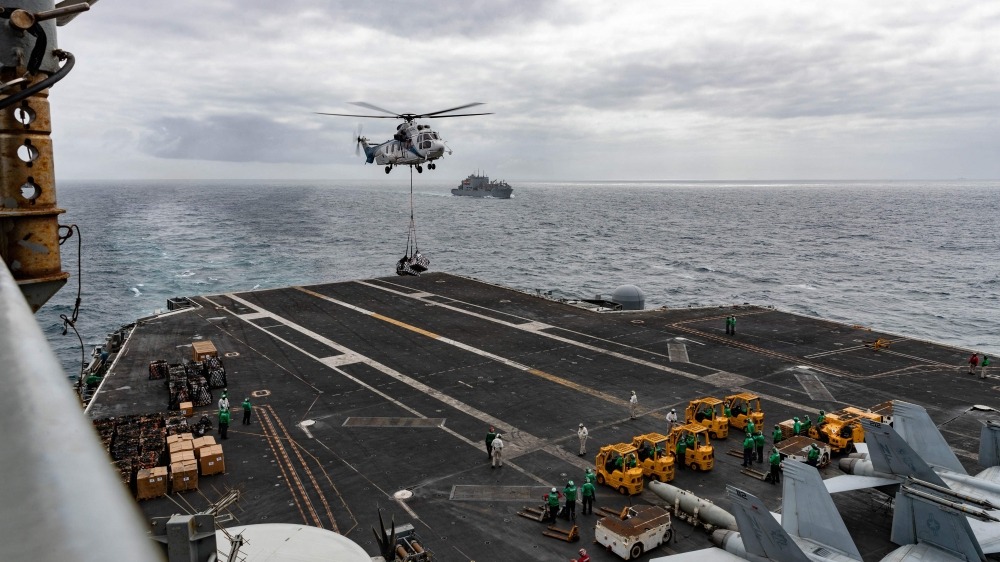
A Eurocopter AS332 Super Puma transports supplies to the Nimitz-class aircraft carrier USS George Washington during an at-sea replenishment operation Sept. 7, 2026. (Credit: U.S. Navy/Handout via AFP)






Senior White House advisers privately discussed with President Donald Trump the possibility that the war against Iran could last until the end of his term in 2029, according to U.S. officials cited in an exclusive Wall Street Journal report published Thursday. The discussions came despite Trump’s statements a day earlier that the United States would secure a swift victory by the midterm elections next November.
The newspaper reported that Vice President JD Vance, Secretary of State Marco Rubio and others raised with Trump in the Oval Office and Situation Room the possibility that Tehran could continue to withstand U.S. pressure despite the blockade and other military tactics, potentially prolonging the conflict beyond the next U.S. president’s inauguration in January 2029.
Shortly before the closed-door warnings were reported, Trump told journalists Wednesday that the war would end “immediately” after the midterm elections in November, “because they [the Iranians] won’t hold out much longer.”
Trump’s advisers, notably Vance and Rubio, who are considered potential candidates in upcoming elections even though neither has spoken publicly about it, reportedly believe that a conflict lasting several years would place enormous pressure on military resources and risk disrupting global oil markets during the 2028 U.S. presidential campaign.
The war against Iran began Feb. 28 as a U.S.-Israeli offensive aimed at toppling the regime and depriving it of the ability to develop nuclear weapons. Israel has since been excluded from direct participation in the conflict, and the United States launched promising talks with Iran that led to a preliminary agreement in June. But the agreement fell through, and U.S. attacks resumed in July, accompanied by a maritime blockade and economic pressure. The Iranians, notably the regime’s armed wing, the Revolutionary Guard, continue their daily attacks on neighboring countries, claiming to target U.S. bases. The fighting’s partial closure of the Strait of Hormuz has had direct repercussions on the global economy, causing oil prices to spike.
According to the Journal, the officials said, “Trump often tells his staff in private that he wants the war, now in its seventh month and having cost the lives of 18 service members, to end quickly.” But they added that he also supports a long-term economic siege, using a naval blockade and sanctions to try to force the regime to dismantle its nuclear program.
Treasury Secretary Scott Bessent has presented the new strategy, dubbed “Operation Economic Outcast,” as an alternative to large-scale combat operations, the newspaper reported. Meanwhile, Defense Secretary Pete Hegseth has extended the deployment of about 50,000 U.S. troops in the Middle East through 2027. The Pentagon also plans to keep certain air defense units deployed in the region indefinitely, according to Journal sources.
Analysts interviewed by the newspaper fear that a protracted conflict could allow the Iranian regime to adapt, redirect its attacks toward neighboring countries and replenish its stock of missiles, drones, radars and other equipment.
Advanced-technology ballistic missiles
In a separate article, the American daily highlighted that during the ongoing escalation between Washington and Tehran, Iranian forces repeatedly used medium-range ballistic missiles — capable of traveling hundreds of kilometers at extremely high speeds — in attacks against U.S. vessels.
According to individuals familiar with the attacks, these missiles were launched from various sites within Iran. These sources noted that the missiles are equipped with advanced technology and capable of maneuvering in flight toward moving targets, making them a greater threat than other Iranian weapons. While CENTCOM stated that these attempted attacks missed their marks, the incidents brought the missiles much closer to their targets than previous attempts, as Iran employed maneuverable warheads.
Meanwhile, analysts told Reuters that following the capture of a U.S. military underwater drone announced the previous day, Iran might study the device to potentially replicate its technology — a setback for the Pentagon and the drone manufacturer Anduril. The U.S. military and Anduril downplayed the significance of the capture of the craft — a Dive-LD autonomous underwater vehicle designed for long-range surveillance and other underwater missions, and part of a new generation of military drones intended to operate for days with limited human intervention.
Captain Tim Hawkins of U.S. Central Command stated that the "malfunctioning drone was an older model that had neither collected sensitive data nor carried classified sonar or radar." However, according to Farzin Nadimi, a senior fellow at the Washington Institute for Near East Policy, Iran "will seize every opportunity to turn this into a propaganda victory," and the fact that the device is now in Tehran's hands "could help the Revolutionary Guards improve their own versions of such devices."
Iran will almost certainly attempt to open the drone to examine its components, but the device’s software features built-in safeguards, noted Bryan Clark, a senior fellow and director of the Center for Defense Concepts and Technology at the Hudson Institute. Iranian engineers "could certainly reverse-engineer the mechanical systems," he assessed, highlighting Tehran’s track record of exploiting captured U.S. aircraft.
